
Best Blockchain Programming Languages for Web3

Vance Wood
December 25, 2025
20 min read
We often write about Web3 development, but what exactly should be used for that? Here, we’ll explore the programming languages that are used for various aspects of Web3 development. Prepare your Web3 ideas - and let’s go!
What are Web3 programming languages?
The difference between a Web3 programming language and other ones is that it’s used for building decentralized applications (dApps) and other decentralized entities, including blockchains themselves.
Usually, it includes languages that can be used for creating smart contracts, self-executing onchain programs that perform given actions under specific conditions. However, dApps, like any other applications, require programming logic and user interfaces, so many ordinary Web2 languages can be used for that. For example, Python and JavaScript have specific Web3 libraries that allow blockchain interactions.
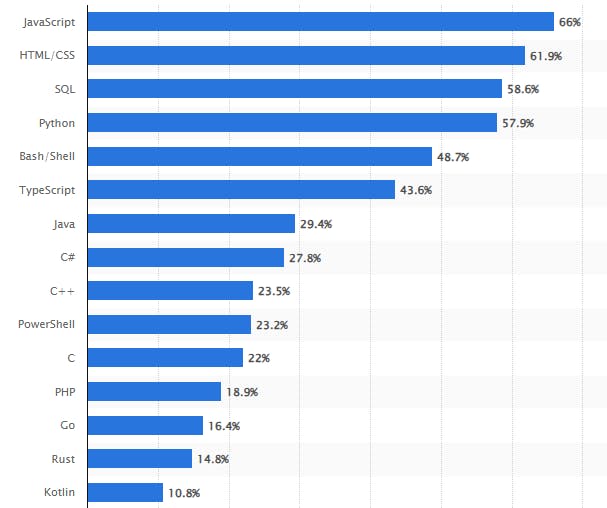
Source: Statista
Here, one can see a programming language popularity chart. We’ll explore several languages and see when they should be applied.
Solidity
Rust
Move
Vyper
Python
Go
C++
JavaScript/Node.js
TypeScript
But first, let’s explore the basics of Web3 development.
Web3 development in a nutshell
We’ve already pointed out that smart contracts are the key component of Web3 development. They determine which actions would be performed under which conditions. Use cases include trading order execution, money lending conditions, ownership proofs, royalty payments, and many more, which are certainly beyond this article’s scope. Still, Web3 development isn’t limited to smart contracts.
Want to share your project with us and get our help? Have something to offer for a fruitful partnership? Interested in presenting GetBlock as an ambassador? Contact us via our form, and let’s explore that!
One needs a platform to support these contracts, an interface for users to interact with the platform, an app’s internal logic for proper automation and execution, and - of course - the code to interact with RPC nodes, so all of that can actually work onchain.
To clarify this a bit, we can divide Web3 development into several key aspects:
Smart contract development is a core component that includes creating smart contracts, self-executing agreements written onchain that execute according to the blockchain consensus and make agreements secure without third parties.
Blockchain communication is another essential component that consists of writing POST requests to call and execute blockchain methods when they are required, such as accessing the block, returning the account balance, or writing data onchain.
Web3 frontend development is all about building the app’s user interface to ensure proper interactions between users, smart contracts, and the blockchain.
Dapp logic development is creating the app’s backend logic, which ensures the connection between all the app’s components and their timely execution.
Infrastructure development includes creating and maintaining additional tools and services necessary for other developers, such as node blockchain clients, automation tools, Web3 libraries, plugins, and many others.
Each of these aspects requires its own approach, has its own best practices, and utilizes specific programming languages. Various blockchains employ different programming languages for building their smart contracts - for example, Ethereum uses Solidity, Solana uses Rust, and Sui uses Move.
For more info, look at our documentation, and we will continue.
Why language choice matters
With that diversity of chains and workflows, one can see why we have different languages for Web3 development. Let's look closer at how to navigate among them.
Developer productivity
At first, your choice depends on the chain you’ll be working with and your specialization.
Which of the workflows mentioned above are you planning to use? Do you want to develop smart contracts, or are you more interested in frontend or backend development?
Which specific chains do you need to implement in your application? It’s best to focus on languages closest to the one designed for your chain; for example, JavaScript/TypeScript if using Solidity.
Based on that, you can select the language that will be the most efficient for your application.
Security & gas optimization
Different languages offer different features for type, memory, gas, access management, and other aspects crucial for safety and efficiency. While many of these points require deep exploration of each language, it’s essential to choose the right ecosystem to land your project.
Sure, you’re limited by the chain you’re developing on, unless you’re ready to use very specialized SDKs that allow you to develop on Rust for EVM or on Solidity for Solana. However, choosing the right blockchain for your project is essential, too.
Explore the secure and diverse blockchain infrastructure that suits every need. Sign up now and select the chain for scaling your project.
The Ethereum ecosystem offers a variety of use cases presented by different L1 and L2 chains, but Solana may offer greater speed and security. The Cosmos ecosystem has robust interoperability, while Sui offers unique capabilities with its Move language and onchain data processing. These are only a few examples of how essential it is to select the right blockchain for realizing your idea.
Key selection factors
Here, let’s summarize the factors that influence the language choice.
What are the crucial points for your project? For example, TypeScript is good for projects prioritizing frontend, such as SocialFi, while Rust or Go is good for performance-critical projects.
Which tools and libraries does the language offer?
How developed is the Web3 ecosystem around the language?
Now, we can proceed to the Web3 ecosystem landscape and then explore each language in detail.
Major Web3 ecosystems
The rise of Ethereum as the first large-scale programmable blockchain and the subsequent development of its Ethereum Virtual Machine (EVM) led to a situation where the EVM ecosystem is comparable in size to all other blockchain ecosystems combined. Therefore, let’s explore them separately.
EVM ecosystem
Ethereum has hundreds of layer-2 (L2) networks, each of which has its own mainnet and specifics, but all of them validate data on Ethereum. Moreover, many layer-1 (L1) blockchains don’t depend on Ethereum but still use the Ethereum Virtual Machine for data processing, among which the most prominent is BNB Smart Chain (BSC).
Explore top Web3 libraries in our dedicated guide.
All of them can use Solidity for smart contract development and libraries like ethers.js for blockchain interactions, which makes the development much more convenient.
Solana & other non-EVM
Solana, along with BSC, consistently shares third place in popularity after Bitcoin and Ethereum, which makes it the largest non-EVM Web3 ecosystem. It uses Rust for writing its smart contracts, called programs. Several other popular blockchains, such as NEAR Protocol and Polkadot, also use Rust for blockchain development.
To know more about Solana development, explore our guide.
Another popular non-EVM blockchain ecosystem is the Cosmos ecosystem, which unites various L1 chains used for cross-chain interaction optimization. Prominent examples, along with Cosmos itself, include Axelar and Akash Network. Its Cosmos SDK supports the Go language for blockchain creation, but various chains can deploy various languages, such as Rust or Solidity (for EVM compatibility).
One can also mention the Move language, which is used in Aptos and Sui, along with several others. It was originally designed for the Diem blockchain by Meta, and now it’s used by its descendants, among which Aptos and Sui are the most popular.
There are many other non-EVM ecosystems, but for now, let’s focus on those we’ve mentioned and proceed with a breakdown of languages used in Web3 development. Pay attention to which aspects each of them covers, and select them according to that.
Smart contract languages
As smart contracts constitute the most essential element of Web3 development, we’ll start with them and explore programming languages used for smart contract development.
Solidity
Used for writing smart contracts on Ethereum, EVM blockchains, and several others
As Ethereum and its EVM ecosystem still dominate the smart contracts ecosystem, its leading development language, Solidity, is definitely the most popular one as of 2025.
This language is based on TypeScript and is specifically designed for building EVM smart contracts. It has a specialized IDE, Remix, which can be used from a web browser or installed on the PC for convenience. Many educational materials are available, including the official content from the Ethereum Foundation, which simplifies the learning process.
It has native support for blockchain concepts, such as addresses, payable functions, and gas price calculations, which are created as constants and variables. Every smart contract can be formulated as an object with functions, while Remix IDE explicitly shows all gas prices.
Here is a typical Solidity program example that shows its essential elements: contracts, variables, events, and functions.
1
2
3
4
5
6
7
8
9
10
11
12
 SPDX-License-Identifier: MIT // Program license
 pragma solidity ^0.8.20; // Solidity version

 contract SimpleStorage {
     uint storedData;  // Variable: Data to record
     event DataStored(uint value);  // Event: records data

     function set(uint x) public { // Function: proceeds data
         storedData = x;
         emit DataStored(x); // Calls the event to record data
     }
 }
Therefore, it’s easy to learn and use, although its features are very specialized for EVM smart contract development and barely allow anything else. It’s essential to pay attention to potential overflows, minimize unnecessary onchain computations, and use access control to ensure stable gas prices and security.
Rust
Used for writing smart contracts on Solana, Polkadot, NEAR, and other chains
Rust is another popular choice for Web3 development. While it’s not as specialized as Solidity, it has many more features and can also be used for developing dApp backend and infrastructure, so it’s employed by many non-EVM chains.
Solana is currently the most popular non-EVM programmable blockchain, and it uses Rust as a primary standard for its program development. Several other chains, most notably NEAR Protocol and Polkadot, also use Rust in their smart contract development.
Rust compilation is much faster than Solidity, which compiles to the EVM bytecode first, and is comparable to C++ in speed. It leads to faster transaction speed and lower gas fees. It also has robust tools for memory management, which improve security and allow the realization of crucial Web3 components like ownership management.
Here is a typical backbone of a Solana program, as shown in the documentation.
1
2
3
4
5
6
7
8
9
10
11
12
13
14
15
16
17
18
19
pub mod entrypoint {
    use solana_program::{
        account_info::AccountInfo,
        entrypoint,
        entrypoint::ProgramResult,
        pubkey::Pubkey,
    };

    entrypoint!(process_instruction);

    pub fn process_instruction(
        program_id: &Pubkey,
        accounts: &[AccountInfo],
        instruction_data: &[u8],
    ) -> ProgramResult {
 // Decode and dispatch instructions here.
        todo!()
    }
}
Unlike Solidity, which uses a unified and specialized interface, every blockchain uses Rust features differently. Due to that, and due to its quite complex structure, it’s harder to learn compared to Solidity. However, it offers many more capabilities, and it can also be used for other use cases, such as backend development.
Move
Used for writing smart contracts on Sui, Aptos, and other Diem descendants
Move is a programming language originally created by Meta for its Diem blockchain. After the project closure, it’s used by its descendants, among which Aptos and Sui became the most prominent.
It’s quite different from other languages and is called a resource-oriented language. It treats objects as “resources” that cannot be copied or duplicated and are recorded directly onchain, ensuring their security. They must also follow linear logic, which means that they should be processed continuously and explicitly.
Here is a quick example: a module that shows the non-copyability of the Move tokens.
1
2
3
4
5
6
7
8
9
10
11
12
13
14
15
16
17
18
19
module 0x02::NonCopyableExample {

  // A `Token` resource cannot be copied (duplicated) or dropped (lost)
  struct Token has key, store {
    value: u64,
  }

  // Function to transfer a Token (resource) from one account to another
  public fun transfer_token(recipient: &signer, t: Token) {
    // move resource t to the recipient
    move_to(recipient, t);

    // try to double spend: move t again
    move_to(recipient, t); // error: invalid usage of previsouly moved value

    // try to make a copy and move it
    move_to(recipient, copy t);  // error: invalid usage of copy
  }
}
To dive deeper, refer to the official Move GitHub, with the documentation and code examples. This language offers robust capacities for Web3 developers with its onchain object processing, but for now, its ecosystem is limited by chains like Aptos and Sui.
Vyper
Used for writing smart contracts on EVM blockchains to accompany Solidity
Vyper is a Python-like language, similar to how Solidity is based on TypeScript, and similarly, it’s used for smart contract development on EVM blockchains. Here is a simple example of an auction contract on Vyper.
1
2
3
4
5
6
7
8
9
10
11
12
13
14
15
16
17
18
19
# @version ^0.4.3
beneficiary: public(address)
auctionEnd: public(uint256)
highestBidder: public(address)
highestBid: public(uint256)
ended: public(bool)

# Defining the auction bid logic
@external
def bid():
    assert block.timestamp < self.auctionEnd

# The condition of the auction’s end with the highest bid
@external
def endAuction():
    assert block.timestamp >= self.auctionEnd
    assert not self.ended
    self.ended = True
    send(self.beneficiary, self.highestBid)
Vyper can be easily combined with Solidity and can be used along with it for realizing various simple functions, as its code is easy to read and audit. For more information, refer to its documentation.
Backend and infrastructure languages
Let’s now explore which languages are usually used for building the app’s core components and interacting with the blockchain using RPC calls.
Go (Golang)
Used for interacting with blockchains, infrastructure, automation, and more
Go is a universal programming language that can be used for different purposes, including Web3 projects. Some chains use it as a smart contract language, but it’s more actively used for backend and infrastructure applications. Here are some examples:
Geth Ethereum client, written in Go, supports Go programs that interact with the Ethereum blockchain
Cosmos SDK is written in Go, so it uses this language to create and manage new blockchains on it
Various specific SDKs allow Web3 infrastructure development on Go, such as Solana-Go SDKs, which allow Solana token transfer
Here is a very quick example of a Cosmos SDK Go function that sends 1 ATOM between Cosmos addresses.
1
2
3
4
5
6
7
8
9
10
11
12
13
14
// Importing Cosmos SDK
import (
    "github.com/cosmos/cosmos-sdk/types"
    "github.com/cosmos/cosmos-sdk/types/msg"
)

// Defining recipient address
toAddr, _ := types.AccAddressFromBech32("cosmos1...")

// Defining amount: 1 ATOM (in micro-units)
coin := types.NewInt64Coin("uatom", 1000000)

// Sending the transaction
msgSend := msg.NewMsgSend(fromAddr, toAddr, types.NewCoins(coin))
Golang has high performance and is quite simple to learn and deploy, so it’s widely used in Web3. Its specialized libraries, such as mentioned go-ethereum (Geth), Cosmos SDK, and solana-go-sdk, contain various development methods. It makes Go a universal choice for various use cases.
Python
Used for interacting with blockchains, data management, infrastructure, and more
One of the most widely used programming languages, Python, is also used in dApp development. It has a web3.py library that allows various blockchain interactions, such as transaction sending and receiving. Below is a quick example of a Python program to sign and send an Ethereum transaction using the GetBlock Ethereum endpoint.
1
2
3
4
5
6
7
8
9
10
11
12
13
14
15
16
17
18
19
20
21
22
23
24
25
26
27
28
29
30
31
32
33
34
35
36
37
# Import
from web3 import Web3

# Define receiver address
receiver_address = ‘receiver_address_string’

# Define gas limit if needed
gas = your_gas_limit_int_number

# Use GetBlock access token
rpc_endpoint = 'https://go.getblock.io/<Your_Access_Token>'

# Define a private key (don’t share with anyone!)
private_key = ‘your_private_key’

# Create a Web3 entity with an RPC endpoint
w3 = Web3(Web3.HTTPProvider(rpc_endpoint))

# Check the connection
if not w3.is_connected():
    raise ConnectionError("Failed to connect to HTTPProvider")

# Create the transaction dictionary
transaction = {
    'nonce': nonce,
    'to': receiver_address,
    'value': w3.to_wei(0.01, 'ether'),  # Amount in Wei
    'gas': gas, # Gas limit if needed
    'gasPrice': w3.eth.gas_price,
    'chainId': w3.eth.chain_id
}

# Sign the transaction
signed_tx = w3.eth.account.sign_transaction(transaction, private_key)

#  Send the transaction
tx_hash = w3.eth.send_raw_transaction(signed_tx.rawTransaction)
Additionally, Python can be used for data management, scripting, and many other cases, which makes it another universal choice, along with Go.
JavaScript (Node.js)
Used for interacting with the blockchain, especially EVM chains
Node.js is a JavaScript framework that adds object-oriented programming elements to it and expands its functionality. It can serve as a robust backend runtime for Web3 development, enabling server-side interactions with blockchains through libraries such as Web3.js or Ethers.js.
Here is a quick example of Node.js code to connect to the blockchain, check essential parameters, and send the transaction.
1
2
3
4
5
6
7
8
9
10
11
12
13
14
15
16
17
18
19
20
21
22
23
24
25
26
27
28
29
// Import from ethers.js
import { ethers } from "ethers";

// Connect to the node provider
const provider = new ethers.JsonRpcProvider(“https://go.getblock.io/<Your_Access_Token>”)

// Specify your wallet, but be careful with the private key!
const wallet = new ethers.Wallet('YOUR_PRIVATE_KEY', provider);

// Check the block number
await provider.getBlockNumber()

// Check the balance and format it to see in Ethers, not in wei
balance = await provider.getBalance("ethers.eth")
console.log = ethers.utils.formatEther(balance)

// Send the transaction from your wallet
const tx = await wallet.sendTransaction({
  to: '0xRecipientAddress', // Specify recipient address or ENS name
  value: ethers.parseEther('0.01'),  // 0.01 ETH parsed from wei
  gasLimit: 21000 // Specify the gas limit if you want
});

// See the transaction hash
console.log('Tx Hash:', tx.hash);

// Wait for confirmation and see when it’s confirmed
await tx.wait();
console.log('Confirmed!');
While JavaScript functionality in Web3 is mostly limited to EVM chains, there are also libraries like @solana/web3.js and Polkadot.js for Solana and Polkadot, as well as custom implementations for other chains. It’s best used with EVM chains, still, as their smart contract language is a descendant of JavaScript, too, which eases the development process greatly.
C++
Used for program logic, blockchain cores, Web3 games development, and more
C++ is a robust language that requires deep technical knowledge to start with, but it offers high-end optimization of everything, so it’s ideal for developing the backend logic of system applications, blockchain games, and other systems that work under a high load. It’s also used for creating blockchains themselves. C++ is recommended for creating low-level entities, essential for the functionality of the high-level ones.
Rust (backend)
Used for infrastructure, program logic, data processing, automation, and more
We’ve already seen this language in the smart contract section, as it’s actively used for creating smart contracts on Solana and several other popular chains. However, Rust has robust data processing capabilities and speed compatible with C++, so it can be used to build the app’s backbone. If it’s also used for smart contract development, it may save time and speed up the development process.
Frontend for dApps
Almost all frontend tools that are used in Web3 development are based on JavaScript, so we’ll quickly overview two popular examples: the TypeScript language and the React.js framework.
TypeScript
Used for frontend development, scripting, infrastructure, and more
TypeScript is an extension of JavaScript that supports typing and is generally more suitable for large-scale programming. Therefore, it’s often used for creating dApp interfaces and building their frontend, allowing users to interact with smart contracts. It’s a good choice for most dApps, especially those that require robust UI, such as NFT marketplaces and social apps.
React.js
Used for UI creation and UX management
React is a popular JavaScript framework for user interface development, and it can be used to create dApp interfaces as well. Its reusable components and JavaScript interface, similar in many ways to Solidity, make it a good choice for creating Web-based blockchain apps.
Languages by use case
Let’s explore typical use cases for Web3 development. Each of them constitutes a whole separate topic, so here we’ll limit ourselves to a quick overview.
DeFi protocols
Decentralized finance (DeFi) services use complex smart contract logic to manage user funds, be it trading, staking, or lending. Therefore, DeFis require a focus on smart contract languages, such as Solidity, Rust, or Move, depending on the target blockchain.
To develop a reliable and trustworthy DeFi protocol, one needs to focus on smart contract development and reach proficiency in it. Other elements, such as a highly secure backend and a simple and responsive frontend, are important, too.
NFT marketplaces
NFT marketplaces showcase various digital items connected with a non-fungible token, which makes each of such items unique. They require an active and responsive frontend, as their primary goal is to show users the NFTs they want and guide them.
SocialFi services
Social networks, community services, and other Web3 social applications allow users to communicate in a decentralized environment, using their Web3 addresses as unique identifiers and often earning some tokens for their activities.
Such services usually require a responsive frontend that supports content publishing and communication, and a robust data processing system with capabilities for user data management and analytics.
Web3 games
Blockchain games are those where in-game items are tokenized and can be owned directly by players, so they can trade, exchange, and manage them. Games use complex logic to be interactive and usually also require graphics.
Read more about best Web3 games here.
Games are often developed using specialized platforms like Unreal Engine or Unity. After that, specific objects can be tokenized or programmed to be tokenized at a specific moment, for example, when a player finds it, so it becomes their ownership as an NFT.
What else to consider
Here are several points that might help you select the best Web3 programming language for your project.
You need to build, deploy, and launch a decentralized app, so start with your idea, explore which blockchains suit it best, define the app’s logic and frontend, and select the languages accordingly.
If you’re unsure, start with Solidity, as it’s currently the most widely used smart contract language with a dedicated and very usable IDE, tens of good educational courses, and an active community, so you’ll enter smart contract development with ease.
Smart contract building, blockchain connection, backend logic development, and frontend interface creation are all distinct processes, each of which often requires a separate specialization, so select the one you like most and start with it.
Thanks for reading, and let’s wrap up.
Conclusion: Developer tools for Web3 builders
As the Web3 industry grows, new development tools arise, from Web3 libraries to automation tools and new IDEs. Builders can use them to optimize their work, but still, the basic programming languages of Web3 development remain the same, and it may take years for that to change. It’s best to focus on several of those mentioned here and explore them in detail.
Don’t forget, GetBlock is always here to help aspiring Web3 projects grow - contact us if you’re developing something interesting, and let’s BUIDL together!
FAQ
Which language is best to start with for Web3?

Is it necessary to learn more than one Web3 language?
What’s the best language for developing blockchain games?
Why is the demand for blockchain development skills increasing?
What are the best programming languages for smart contract development?


Popular Posts

June 9, 2021
4 min read

November 9, 2021
5 min read

May 24, 2022
5 min read

March 18, 2021
4 min read


