
What Is the Optimism Superchain? A Practical OP Stack Guide

Vance Wood
March 16, 2026
8 min read
The Optimism Superchain is a unified ecosystem of interconnected Layer‑2 (L2) chains built on the OP Stack and secured by Ethereum. They’re designed to work as a single, logical network for users and developers and include popular L2s like Optimism and Zora. It began as the extension of the Optimism chain, but now it includes more than 30 active networks. GetBlock monitors the Web3 ecosystem development, so let’s explore the Optimism Superchain ecosystem and learn more about its OP Stack.
How the Optimism Superchain works
The Optimism Superchain is a blockchain interconnection network that includes Layer 2 chains which share:
Security mode
Bridging layer
Ethereum governance
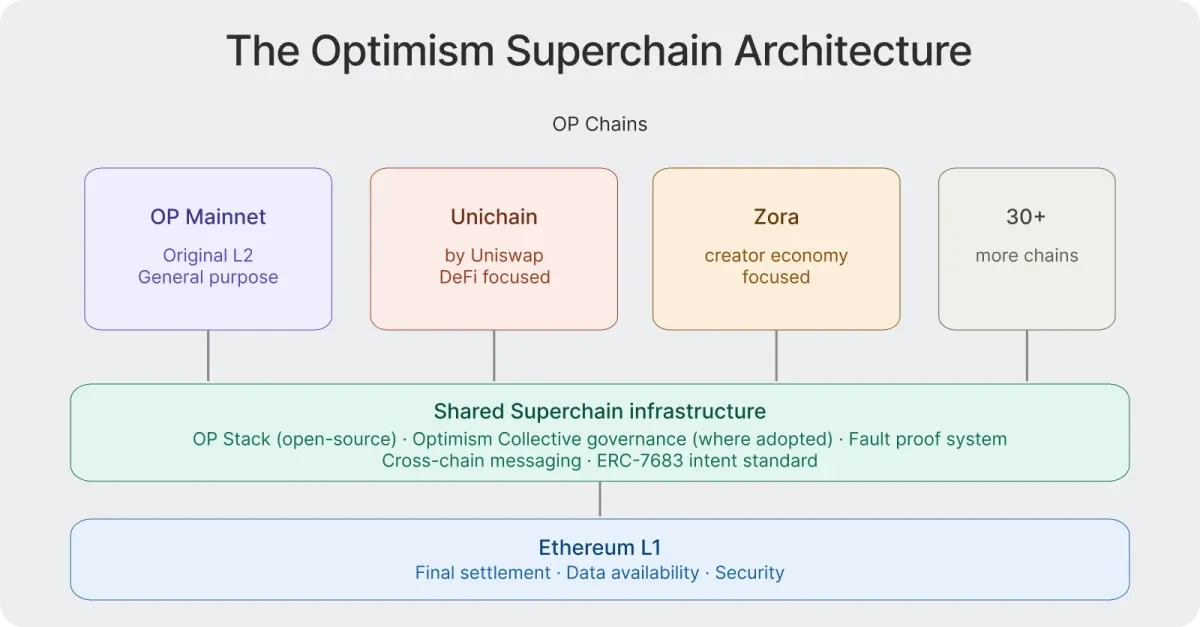
Each chain can run its own sequencer and gas token, but all post data to Ethereum and inherit its security through fault‑proof systems. Transactions are bundled on each OP Chain, published to L1, and then resolved or challenged there, so the Superchain scales horizontally while keeping Ethereum as the final settlement layer. Each chain can keep its own tokenomics and gas asset, while benefiting from the Superchain.
Chain | Statistics | Distinctive Features | Use For |
Optimism | TVL ~$565M on own chain; mature DeFi ecosystem with dozens of protocols | Governance via OP token; drives Superchain protocol upgrades | Governance-critical infra and mature DeFi protocols |
Unichain | TVL ~$780M; 80+ ecosystem apps; handles ~50% of Uniswap v4 transaction volume | 250ms sub-block finality via Flashblocks; native ERC-7683 cross-chain support | DeFi protocols, AMMs, and cross-chain liquidity |
Zora | 1M+ unique collectors; 4M+ NFTs minted; modest TVL (~$92K on-chain DeFi); creator economy focus | Permissionless NFT minting with on-chain royalties; Coins social launchpad | NFT platforms, creator tools, and social Web3 apps |
Let’s now explore the OP Stack, on which all these blockchains are developed.
OP Stack overview
The OP Stack is a modular, open‑source framework for building Ethereum‑secured L2s, which underpins the Superchain. Instead of monolithic rollups, it exposes clearly separated layers: data availability, execution, settlement, and governance. They can be customized while keeping chains interoperable.
It runs optimistic rollups, which works under the similar scheme:
Transactions are processed on an EVM‑compatible execution layer
Transaction data is posted to Ethereum
Their validity is enforced via fault‑proof mechanisms
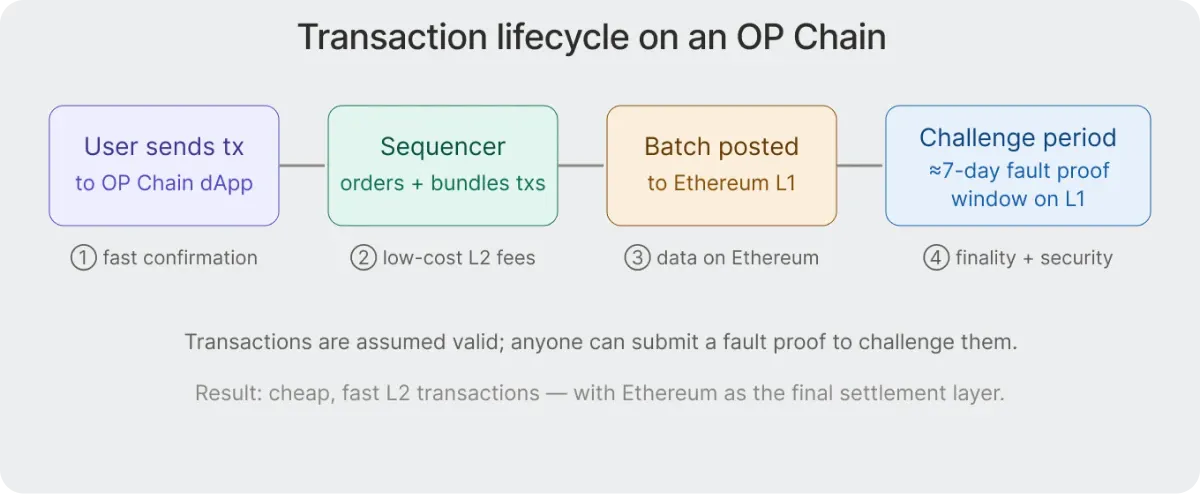
This approach gives apps much lower fees and higher throughput than Ethereum L1, while relying on it for final settlement and security. The modular design lets developers either deploy on existing OP‑Stack chains (like Optimism Mainnet) or build their own customized OP Chain and plug it into the Superchain’s unified communication and governance layer.
Key chains in the Optimism ecosystem
Let’s now focus on the four OP Stack chains, mentioned earlier.
Optimism
The original and most established OP Stack chain, Optimism has more than $565M TVL, 200ms block times, and the dual‑house Optimism Collective governance with the OP token. It hosts a mature DeFi and infrastructure ecosystem and drives Superchain protocol evolution as the first chain in the ecosystem. Choose Optimism when you need deep ecosystem liquidity and established governance, or when building infrastructure components that work for the entire Superchain.
Unichain
Launched by Uniswap Labs in early 2025, Unichain is a DeFi‑native OP Stack chain designed to defragment liquidity across Ethereum L2s. It features 250ms sub‑block finality via Flashblocks and native ERC‑7683 cross‑chain support. Over 80 apps and infrastructure providers are already building on it. Choose Unichain when building DeFi protocols, AMMs, or cross‑chain liquidity applications where ultra‑low latency and deep Uniswap ecosystem integration can help.
Zora
Zora is a creator‑centric chain focused on NFT minting, social tokens, and the on‑chain creator economy, with over 1 million unique collectors and 4 million NFTs minted. It supports on‑chain royalties, permissionless contract deployment, and a suite of DeFi modules (Swap, Vaults, Lending) unified under the native ZORA governance token. Select Zora when building NFT platforms, creator monetization tools, or cultural/social Web3 apps where creator tooling and collector community take priority.
Why developers choose the Optimism Superchain
The unified nature of the Superchain allows easier cross-chain communication, development, and deployment. It offers a toolset for creating decentralized applications working across the OP Stack chains and optimized for the whole EVM ecosystem, or even launching customized L2 chains. Let’s explore specific benefits of using the Optimism Superchain resources and its OP Stack for Web3 development.
Unified network of blockchains
One of the biggest pain points for Web3 developers is fragmentation. Deploying and maintaining apps across multiple isolated chains requires separate bridges and different programming logic. The Superchain reduces this complexity by treating all OP Stack chains as a single logical network. It uses:
shared bridge contracts
standardized cross‑chain messaging (ERC‑7683)
common RPC/indexer standards
This lets developers write once and deploy across Optimism, Unichain, Zora, and others with minimal friction. Native L2‑to‑L2 messaging primitives allow dApps to read state, transfer assets, and trigger contract calls across multiple chains without integrating third‑party bridges or custom trust assumptions for each pair. This dramatically reduces cross-chain bugs and the time cost of going multi-chain.
Development convenience
The OP Stack is fully EVM-compatible, so developers can reuse the existing Ethereum tools, such as Foundry, Hardhat, wagmi, viem, and ethers.js without learning new languages or libraries. Local development is streamlined by tools like supersim (a local Superchain simulator) and starter templates, which spin up a full L1 + multiple L2 environment in seconds for rapid iteration and cross-chain testing before mainnet deployment.
Beyond deploying on existing chains, the OP Stack lets any team launch their own app-specific chain (an OP Chain) using the same modular blueprint while configuring gas tokens, sequencers, and execution logic. Then, developers plug it directly into the Superchain's shared infrastructure. This means they can customize their environment for high‑throughput games, DeFi-specific latency requirements, or unique tokenomics, while inheriting all of Superchain's tooling and interoperability.
Shared security and governance
All OP‑Stack chains settle on Ethereum L1 and use shared fault-proof (optimistic) security mechanisms, so developers building on any Superchain chain inherit Ethereum's economic security without independently bootstrapping validator sets or trust networks.
Governance is coordinated through the Optimism Collective and the OP token, which manages protocol upgrades and security decisions uniformly across all Superchain participants. This means critical changes, such as fault-proof upgrades or bridge security patches, are applied consistently across chains, rather than each chain managing its own governance process.
For developers, this translates to a lower governance maintenance burden and a more predictable upgrade path, since they can rely on a shared, community-audited security and governance layer rather than implementing it independently for every dApp or chain.
How to start building on OP Stack
Here is a quick algorithm to start building on the Optimism Superchain.
Choose target: Pick one or more OP‑Stack chains or launch a new OP‑Stack chain using the framework’s instruments.
Provide an infrastructure: Establish the blockchain connection using RPC nodes or set up your own nodes in case of the new blockchain deployment.
Use standard tooling: Deploy with EVM‑compatible tools (Hardhat/Foundry) plus Optimism‑specific SDKs indexed by the Superchain.
Integrate common bridging: Use the shared bridge or Superchain ERC20‑style contracts to transfer assets and messages between chains.
Test locally: Spin up a local Superchain with supersim or starter templates to simulate L1 + multiple L2s and test cross‑chain flows.
Running your own blockchain requires significant infrastructure and community resources, as it means running a decentralized network of nodes and validators. It makes sense to do that only if you have a clear vision for this blockchain and can attract reasonable funding for that. For Web3 development on established blockchains, you may use the Web3 infrastructure provider to save time and money.
GetBlock for Superchain development
The Optimism Superchain lets developers build apps that treat many OP‑Stack chains as a single, unified network, while users experience seamless movement of assets and data across rollups. For any deployment, developers need an RPC node - and that’s where they need GetBlock. We offer robust RPC infrastructure for Optimism, Unichain, Zora, and many other blockchains that may be helpful in your dApp development journey.
Sign up now, and explore it yourself!
FAQ
What is Optimism Superchain?

What blockchain is Optimism Superchain built on?
What are Superchains in the Optimism ecosystem?
How does the OP Stack connect to the Optimism Superchain?
How do I connect to Optimism using RPC endpoints?


Popular Posts

June 9, 2021
4 min read

November 9, 2021
5 min read

May 24, 2022
5 min read

March 18, 2021
4 min read


