

What is a Machine Payments Protocol (MPP)? How AI Agents Learning to Pay

Deen Newman
March 23, 2026
8 min read
MPP (Machine Payments Protocol) is a new payment standard built around HTTP 402 that lets AI agents, apps, and automated workflows pay for services directly inside the same request they use to call those services.
TL;DR:
If you're familiar with the x402 protocol by Coinbase, MPP covers similar ground – HTTP 402 as a payment layer for agents and APIs – but goes further.
MPP removes the facilitator requirement, is payment-method agnostic by design, and has a complete session model for high-frequency micropayments live from day one.
Launched on March 18, 2026, and co-developed by Tempo and Stripe, it is already implemented across 50+ services, including OpenAI, Anthropic, Google Gemini, Dune, and other Web3 and real-world services (and food delivery, too).
The core spec has been submitted to the IETF for standardization as the official implementation of HTTP 402.
Notably, the spec is open and designed for extension – Visa and Lightspark (Bitcoin Lightning) have already published their own MPP payment method specs.
What is MPP?
MPP, or Machine Payments Protocol, is a protocol for machine-to-machine payments. In plain terms, it lets software pay for access to a service the same way a browser asks for a webpage: the server returns an HTTP 402 Payment Required response with payment details, the client authorizes payment, retries the request, and then gets the resource plus a receipt.
How MPP works: The basic flow
MPP repurposes the HTTP request cycle to include payment negotiation. Here's what a single interaction looks like:
Agent requests a resource – an API call, a model inference, a data query, or any HTTP endpoint
Server responds with HTTP 402 – specifies the price, accepted payment methods, and constraints
Agent authorizes payment — a wallet signs a payment credential based on that request
Agent retries with payment attached — the credential travels as an HTTP header
Server verifies and responds — funds settle, service is delivered
This works over standard HTTP, MCP (Model Context Protocol), and JSON-RPC, meaning it plugs into the existing agent infrastructure developers are already building on.
Sessions: The key innovation for agent workflows
Agents often need to make thousands of requests in a short window – querying a data feed in a loop, streaming token-by-token from an LLM, scraping at scale.
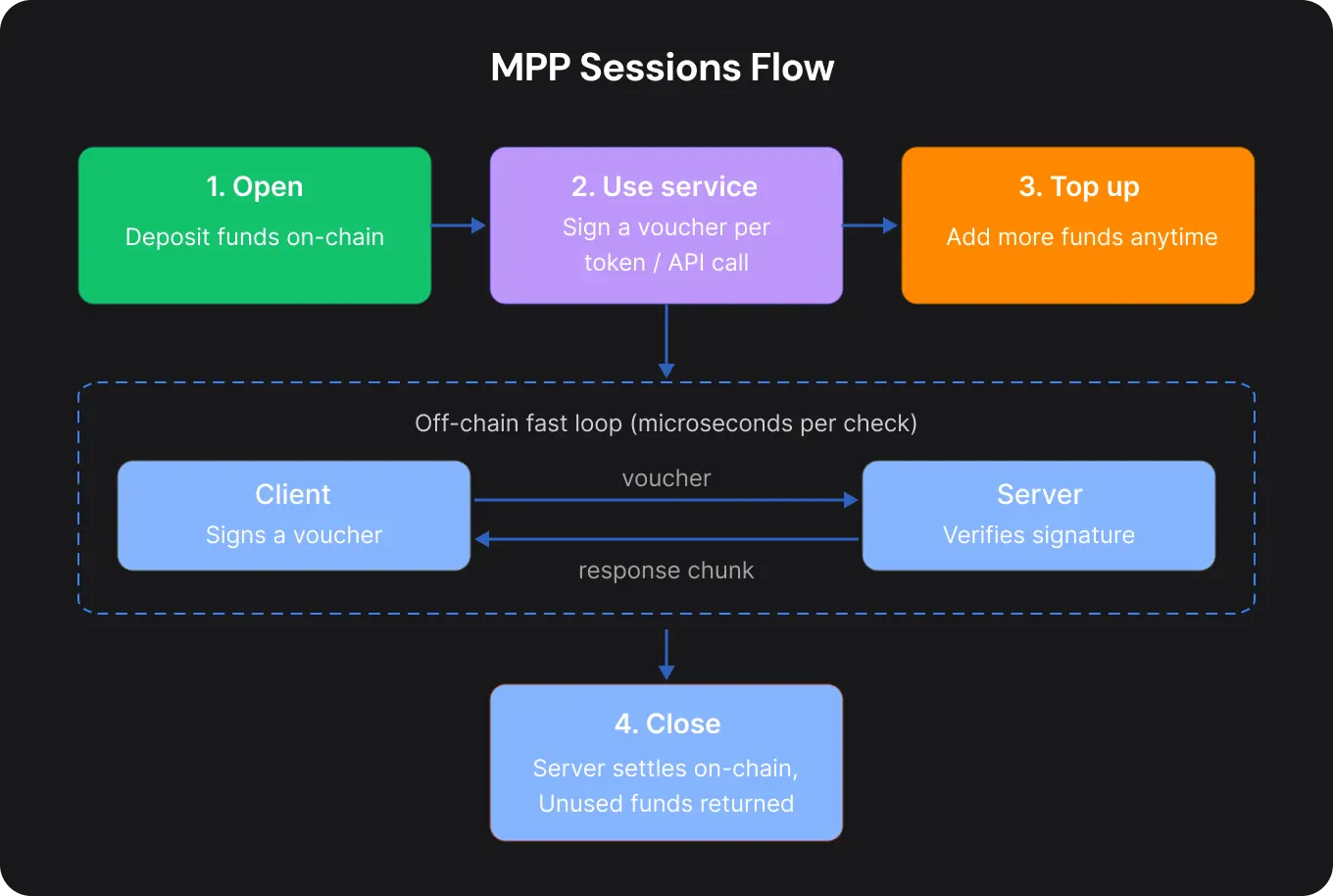
MPP handles this with sessions — a payment model that works like a prepaid tab. How it works:
The agent deposits funds into an escrow contract upfront, opens the connection, and issues vouchers for subsequent request
The server accumulates vouchers and submits the final one onchain in one transaction, collects what it's owed, and returns any leftover deposit
Here's what makes this clever:
The slow part, touching the blockchain, only happens twice – to open and close the channel
Everything in between is off-chain and fast – the server checks the signature in microseconds
The key win: Billing can happen at the same speed as the service itself.
The only tradeoff: MPP itself is an open standard that works with any custom payment rails, but sessions for now are limited to the Tempo chain. The reason is that the mechanism requires an on-chain escrow contract to hold deposited funds.
Payment methods supported by MPP
MPP is designed from the ground up to be payment-method agnostic. Out of the box, it supports:
Stablecoins on the Tempo blockchain
Stripe cards (Visa, Mastercard) and other Stripe-supported methods
Bitcoin payments over the Lightning Network
Custom rails – the spec is open for anyone to extend
MPP is built around familiar auth primitives rather than tying the protocol to any specific blockchain mechanic. The result is that adding a new payment method requires only a well-defined extension.
MPP vs. x402: What's the difference?
If you've been following agent payment standards, you've come across x402, Coinbase's HTTP 402-based micropayment protocol that launched in May 2025. We have a breakdown of how x402 works in practice.
The two protocols share the same foundation: both use HTTP 402. Here's where they differ:
The facilitator. x402 routes payments through a facilitator component – a bridge that handles settlement between client and server. x402 v2 made the facilitator more modular and pluggable, but it's still a required piece. MPP eliminates this dependency (e.g. Stripe and Visa wrote their own payment method extensions directly into the protocol spec).
Supported payment methods. MPP provides a unified interface for multiple payment methods from the start. After v2, x402 can integrate with different payment rails, but handled through facilitators.
Sessions. x402 v2 introduced the architectural foundation for reusable wallet-based sessions; MPP's session model is native from day one, backed by Tempo's transaction format, making the off-chain voucher flow cleaner to implement.
Standardization. MPP has been submitted to the IETF as a candidate for the official HTTP 402 spec.
Machine Payments Protocol (MPP) | x402 | |
Launch Date | March 2026 | May 2025 |
Developed by | Tempo Labs and Stripe | Coinbase |
Core Idea | A payment protocol standardizing HTTP 402 with a formal authentication scheme | An open payment standard built around HTTP 402 for programmatic payments |
Facilitator | Eliminated | Required (modular in v2) |
Payments Supported | Payment-method agnostic (Stablecoins, Stripe cards, Lightning already in production) | Primarily on-chain payments across multiple networks; other rails possible via facilitators |
Compatible Blockchains | Chain-agnostic by design (Tempo blockchain supported, multi-chain roadmap) | Base, Solana, extensible |
Sessions / Streaming | Native session model | Supported since v2, but not a native primitive |
One way to compare them is this: x402 is a multi-network on-chain payment protocol, while MPP is a broader payment abstraction.
Who can use MPP (Machine Payments Protocol)?
If you're using AI agents, building an infrastructure for AI agents, MPP is worth the attention.
Developers building AI agents
If your agent calls external APIs, MPP removes the credential management overhead. Point the agent at an MPP-enabled service and it handles payment inline, automatically, within the request. If you're building on Solana specifically, our guide to agent architecture on Solana is a good starting point.
API and service operators
MPP lets you accept payments from any client without requiring signups or accounts. You add a few lines of middleware, declare a price, and the protocol handles the rest. The TypeScript SDK has ready-made middleware for Next.js, Hono, Express, and Cloudflare Workers.
Users running autonomous agents
To use MPP as an end user, you paste a single prompt into your AI agent – Claude, Codex, or any other – pointing it to Tempo's skill file. The agent gets a Tempo wallet, asks you to secure it, fund it, and set a spending limit. From that point, the agent pays for MPP-enabled services on its own, up to a defined limit.
The services already integrated with MPP at launch include OpenAI, Anthropic, Google Maps, Gemini, Dune, AgentMail, Modal, fal.ai, Browserbase, PostalForm, Prospect Butcher, and dozens more.
The bottom line
MPP is a bet that the next wave of internet commerce will be driven by agents, not humans. The stack is assembling piece by piece: MCP (Model Context Protocol) gave agents a standard way to communicate with tools, now MPP gives them a standard way to pay for those tools.
It's early. The protocol was submitted to IETF days ago, multi-chain support is still a roadmap item, and adoption relative to x402 is yet to be determined. But MPP has a credible shot at becoming the standard interface for how software buys things on the internet.
GetBlock provides node infrastructure for developers building on 130+ blockchains. If you're integrating MPP or building agentic payment flows, our RPC endpoints are ready.
FAQ
What is the Machine Payments Protocol (MPP)?

What is the difference between MPP and x402?
How does MPP handle a payment?
What are MPP sessions and why do they matter for AI agents?
What’s the difference between MCP and MPP?


Popular Posts

June 9, 2021
4 min read

November 9, 2021
5 min read

May 24, 2022
5 min read

March 18, 2021
4 min read


