
Solana RPC Providers Comparison: GetBlock vs. Helius

Deen Newman
January 28, 2026
15 min read
GetBlock's Solana RPC infrastructure is one of the fastest in the industry – but as a multi-chain provider, it’s often overlooked when builders evaluate Solana-native options like Helius. In practice, GetBlock and Helius serve many of the same builders who need low-latency RPC and production-grade reliability.
We evaluate both Solana API providers head-to-head across the metrics that matter for development: up-to-date RPC performance benchmarks, pricing, developer tooling, and customer support responsiveness.
Solana-only infrastructure optimized for ecosystem depth, or multi-chain flexibility without sacrificing Solana performance? This detailed comparison gives you the data to decide.
GetBlock or Helius? Key takeaways
Both GetBlock and Helius provide the fundamentals required to build and run production Solana applications: Solana RPC endpoints, WebSocket subscriptions, historical data access, dedicated nodes, and enterprise offerings
On top of core RPC access, both providers deliver advanced Solana tooling: low-latency streaming, transaction delivery optimizations, and archive Solana data APIs
Helius and GetBlock offer similar pricing tiers, but GetBlock delivers higher raw request capacity than equivalent Helius plans; Helius bundles more tools in its plans – a choice between performance-first and developer convenience
Additionally, GetBlock’s tier structure includes plans that align well with mid-range performance needs, while Helius jumps more steeply from small to larger plans
Helius dedicated nodes are meant for streaming-focused workloads. GetBlock’s dedicated nodes are its flagship offering for full-featured, customizable, production RPC infrastructure
Both providers deliver high-performance Solana RPC, but GetBlock’s low latency is verified by independent benchmarking services, while Helius’s sub-100 ms figures are primarily self-reported
GetBlock is ranking among the fastest Solana RPC providers globally and leading in key regions according to CompareNodes benchmarks
In summary, Helius optimizes for developer workflows on Solana, and GetBlock optimizes for performance at scale.
The sections below break down pricing, performance benchmarks, and tooling in detail for both providers. Or skip ahead: if GetBlock's approach aligns with your needs, explore our Solana infrastructure.
What is GetBlock?
Founded in 2019, GetBlock is an enterprise-grade RPC and node infrastructure provider built for teams that require predictable performance and bespoke setups. Beyond its existing catalog of 100+ protocols, GetBlock supports ecosystem growth by adding emerging chains and giving builders early access to new protocols.
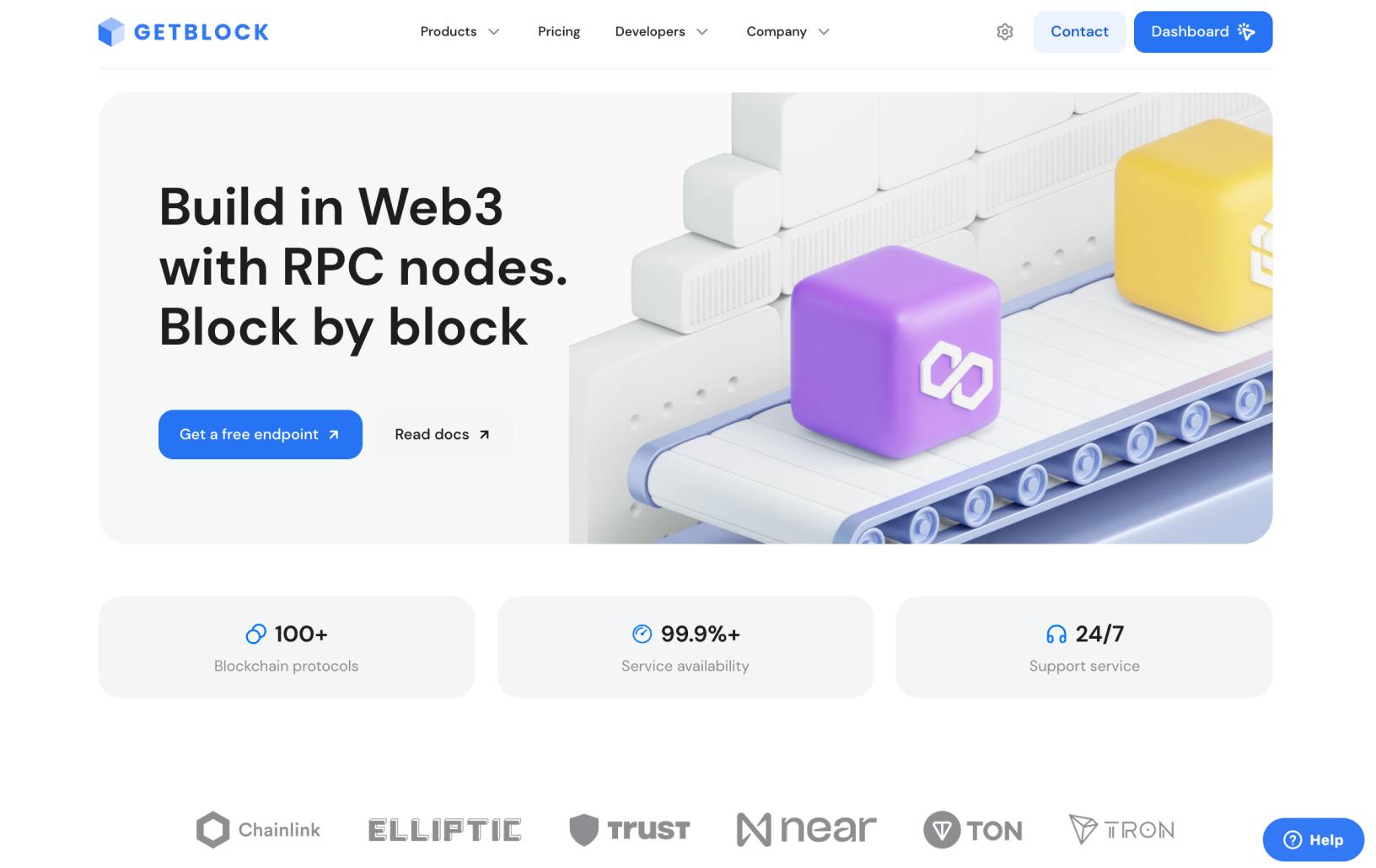
The platform offers flexible service options, from free-tier shared infrastructure for individual developers to dedicated nodes for institutional clients and performance-sensitive applications.
GetBlock operates a global infrastructure footprint across North America, Asia, and Europe, designed to reduce latency and deliver consistent throughput for trading systems, wallets, and large-scale dApps.
A substantive part of the company’s offering is bespoke infrastructure: hands-on engineering support for complex configurations and bespoke infrastructure design, full node parametrization, and node clustering solutions with managed load distribution.
What is Helius?
Helius is a Web3 infrastructure company founded in 2022 that provides Solana development tools for builders, traders, and enterprises.
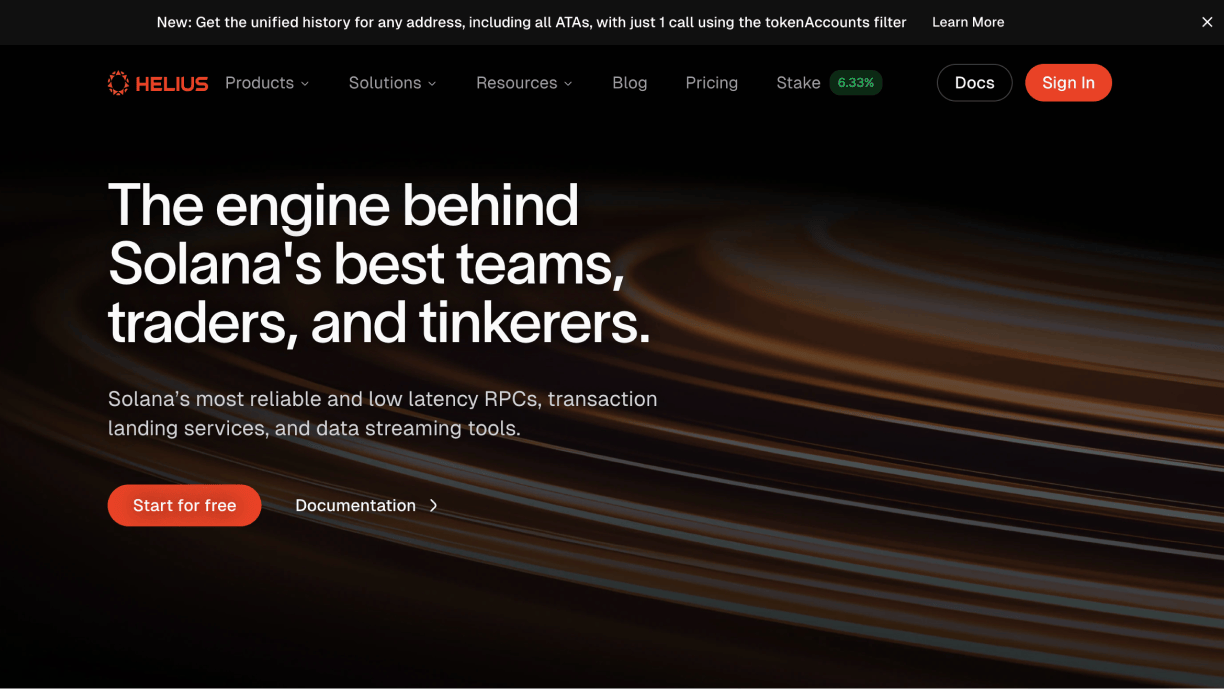
Source: Helius
The platform offers high-performance Solana RPC endpoints with multi-region redundancy powered by staked connections – a stake-weighted routing feature aimed to improve transaction delivery during congestion.
Alongside its standard infrastructure offerings, Helius places strong emphasis on developer-first solutions, offering APIs and data streaming infrastructure to meet the needs of applications built on the Solana network.
The platform has established itself as a reliable Solana-centric infrastructure provider widely adopted within the ecosystem and the network's largest validator, staking over 15 million SOL. The company has backing from Solana Ventures and other major VCs, reinforcing its strong community standing.
Helius vs GetBlock RPC: Key features comparison
Helius is a leading Solana-only provider embedded in the ecosystem, with deep domain expertise, broad developer-facing data services, and comprehensive documentation.
GetBlock’s differentiator is its extensive multi-chain coverage, performance-tuned RPC infrastructure, strong customer support, and bespoke deployments that go beyond off-the-shelf node access.
The table below provides a side-by-side comparison of their pricing, performance metrics, and core service offerings.
Feature | GetBlock | Helius |
Supported Blockchains | 100+ (multi-chain) | 1 (Solana) |
Pricing Model | Subscription-based | Subscription-based |
Pricing Tiers (Shared Nodes, monthly) | $0, $49, $199, $499, $999 | $0, $49, $499, $999 |
Free Tier | 50K CU/day, 20 RPS (direct support, geo-selectable endpoints) | 1M credits/mo, 10 RPS (community support, archive data, webhooks) |
Throughput Scaling by Tier | 20 RPS → 100 RPS → 300 RPS → 500 RPS → 1,000 RPS | 10 RPS → 50 RPS → 200 RPS → 500 RPS |
Dedicated Nodes | $3,200/mo Solana, $1,000+ other chains (full RPC functionality) | $2,900-$3,000/mo (optimized for data streaming only) |
Annual Discount | Yes, 20% | Yes, ~16.7% off (2 months free) |
Global Latency (avg) | 127 ms | 100-140 ms |
Regional Latency | EU: 21.8 ms, US: 111 ms, Asia: 194 ms, MEA: 103 ms | No public data |
Geographic Coverage & Control | Europe (Frankfurt), North America (New York), Asia (Singapore) – user configurable | 11 locations across North America, Europe & Asia – mostly auto-routed |
Support (Free) | 24h response via direct tickets | Community only |
Support (Paid Tiers) | 4h response | 8-24h |
Solana Tools | Yellowstone gRPC, StreamFirst, LandFirst, TradeFirst, Metaplex DAS, Jito MEV, indexed archive, DEX integrations | Staked connections, LaserStream, Sender, DAS API, Enhanced Transactions, Enhanced WebSockets |
Additional Services | Archive endpoints, MEV protection, custom infra deployment | Validator-as-a-Service, Staking |
Security Audits | SOC 2 in progress | SOC 2 Type II certified |
Best For | Multi-chain support with high performance, customizable infrastructure, budget-conscious scaling | Solana-specific features, established ecosystem presence |
In the sections below, we'll unpack what these differences actually mean in the context of leading Solana RPC providers in Web3.
GetBlock pricing vs Helius pricing – Core RPC services
GetBlock and Helius both offer Shared node services as a core product – plug-and-play RPC endpoints run by a provider with monthly subscription plans.
GetBlock’s shared plans are billed around a CU (Compute Unit) model. There’s a free tier and several paid tiers – $49, $199, $499, $999 monthly. Free users get geo-selectable endpoints and MEV protection; paid tiers add much larger CU quotas, higher RPS limits, archive query access, and team accounts.
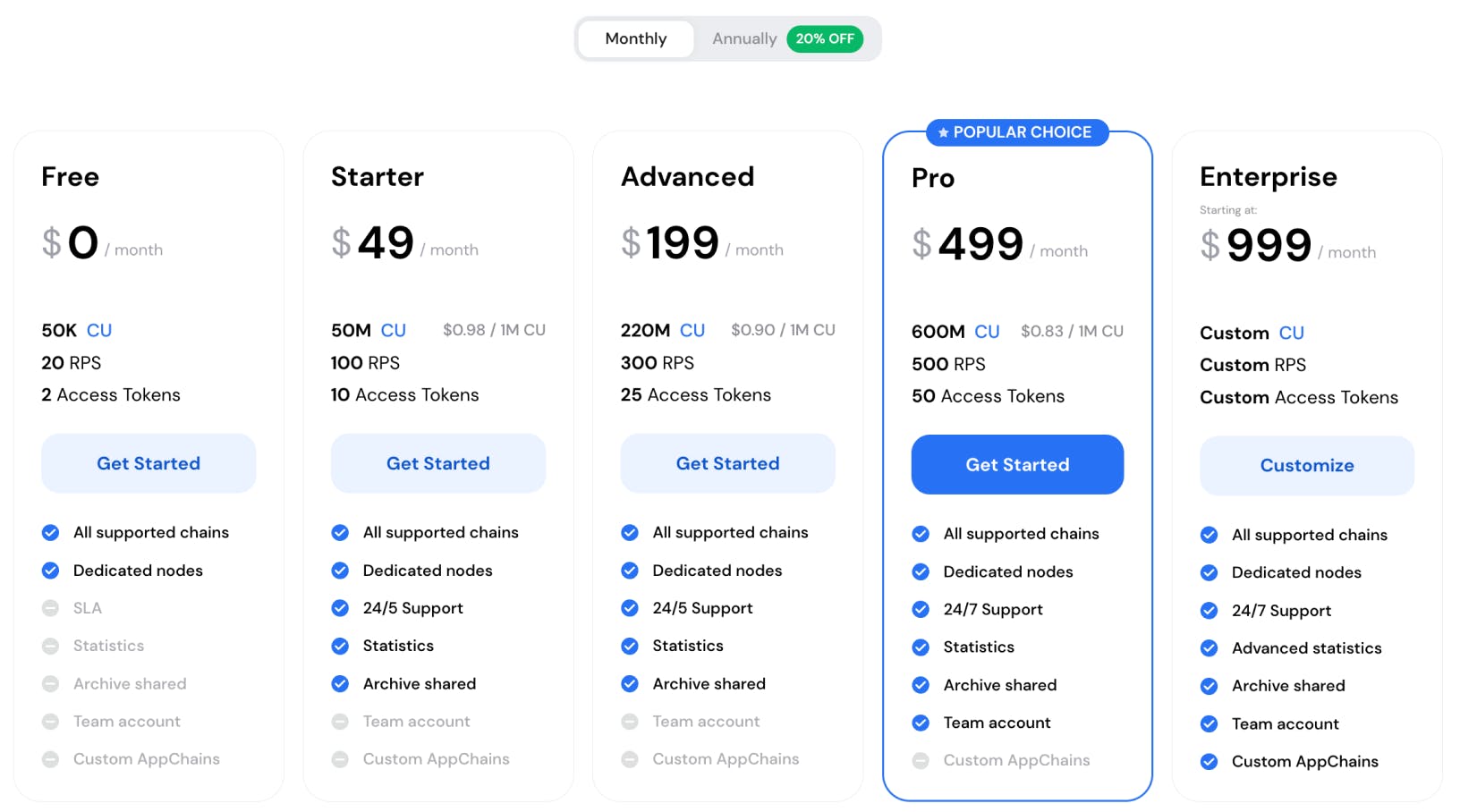
GetBlock Shared RPC Pricing / Source: GetBlock
Helius’ standard plans bill usage in “credits”. The free tier includes Websocket connections, Webhooks, and archive data. Paid tiers – $49 / $499 / $999 monthly – raise credit quotas, RPS limits, unlock direct support, staked connections, and advanced streaming features.
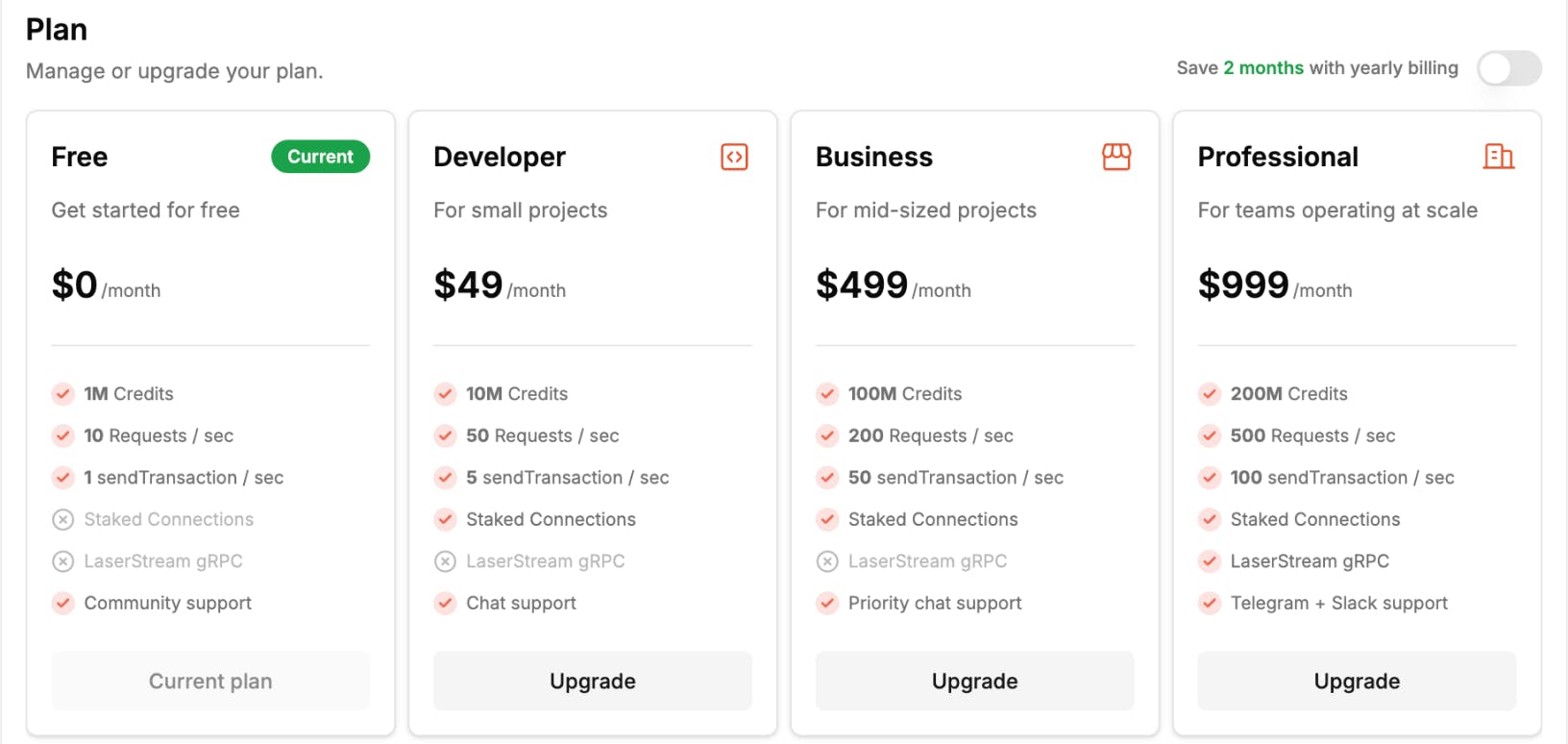
Helius Shared RPC Pricing / Source: Helius
Below is a direct side-by-side comparison of how much GetBlock and Helius shared plans cost, with resource and RPS limits at each tier.
Shared Plan | GetBlock | Helius |
Free | $0/mo 50K CU/day 20 RPS | $0/mo 1M credits/mo 10 RPS |
Entry | $49/mo 50M CU 100 RPS | $49/mo 10M credits 50 RPS |
Mid-Tier | $199/mo 220M CU 300 RPS | — No plan at this tier |
Higher | $499/mo 600M CU 500 RPS | $499/mo 100M credits 200 RPS |
Top | $999/mo Up to 200B CU 1,000+ RPS | $999/mo 200M credits 500 RPS |
Annual Discount | 20% | ~16.7% |
In short:
At every subscription tier, GetBlock offers significantly higher throughput than Helius – 100-150% more, depending on the plan
GetBlock's $199/mo plan fills a gap that Helius doesn't address. Helius jumps directly from $49 to $499, a 10x price increase
Helius rate-limits some heavy operations separately. This prevents a single method from consuming an entire RPS allocation, but may add usage tracking complexity
GetBlock offers a 20% off annual subscriptions, Helius has a “2 months free” offer for yearly plans – roughly a 16.7% discount. For a $999/mo plan, that's $2,400 annual savings with GetBlock vs $1,998 with Helius
Note that GetBlock uses Compute Units (CU) while Helius uses credits. These aren't directly comparable without knowing your specific method mix, as different workloads consume different amounts of each unit.
Free tier: Limits & included tools
Both providers offer genuinely usable free tiers:
Feature | GetBlock Free | Helius Free |
Price | $0/mo | $0/mo |
Volume Limit | 50K CU/day | 1M credits/mo |
RPS Limit | 20 RPS | 10 RPS |
Support | Direct support line | Community only |
Included Services | Regional endpoint selection (NY / FRA / SG), All native chain RPC methods MEV-protected endpoints | Archive data, Webhooks, WebSockets |
Sign Up Options | Web3 wallet, email, Google, GitHub | Google, GitHub |
GetBlock's free tier is suitable for development work, with direct support, anonymous sign-ups, built-in MEV protection, and geo control. Features like archive queries, team accounts, SLAs, and priority support will need an upgrade.
Helius gives free tier users features like archive data and WebHooks, but at a more constrained performance. Expect to upgrade for better performance, support, the flagship staked connections feature, and auto-routing across global regions.
Dedicated node services & pricing
If you need an isolated server (or a cluster) instead of a shared endpoint, both Helius and GetBlock offer dedicated node services – but they solve slightly different problems.
Helius’ dedicated Solana nodes are deployments specialized for low-latency streaming and lightweight queries with a free optional Geyser plugin.
Helius notes their dedicated nodes aren’t intended as a full replacement for a complete RPC stack, i.e.:
Not suitable for reliable transaction submission, heavy read RPC workloads, or archival queries
Do not support most of Helius’ tools and features available on Shared plans
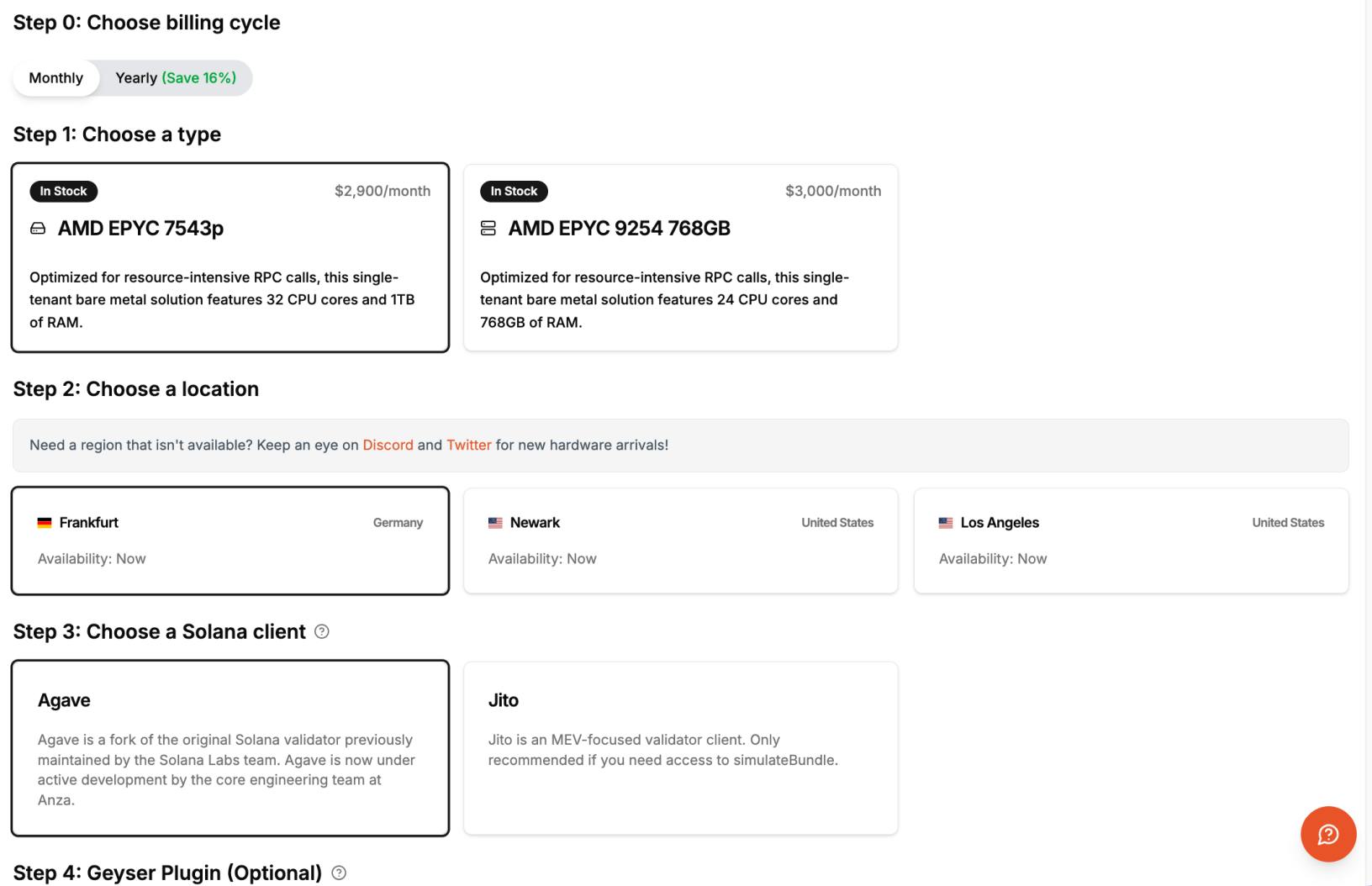
Helius Dedicated Node Setup / Source: Helius Dashboard
GetBlock’s Dedicated node service is designed for customers who need an isolated, high-performance blockchain node with full RPC functionality. Users can:
Deploy a standard isolated server - full or archive node - through a configurator for any supported blockchain and network
Work directly with GetBlock engineers to build a fully custom setup
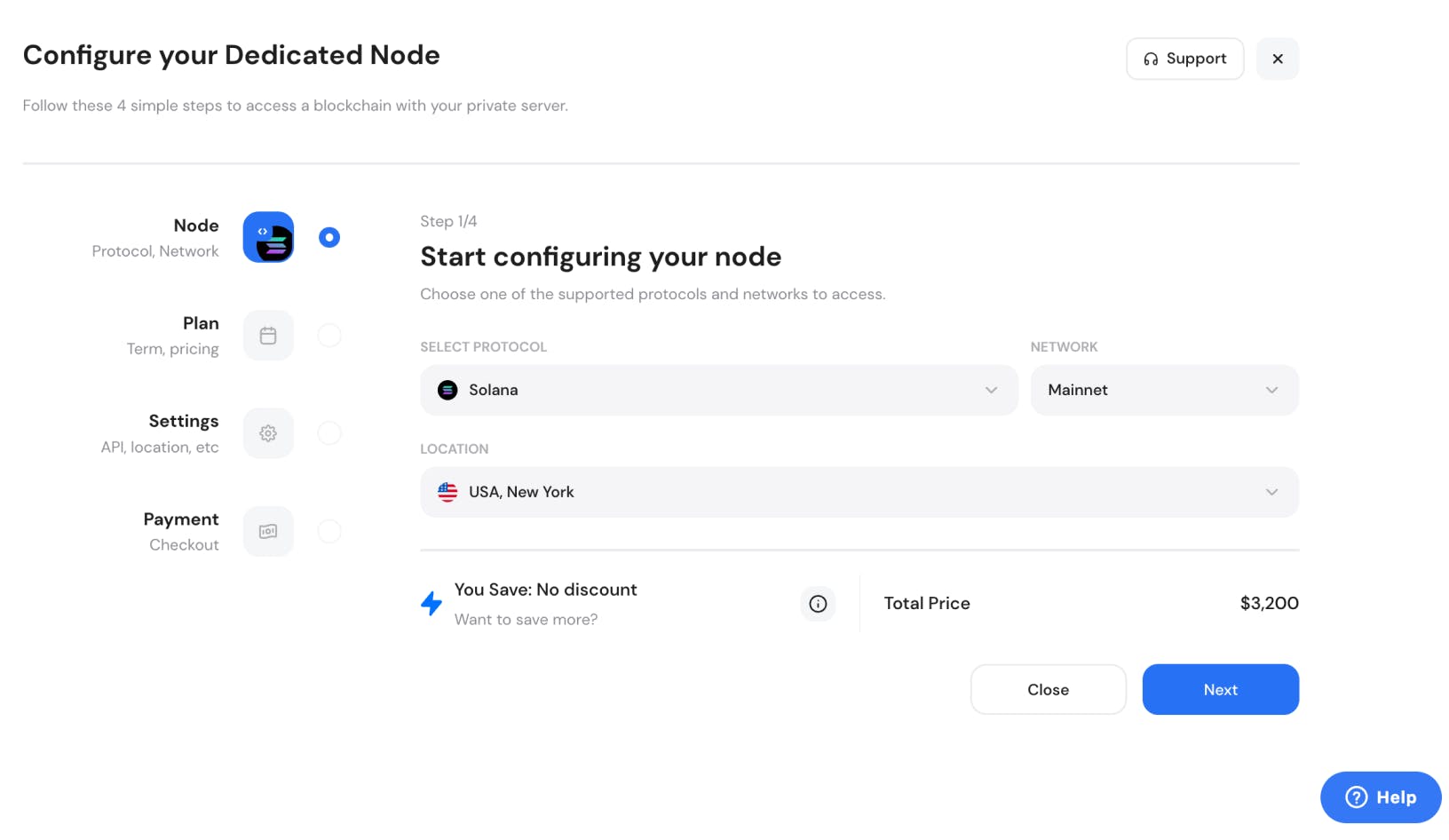
GetBlock Solana Dedicated Node Setup / Source: GetBlock Dashboard
For Solana specifically, dedicated nodes come with the free Yellowstone gRPC add-on and can be customized further to match specific workloads.
Dedicated Node Service | GetBlock | Helius |
Price | Solana mainnet – $3,200/mo; Other chains: from $1,000 (full node) / $1,500 (archive node); 20% annual discount & shorter-term discounts available (3/6/9 month tiers) | $2,900/mo – $3,000/mo; 16% annual discount available |
Pros | Full RPC functionality out of the box; Flexible deployment location, node mode (full/archive), APIs, and add-ons; Free Yellowstone gRPC plugin for Solana | Optimized for high-performance streaming; Yellowstone gRPC included; Configurable hardware type, node client, and location |
Cons | While self-service for standard setups, requires more provider coordination for bespoke setups | Not a standalone RPC stack (limited sendTransaction reliability, not for complex queries or archival access) – must be paired with a shared plan for full functionality |
Bottom line: pick a dedicated Solana node provider by features and operational fit, not price alone.
Helius is slightly cheaper on paper, but optimized for one specific thing and needs a shared plan ($49-$999/mo) for full platform features, which will increase the total cost significantly. Customizations and enterprise configurations are part of an Enterprise plan with custom pricing.
GetBlock’s dedicated nodes are sufficient as a core infra component, highly customizable, and designed to support the full development lifecycle.
Build a dedicated node tailored to your stack.
Configure a production-ready Solana node in minutes via the GetBlock dashboard, or talk directly with GetBlock engineers to design a custom setup optimized for your workload.
RPC speed comparison: Helius vs GetBlock
Let's cut to the chase with actual numbers.
Recent performance tracking by CompareNodes confirms that GetBlock achieves some of the lowest latencies for Solana RPC:
Frankfurt nodes deliver as low as 6ms average response times, consistently maintaining sub-25ms performance
Globally, GetBlock’s Solana nodes show around 127 ms – below average latency
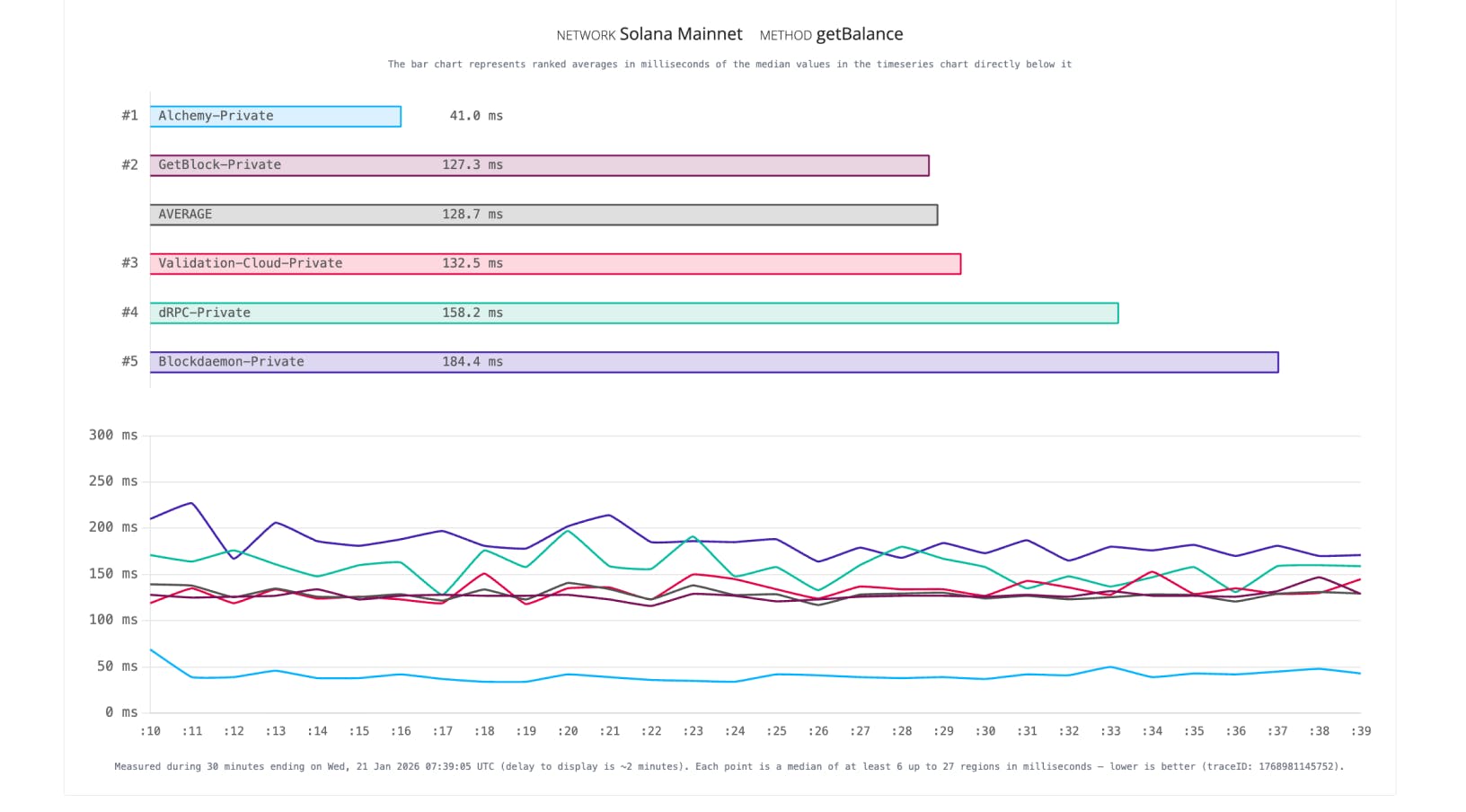
Solana Mainnet Global Latencies across providers, Data as of 21 Jan 2026 07:39 UTC / Source: CompareNodes
For standard RPC services, Helius claims its infrastructure delivers sub-100ms latency globally in optimal conditions.
QuickNode benchmark (August 2025) measured Helius at 225ms p95 latency across global regions
Chainstack analysis (January 2026) listed Helius with an average latency of around 140ms.
Transaction speeds are difficult to compare directly. For standard Solana API services:
GetBlock measures when a validator RPC reports the transaction in a block – according to validator stress-tests, 95% of transactions are visible within 0.52 seconds
Helius measures how long it takes for a transaction to be confirmed and visible to Helius – currently averaging 0.7 seconds
The table below breaks down Helius and GetBlock latency benchmarks based on Solana Mainnet RPC performance.
Metrics | GetBlock | Helius |
Global Latency (avg) | 127 ms | >100-140 ms |
Regional Latency | 21.8 ms (EU), 103 ms (the Middle East & Africa), 111 ms (US), 194 ms (Asia) | No data |
Transaction Speed | 0.52s (p95, on-chain inclusion speed) | 0.7s (average confirmation time) |
Note: These metrics come from different sources: GetBlock latencies are reported by CompareNodes (data as of Jan 21, 2026, 07:39 UTC); Helius data is mainly self-reported or sourced from its Solana Ping dashboard. Treat them as reference points rather than direct comparisons.
See GetBlock's low-latency Solana RPC in action. Just connect with your wallet and get started – deploy your first endpoint to test.
Geographic coverage and latency impact
Region and routing are often the dominant factors in real-world RPC latency.
Helius operates a wide multi-region footprint:
Asia: Tokyo, Singapore
North America: Pittsburgh, Newark, Salt Lake City, Los Angeles, Vancouver
Europe: Dublin, London, Amsterdam, Frankfurt
On shared plans, Helius automatically routes requests to the region it determines to be optimal. Users have less control over exact server placements unless they use specialized services such as LaserStream, dedicated nodes, or enterprise configurations.
There are no publicly available benchmarks specifically measuring Helius's latency variance across different regions.
GetBlock provides robust coverage in the same regions:
Europe: Frankfurt
North America: New York
Asia: Singapore
In the case of GetBlock, users themselves configure the region when setting up shared RPC endpoints or deploying dedicated nodes.
For Solana RPC in particular, GetBlock delivers verifiable low latency in its covered regions, with the fastest average RTT in Europe (21.8ms), Africa and the Middle East (103 ms).
Latency optimization tooling
Both providers offer several specialized tools to push latency even lower.
On top of its core RPC service, Helius provides:
LaserStream with shred-level ingestion to lower notification latency for on-chain events
Shred Delivery for raw, unprocessed data streaming
Sender for ultra-low-latency submission via dual-routing to validators and auction paths such as Jito
For Solana RPC specifically, GetBlock offers similar tools:
StreamFirst: optimized gRPC shred-aware streams with up to 30 ms faster notifications than standard Yellowstone gRPC
LandFirst: multi-path, leader-aware transaction routing with SWQoS and network-level tuning to boost the chance of landing to over 95%
TradeFirst: a bundle combining all streaming, routing, and execution optimizations
Functionally, these tools target the same goals: faster on-chain events visibility and faster transaction landing in a block.
Customer support
GetBlock’s customer support is the most underrated competitive advantage: free users get ticketed help (~24-hour response target) and paid customers get fast priority support: a 4-hour response time across all paid plans – that's the same support responsiveness competitors reserve for enterprise contracts.
Helius free users rely on community help, while SLA-backed support is a paid perk and plan-dependent, with the strongest support guarantees for Enterprise customers.
Plan Level | GetBlock | Helius |
Free | 24h response (direct tickets) | Community support (Discord, Telegram, docs) |
Entry paid ($49/mo) | Up to 4h response (24/5 coverage) | 24h response time |
Mid-Higher plans | Up to 4h response (24/7 coverage) | 8-12h response time |
Enterprise | Dedicated chats, 5 min reponse | Dedicated chats, up to 4h response time |
Note: GetBlock response times shown above reflect our current operating standard. Helius response times are based on their published support SLAs – actual response time may be faster.
We'll be direct: GetBlock's support is exceptional, and we're proud of it.
The best way to evaluate our support? Contact us with a question. Ask about your infra needs, migration assistance, custom solutions, and anything else about GetBlock's infrastructure.
Developer tools: APIs, SDKs, add-ons
As a Solana-centric provider, Helius provides a set of useful developer tools: high-level data APIs (DAS, Enhanced Transactions), archival endpoints and helpers, staked connections and Sender to improve send reliability. All of these tools are well-documented and available to paid tiers, some on free plans with tiered limits. Helius also provides official SDKs for Node.js and Rust.
On a more premium side, there is the LaserStream tool for realtime data streaming built on top of the gRPC protocol – often offered as an alternative to Helius dedicated nodes, included in a $999/mo plan or in a separate paid add-on bundled with Enhanced Websockets.
As a multichain provider, GetBlock offers more plug-in and modular tooling. For Solana specifically, multiple third-party integrations and custom products are available:
Yellowstone Geyser gRPC and StreamFirst for low-latency streaming
LandFirst - transaction delivery optimization layer
TradeFirst - a higher-level trading infrastructure
Metaplex DAS - indexed NFT and token API
Jito MEV and ORE mining clients
DEX integrations (e.g. Jupiter, Raydium)
Indexed archive API
Most of these are add-ons that the user can enable alongside their dedicated node. Customers choose the specific extras they need or request custom integrations when standard tooling isn’t enough.
Don't see what you need? Let's talk custom integrations.
Many of GetBlock’s current add-ons started as custom requests from customers with specific needs. If you think your integration needs are too niche or complex, we've likely solved similar problems. Schedule a call with our dedicated team focused on Solana performance optimizations.
Extra services
Beyond RPC services, GetBlock offers developer utilities, such as explorers and faucets, and offers AppChain deployment services relevant for teams launching custom chains. Flexibility is a product of its own: GetBlock can onboard new blockchains into its infrastructure and operate the required nodes for customers.
Helius operates a Solana blockchain explorer, validator, and a liquid-staking product and offers Validator-as-a-Service for institutions that want a managed, production-grade validator.
Security
Helius achieved SOC 2 Type II certification in June 2025, audited by Sensiba LLP. GetBlock has initiated the SOC 2 audit process in 2025 and is working through the required control implementation and observation period. The formal attestation is expected in 2026.
SOC 2 status matters more for production deployments where procurement, compliance, and risk reviews are involved.
Wrapping up
Helius goes all-in on Solana with deep ecosystem integration. GetBlock takes a different approach to RPC services: multi-chain breadth without compromising on performance.
You shouldn't have to choose between multi-chain support and Solana expertise – GetBlock proves you can have both. Our Solana infrastructure ranks among the fastest globally, and this didn't happen by accident. We've invested heavily in optimizing our Solana nodes – dedicated engineering work, infrastructure tuning, and rigorous performance testing – to ensure our multi-chain platform delivers the same speed and reliability that Solana specialists offer.
Start with our free tier to benchmark performance from your region, explore our deployment options, or contact us directly for guidance on the right setup for your project.


Popular Posts

June 9, 2021
4 min read

November 9, 2021
5 min read

May 24, 2022
5 min read

March 18, 2021
4 min read


