
How to Build an AI Agent On Solana

GETBLOCK
March 12, 2026
5 min read
Imagine telling your wallet to "swap 50 USDC to SOL when the price drops below $150" and walking away. No monitoring charts. No manual transactions. No missed opportunities while you sleep.
This is what AI agents are capable of on blockchain today.
In this guide, GetBlock highlights what AI agents are, why Solana is the ideal network for building them, and introduces our step-by-step tutorial for creating your own.
TL;DR
AI agents are autonomous systems that perform blockchain operations without human intervention. Here's what you need to know:
AI agents combine LLMs with blockchain toolkits to interpret natural language and execute on-chain actions like swaps, transfers, and balance checks.
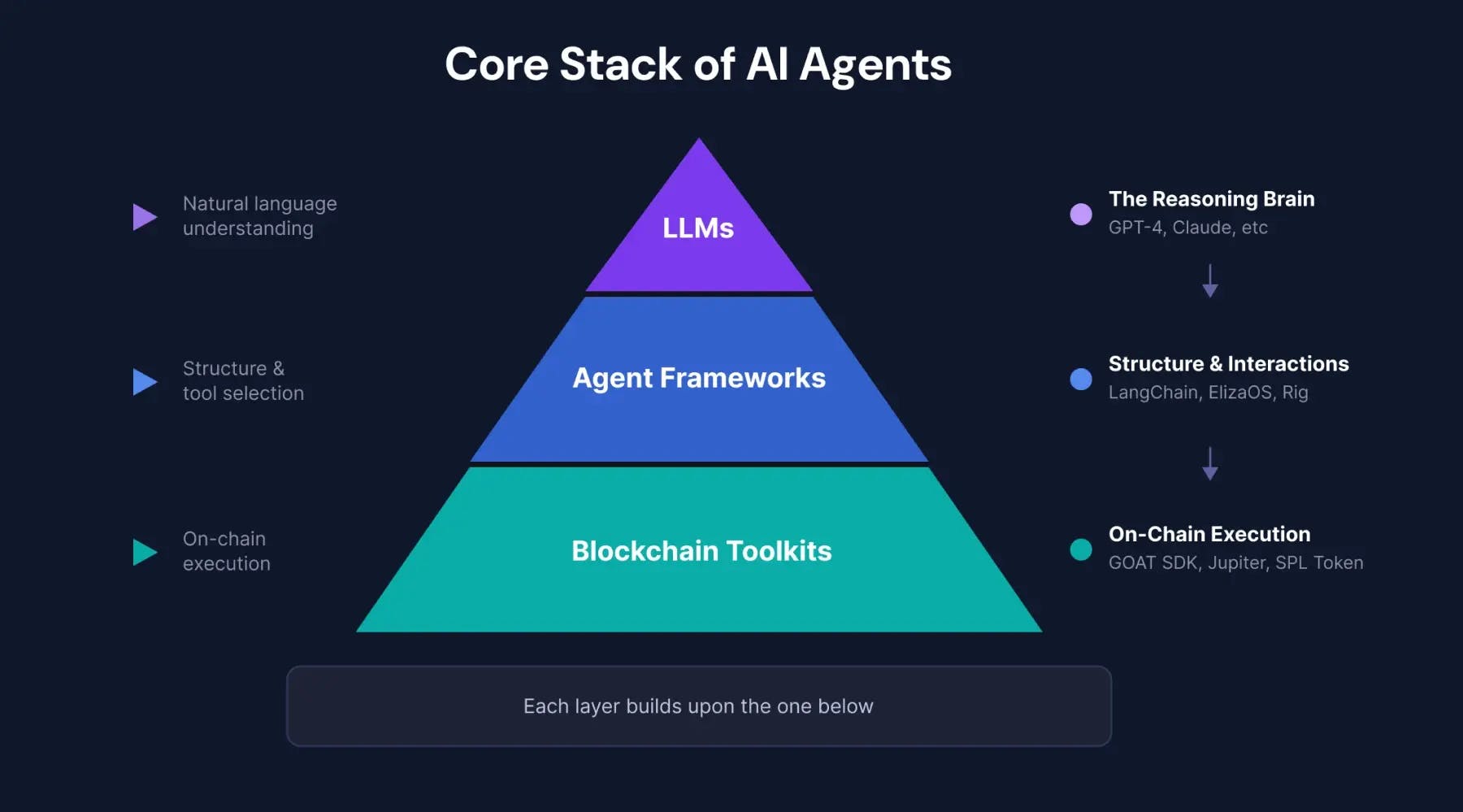
The core stack consists of three layers: Large Language Models (reasoning), Agent Frameworks (structure), and Blockchain Toolkits (execution).
Solana's speed makes it ideal for AI agents. Sub-second finality means your agent can react to market conditions almost instantly.
We've published a complete implementation guide with working code in our documentation.
Let's explore what makes AI agents powerful—and why you should build one.
What Are AI Agents in Blockchain?
AI agents are autonomous systems that perform operations or tasks without human intervention. You set them up, define their capabilities, and they act independently on your behalf.
Think of them as smart assistants with wallet access. You tell them what to do in plain English or in other languages, and they translate that into blockchain transactions.
In the blockchain context, AI agents can:
Execute token swaps when prices hit targets. Set conditions, and your agent monitors and acts.
Rebalance portfolios across DeFi protocols. Maintain target allocations automatically.
Monitor wallets and automate transfers. Move funds based on triggers you define.
Mint NFTs based on external events. React to social media, market data, or any API.
The key difference from traditional automation? Natural language. Instead of writing complex scripts, you simply describe what you want.
The Core Stack of AI Agents
Every AI agent consists of three fundamental layers:
Large Language Models (LLMs)
The reasoning brain. LLMs like GPT-4 or Claude handle natural language understanding, interpret user requests, process blockchain data, and decide which actions to take. When you say "send 0.1 SOL to this address," the LLM parses your intent and determines the appropriate function call.
Ready to access blockchain data with flexible pricing? Sign up for GetBlock and start building with our RPC endpoints today.
Agent Frameworks
These define the agent's structure, personality, and interactions with external systems. Popular frameworks include LangChain, ElizaOS, AgentiPy, and Rig. The framework manages the conversation loop, tool selection, and error handling.
Blockchain Toolkits
SDKs that give agents actual on-chain capabilities. For Solana, toolkits like the GOAT(Greatest onchain Toolkit) SDK connect wallets to AI-usable tools, while plugins for Jupiter, SPL tokens, and Pump.fun enable specific actions. These toolkits translate high-level commands into RPC calls that are executed via endpoints such as GetBlock's Solana nodes.
Why Build AI Agents on Solana?
Solana's architecture makes it particularly suited for AI agents:
Sub-second finality: When your agent executes a trade, the confirmation takes ~400ms. This matters when market conditions change rapidly.
Low transaction costs: At fractions of a cent per transaction, your agent can make frequent, small decisions without cost concerns eating into returns.
Rich DeFi ecosystem: Jupiter aggregates liquidity across dozens of DEXs. Pump.fun enables token launches. Raydium provides concentrated liquidity. Your agent can tap into all of it.
Growing infrastructure: Services like GetBlock provide reliable RPC access to the Solana mainnet and devnet, which is essential for agents that need consistent blockchain connectivity.
What Can You Build?
The combination of LLMs and blockchain toolkits opens up numerous possibilities:
Trading bots that execute complex strategies from natural language rules
Portfolio managers who rebalance based on market conditions
DAO operators that execute governance decisions automatically
Payment processors that handle invoicing and disbursements
Gaming agents that manage in-game economies and NFT inventories
Here's a glimpse of what interacting with a working agent looks like:
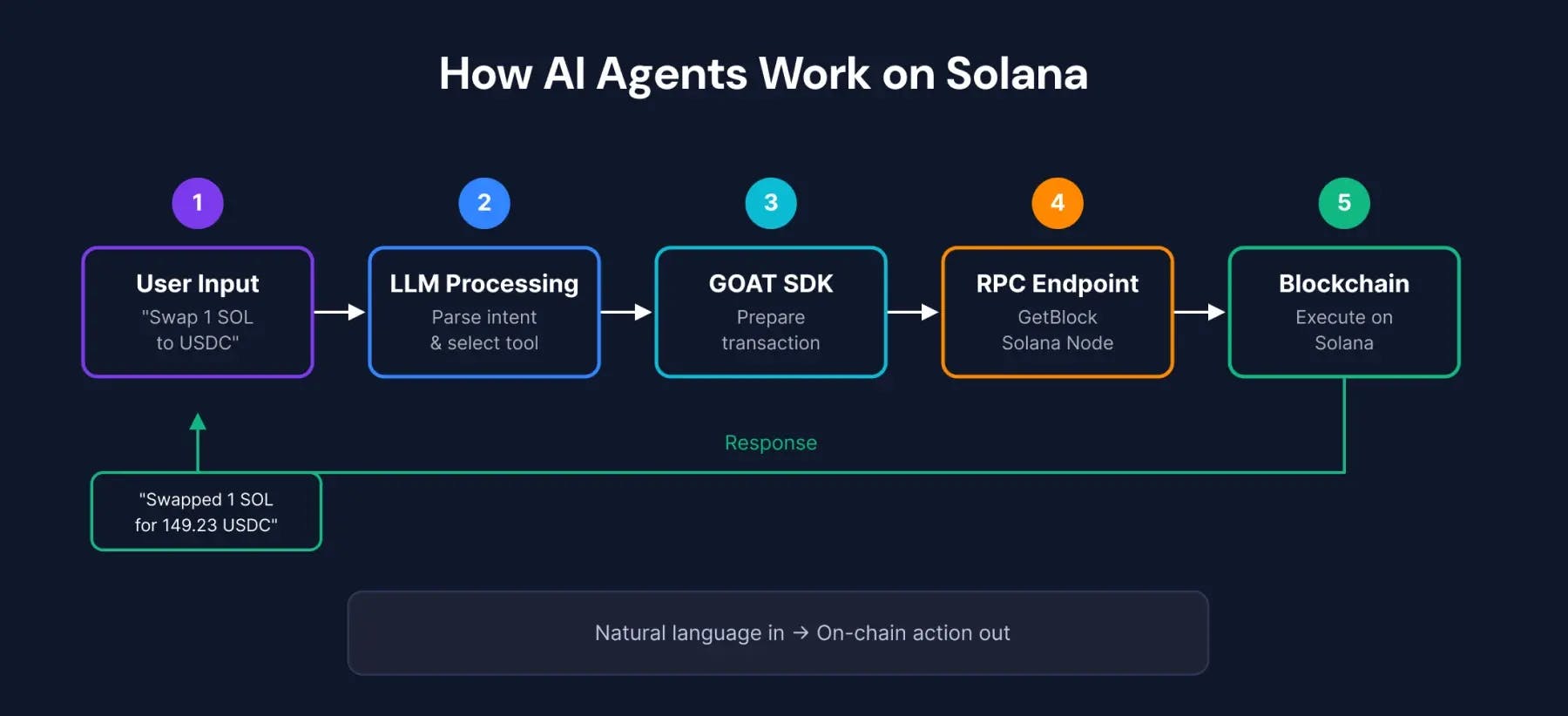
The agent understands context, handles errors gracefully, and even works in multiple languages—users have successfully tested requests in Russian, Spanish, and Mandarin.
Ready to Build Your Own?
We've created a comprehensive guide that walks you through building a fully functional AI agent on Solana. You'll learn how to:
Set up the development environment with the right dependencies
Connect to Solana using GetBlock's RPC endpoints
Initialize the GOAT SDK with Jupiter, SPL token, and Pump.fun plugins
Configure LangChain with GPT-4 for natural language processing
Build an interactive CLI for conversing with your agent
Extend capabilities with additional plugins like NFT minting
The complete implementation takes under 100 lines of code. By the end, you'll have an agent that can check balances, transfer SOL, swap tokens, and respond to commands in any language.
Now that you have learned about AI agents, you can learn how to build an AI agent that can swap tokens, send tokens, and check account balances. Access the full guide here and the guide repository.
Conclusion
AI agents represent a fundamental shift in how we interact with blockchains. Instead of navigating complex interfaces and signing cryptic transactions, you describe what you want in plain language.
Solana's speed, low costs, and rich DeFi ecosystem make it an ideal platform for these agents. And with tools like the GOAT SDK, LangChain, and reliable RPC providers like GetBlock, building your own agent is more accessible than ever.
The question isn't whether AI agents will become standard infrastructure for blockchain interactions—it's whether you'll build them or use someone else's.
Want reliable Solana infrastructure for your AI agent? Create your free GetBlock account and access production-grade RPC endpoints.


Popular Posts

June 9, 2021
4 min read

November 9, 2021
5 min read

May 24, 2022
5 min read

March 18, 2021
4 min read


