

GetBlock’s 2025 Mega Dev Update: Year in Review

GETBLOCK
January 5, 2026
11 min read
Well, we made it to the finish line of what might be GetBlock's biggest year yet. And honestly, what better way to wrap up 2025 than with a proud look back at everything we crushed this year?
TL;DR
Here are ten of our biggest highlights from 2025:
GetBlock went global, expanding our RPC infrastructure from Europe to North America and Asia – geography is now a user choice
Advanced Solana data instruments stack for industry-fastest transaction landing and data fetching
Core performance work: new high-performance servers, internal optimizations
Moved to Compute Units (CU)-based pricing for Shared Nodes that maps to actual usage and increased maximum throughput on Shared plans to 500 RPS by default
More flexible node setups: New subscription plan, archive data access on Shared Nodes, and Dedicated Node configs
Added built-in MEV protection at the node level through our partnership with Merkle
New add-ons & integrations: bloXroute for BNB Chain, Clio for XRPL
40+ new blockchains onboarded across AI infra, gaming, DeFi, high-perf L1s, Bitcoin L2s, and more markets for your products
Our open-source MCP Server launched
GetBlock’s public Feedback Portal is live so you help decide what we build next
And that's just scratching the surface! Keep reading for all highlights of 2025 and a sneak peek into what we're cooking up for 2026.
1. Going global
If we had to pick one achievement that defined GetBlock in 2025, it would be this: we became a genuinely global infrastructure provider, bringing our infrastructure to three continents – Europe, North America, and Asia.
More than this, we made it a user-controlled feature, giving all of our customers a choice over where their infrastructure runs.

It was a year-long execution:
Q1 2025: Launched Dedicated servers in New York and Singapore (previously Europe-only) – Our customers running Dedicated Nodes choose the physical region where their node instance runs.
Q2-Q3 2025: Extended the same geographic placement to Shared Node clusters so that our RPC API users could route traffic to nearby endpoints and benefit from lower latency.
Q4 2025: Continued expanding blockchain support across all three regions.
This was radical. Major RPC providers typically restrict regional customization to premium or enterprise plans or handle geography entirely behind the scenes. We turned it into a standard feature of the GetBlock platform available to all users starting from the free tier. You choose where your traffic goes.
Why node location matters
If you're using a dApp in Montreal, Canada, and your RPC provider's servers are in Germany, every blockchain query travels halfway around the world, adding hundreds of milliseconds of delay. But if you can connect to servers in New York instead, that drops to around 40 ms.
For real-time applications like trading bots, DEX interfaces, or blockchain games, that difference is massive.
2. Latency wins: turning global reach into real-world speed
By making regional infrastructure available, GetBlock turned geography into one of the biggest performance multipliers on the platform.
Throughout 2025, independent benchmarks confirmed measurable reductions in latency across multiple blockchains:
Shortly after launch, our North American infrastructure averaged 37.2 ms response times for BNB Smart Chain operations, performing faster than any other competitor. In certain locations, latency dropped to just 21 ms
Frankfurt nodes delivered as low as 6 ms average response times for Solana, with sustained sub-20ms performance across major European locations, making GetBlock #1 Solana RPC provider in Europe
Singapore infrastructure achieved 102.7 ms median response times across top supported blockchains
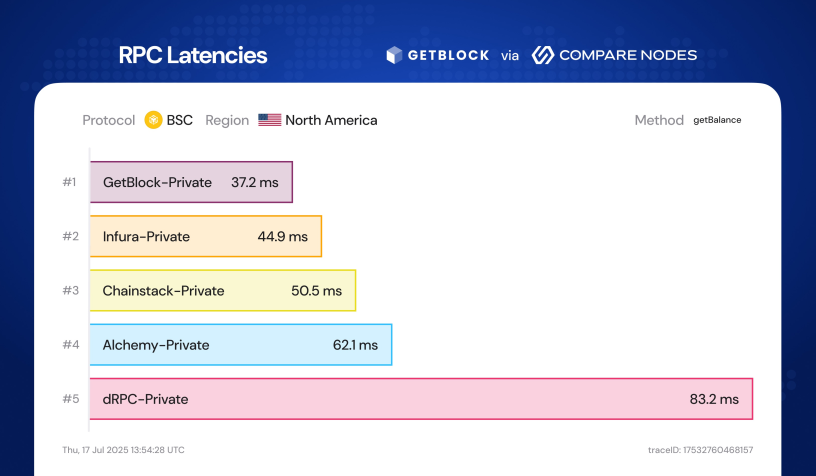
Don’t take our word for it; check the independent benchmarks on CompareNodes.
Core infra optimizations
Beyond expanding regionally, we improved our core architecture to make every request faster.
First, we migrated nodes to high-performance servers in top-tier data centers, with improved failover protection and higher-capacity network connectivity.
Next, by caching user configurations in memory, access token authorization checks happen almost instantly, and by making our internal accounting asynchronous, requests reach blockchain nodes immediately. Together, these changes cut average latency by about 50 ms across all services.
3. RPC service upgrades
We shipped several upgrades to how GetBlock RPC works day to day – expanding access to archive data, adding flexibility to Dedicated Nodes, and raising throughput limits across Shared plans.
Archive data on Shared Nodes
Since October 2025, GetBlock’s Shared Node endpoints support archive data queries.
Previously, if you needed access to historical blockchain data, you had to order GetBlock's premium Dedicated Node service. Now, this functionality is available on Shared Node subscription plans, which start at only $39/month.
To enable, toggle "Archive mode" when creating a new endpoint in your GetBlock dashboard. There’s no extra subscription fee for this. Just note that since historical queries are more resource-intensive, Archive RPC calls consume more Compute Unit (CU), as shown in our CU costs table.
We first launched access to archive RPC calls on core networks such as Ethereum, Polygon, Arbitrum, BNB Chain, Cardano, and now progressively enabling it across our RPC nodes list. The feature is also becoming standard for most new blockchains added to GetBlock. Check the availability in your dashboard.
New Shared Nodes plan
Remember hitting Starter plan limits but not being ready for Pro (which is a 12x capacity jump from Starter)? We heard that a lot. In August, we launched Advanced – a new Shared Node plan that finally filled the gap between entry-level and enterprise-scale infrastructure.

Advanced landed with 220M Compute Units, 100 RPS (bumped to 300 RPS in November), and 25 Access Tokens. That's over 4x more capacity than Starter with 50M CUs and only 40% of Pro plan's cost.
Tiered Dedicated Nodes
In 2025, we packaged our Dedicated Node services into two tiers – High and Standard. The tiers differ by performance profile and pricing.
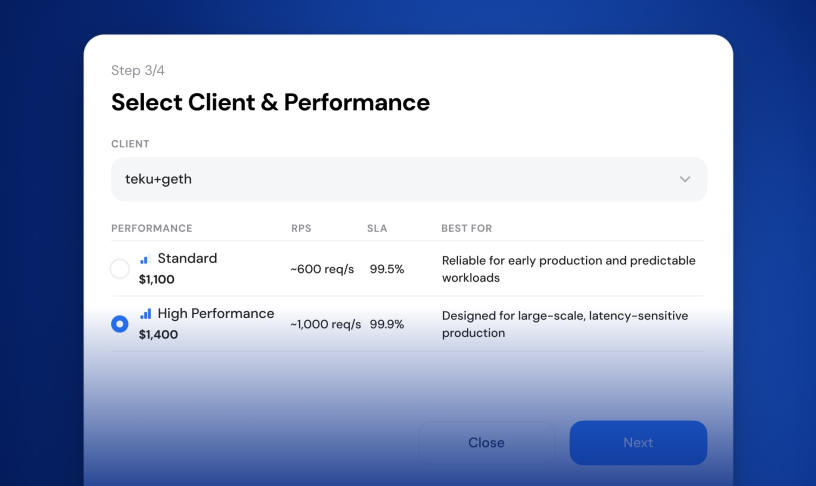
The High tier targets use cases needing absolute maximum throughput and reliability. Projects with solid but less extreme requirements can opt for Standard and reduce infrastructure costs by roughly 40%.
Instead of defaulting to a single, maximum-spec Dedicated Node configuration, GetBlock now matches hardware allocation to different performance needs.
RPS limits 4x'd
In November 2025, we increased default RPS (requests per second) limits across Shared Node plans without changing prices.
Free: 5 → 20 RPS
Starter: 25 → 100 RPS
Advanced: 100 → 300 RPS
Pro: 200 → 500 RPS
Our lower-tier plans, Free and Starter, got the biggest increase (up to 4x) and now support more realistic workloads. Pro reached 500 RPS, but it’s not yet the limit – Enterprise plan stays fully configurable, so users can request even higher throughput as needed.
Users across all plans tell us the difference is real: fewer timeouts and more consistent response times.
4. New tools & integrations
In 2025, we added several tools and partner integrations that extend what you can do with GetBlock RPC.
bloXroute-powered BNB Chain nodes
If you're running time-sensitive operations on BSC, like trading bots, you now have infrastructure that moves faster than standard RPC. For our Dedicated BSC nodes, we created a specialized setup that connects you directly to bloXroute's BNB Chain BDN.
Add bloXroute during Dedicated Node provisioning: pick BSC, move to the add-ons step, and enable the bloXroute add-on. Your node gets its own bloXroute Gateway instance deployed in parallel.
Instead of waiting for blocks and transactions to move node-to-node across the public network, bloXroute uses optimized paths through its relay network, reducing propagation time.
This delivers measurable competitive advantages:
New blocks appear in your node's view ~150 ms sooner
Transactions land faster, within ~80-100 ms, and with higher success rates
Access to private mempools helps keep your tx hidden from front-runners scanning public mempools
Give your transactions even faster processing by adding tips for relayer nodes in bloXroute’s network
There’s also a limited-time offer worth taking advantage of: Until Feb 1, 2026, you can provision a BSC node with bloXroute and only pay the standard node price. The add-on is included for free during this period.
Advanced Solana tools for trading and low-latency apps
This year, GetBlock invested in understanding and solving the hardest Solana infrastructure problems. More specifically, problems that appear under competition: latency, congestion, competitive execution environments, data completeness and accessibility.
Since Solana is the primary hub for high-frequency crypto activity, these are real pain points for high-frequency trading scenarios, MEV searchers, and institutional operations.
To address this, we developed four specialized tools through partnerships with best-in-class Solana ecosystem teams:
StreamFirst: Receives blockchain data directly from validators via shred-stream interception before full block confirmation. Uses optimized Yellowstone gRPC for faster delivery than standard RPC
LandFirst: Multi-path transaction routing for faster Solana transaction inclusion, achieves 95%+ landing probability
TradeFirst: Solution combining the previous two tools
Indexed Archive: Built on SQD Network infrastructure, provides API access to indexed Solana blockchain history to do analytics or backtesting
See our Solana documentation for a technical deep dive into these solutions. Details coming in 2026.
MEV-protected RPC endpoints
In May 2025, we partnered with Merkle to launch MEV‑protected endpoints across our Ethereum, Base, Solana, and BNB Smart Chain RPC node services.
The protection is automatic, built-in, and ready to use. How it works:
In GetBlock’s dashboard, choose your chain
Select an endpoint type like “MEV‑Protected JSON‑RPC” or “MEV‑Protected WebSocket”
Use that RPC URL in your wallet, backend, or dApp the same way you’d use a standard endpoint
Importantly, it’s not a premium or enterprise-only feature – the MEV protection is included by default in all paid plans.
Clio API for XRP Ledger
Rather than a one-size-fits-all approach, we optimize our infrastructure to match each chain’s specifics. One good example is launching Clio API support for XRP Ledger, giving our RPC users a faster, more efficient way to access XRPL data. We worked directly with Ripple's core engineers to get it right.
Clio is Ripple's high-performance API server that pulls validated data from trusted rippled servers, indexes it in a much more compact format, and serves API requests significantly faster. It also unlocks specialized RPC methods that standard XRPL nodes don’t support.
Users can request Clio-powered nodes – both full and archive – through GetBlock's Dedicated Node dashboard.
GetBlock MCP server
We released an MCP Server, a small open-source service that lets AI tools talk to blockchains through GetBlock using the Model Context Protocol. It's compatible with popular coding assistants like Claude, Cursor, and other AI-powered IDEs.
Out of the box, GetBlock’s MCP works with Ethereum and Solana and allows several blockchain operations:
Retrieve chain info
Get wallet balances, transaction details, recent blocks
Track gas prices
If you’re building tools or applications that use AI agents to interact with blockchain data, the MCP Server removes a lot of manual work.

In our GitHub, we published installation steps via Node.js or Docker and examples showing how to connect GetBlock MCP to popular agent frameworks.
5. New Feedback portal: Your voice, our roadmap
GetBlock's Feature Request and Feedback Portal is live since November 2025. It is a platform where the community of our users can submit, vote on, discuss, and track new features.
We believe the best product ideas come from the developers using our infrastructure every day. Now you can request and track what we're building next.
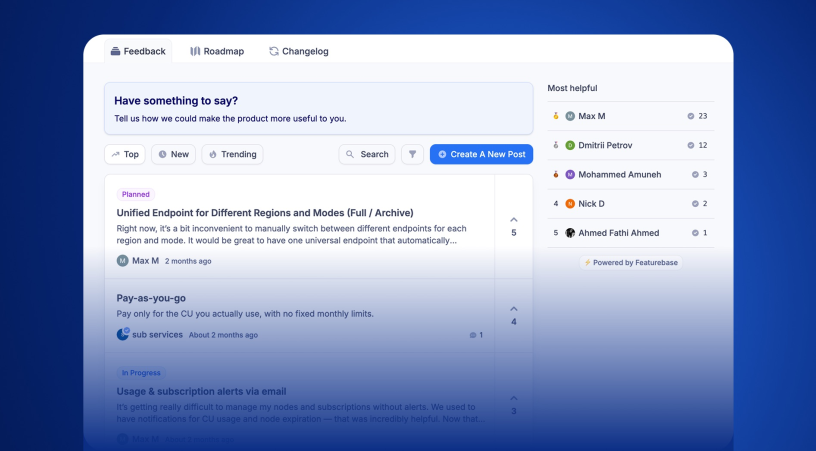
Check it out at getblock.featurebase.app. Don't hold back: submit the feature you actually want and push us to build it!
6. 40+ new blockchains joined GetBlock this year - an unprecedented scale-up
In 2025 GetBlock onboarded 41 new blockchains, bringing together an unusually broad mix of L1s, L2s, and diverse ecosystems where Web3 is actually building right now.
That number matters not because it’s big, but because it shows the ecosystem’s growth. Many networks crossed from “interesting” to production-relevant for builders in 2025. Better support for new and actively growing markets is what we aim for.
Just look at the categories of blockchains GetBlock onboarded:
AI infrastructure: Bittensor, 0G (Zero Gravity), Akash, Story
Gaming, creator & entertainment focused: Zora, Immutable zkEVM, Ronin, Xai, B3, Soneium, Sonic
DeFi-first chains: Berachain, Katana, Unichain, HyperEVM, Ink, Metis, Fraxtal
High-performance L1s: Sei, Monad, Somnia, Zilliqa
Bitcoin L2s: Core, Corn, Bitlayer, Stacks
More Layer-2s: HashKey Chain, Fluent, Mantle, Abstract, Arbitrum Nova, Taiko, Etherlink
Interoperability focused: Axelar, Gravity, TAC, Flare
Privacy & identity oriented chains: World Chain, Oasis
Payments focused: Celo, Stellar
For every chain listed, there’s now a GetBlock endpoint. Dedicated nodes, multi-regional placement, historical access – also wired in.
On a sidenote, this is our largest single-year expansion ever! Shoutout to the GetBlock team: DevOps, SRE, and node engineering moved at a breakneck pace.
See our RPC nodes list to get a full scope of supported chains after these additions.
Looking back at 2025 for GetBlock
2025 was nothing if not a year of doing the hard, visible work. The single biggest signal? Scale. GetBlock is ready to be the go-to infra for diverse ecosystems and use cases.
In 2026, we’re building on that momentum:
SOC 2 compliance in progress: We’re currently in the preparation and observation phases for SOC 2 Type I and Type II audits, validating our security controls and processes for enterprise and regulated customers
Ongoing performance work: Because we never stop obsessing over latency
New integrations & add-ons: Tooling to give our users more performance boosts and service flexibility
AI + agents: MCP is only the beginning, and we expect to continue improving AI‑specific tooling in 2026
Track our progress in real-time via our Feedback portal.
With 2025 behind us, we wish you a fresh and strong start in 2026. Recharge, reset, and come back ready to build the next wave of Web3 together.
Best regards,
– The GetBlock Team


Popular Posts

June 9, 2021
4 min read

November 9, 2021
5 min read

May 24, 2022
5 min read

March 18, 2021
4 min read


