
GetBlock Launches Ethereum Hoodi Testnet RPC – Holesky Endpoints Deprecated

GETBLOCK
November 28, 2025
4 min read
The Ethereum Foundation has announced Holesky’s planned end-of-life: infrastructure and staking testing should move to Hoodi. GetBlock is following that guidance and has enabled Ethereum Hoodi testnet RPC support so builders can continue testing validator flows and protocol upgrades without interruption.
TL;DR:
The Ethereum Foundation formally announced Holesky’s sunset and a shutdown window in early September 2025.
GetBlock deprecates Holesky testnet RPC support and starts providing node infrastructure for Hoodi testnet.
Hoodi RPC access is live on GetBlock for Shared Node endpoints and Dedicated Node service with servers deployed in Europe, Asia, and the United States.
API interfaces available: JSON-RPC, WebSocket, and GraphQL – selectable when creating an endpoint or deploying a dedicated node.
With this update, GetBlock provides managed Ethereum node services for the mainnet and both major testnets: Sepolia and Hoodi. Developers can deploy dedicated nodes or endpoints on any of these networks directly from their user dashboard and interact via standard APIs.
Need bespoke Ethereum infrastructure tailored to your business? Talk to GetBlock’s experts about premium solutions designed for demanding enterprise environments.
Ethereum retires Holesky, time to migrate to Hoodi
Launched in March 2025, Hoodi is Ethereum's latest long-term testnet. It replaces the Holesky testnet, which faced finality issues during Ethereum Pectra upgrade testing earlier this year and is being formally sunsetted.

Source: EtherWorld
The newest test network features a merged-from-genesis Proof-of-Stake architecture, a realistic validator set (over 20 million test ETH staked), staking conditions, and the latest protocol enhancements.
This makes Hoodi the ideal environment for developers and infrastructure builders to test protocol upgrades, including the upcoming Fusaka hard fork, scalability improvements, core smart contract functionality, and infrastructure in a low-risk setting.
In alignment with the ecosystem, GetBlock has officially deprecated support for the Ethereum Holesky testnet and announces support for the Ethereum Hoodi testnet nodes and endpoints.
Hoodi RPC API is live on GetBlock
GetBlock now provides a ready-to-use Hoodi node infrastructure that developers and infrastructure teams can deploy and connect to without the need to manage complex node setups or hardware.
Ethereum Hoodi access is supported on both Shared Node and Dedicated Node services, enabling access to:
Hoodi JSON-RPC, WebSocket, and GraphQL endpoints, generated in a click from the dashboard.
Full and archive dedicated Hoodi node deployment with guaranteed uptime, unlimited requests, and customizable configurations.
GetBlock’s Hoodi node infrastructure is globally distributed with servers located in key regions – Frankfurt, New York, and Singapore. This setup enables developers worldwide to connect to Hoodi testnet nodes with optimized network speed and reliable uptime.
Vasily Rudomanov, GetBlock CEO, comments on Hoodi RPC node debut on the platform:
While we typically focus on EVM functionality like dApps and smart contracts—areas covered by testnets like Sepolia—Hoodi's launch on GetBlock represents a significant milestone. This testnet simulates Ethereum's post-Pectra staking and validation architecture, which is critical for improving the blockchain's cost-effectiveness and speed. As one of the first RPC node providers to support the Hoodi Ethereum testnet, we're excited to see real innovators here. Beyond JSON-RPC, we've also enabled GraphQL and WebSocket interfaces for Hoodi, with region-specific deployment available in Singapore, New York, and Frankfurt—even for shared nodes.
Vasily Rudomanov — CEO, GetBlock
The Holesky testnet has been deprecated and is no longer available on GetBlock services. We encourage our users to migrate their testing, integrations, and monitoring of Ethereum-based projects to Hoodi to leverage the latest Ethereum capabilities.
Smart contract developers can continue to use GetBlock’s Sepolia API for application-level testing.
Quick Hoodi RPC endpoint migration guide
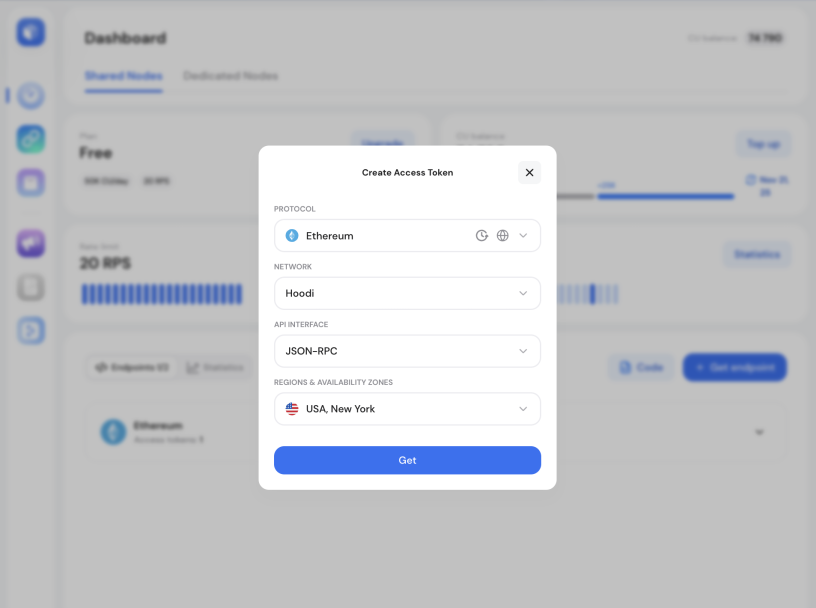
Our Shared Node service offers the most hassle-free way to connect to Hoodi. Simply sign in to your GetBlock dashboard and generate your Hoodi RPC endpoint:
From your GetBlock Dashboard → Get endpoint
Select Ethereum Hoodi
Choose a node server location (Frankfurt, New York, and Singapore)
Click Get to generate an endpoint and update your development environment to use this new Hoodi RPC URL
Hoodi’s Chain ID is 560048 (hex 0x88bb0). Confirm by calling eth_chainId on your new endpoint:
1
2
3
curl -X POST 'https://go.getblock.io/<ACCESS_TOKEN>/' \
  -H 'Content-Type: application/json' \
  -d '{"jsonrpc":"2.0","id":1,"method":"eth_chainId","params":[]}'
Note: Now is the perfect time to upgrade your infrastructure. Take advantage of GetBlock’s biggest sale of the year – get up to 60% off on Shared Node packages during our Black Friday event from November 24 to December 2, 2025.
Deploying Ethereum Hoodi nodes with GetBlock
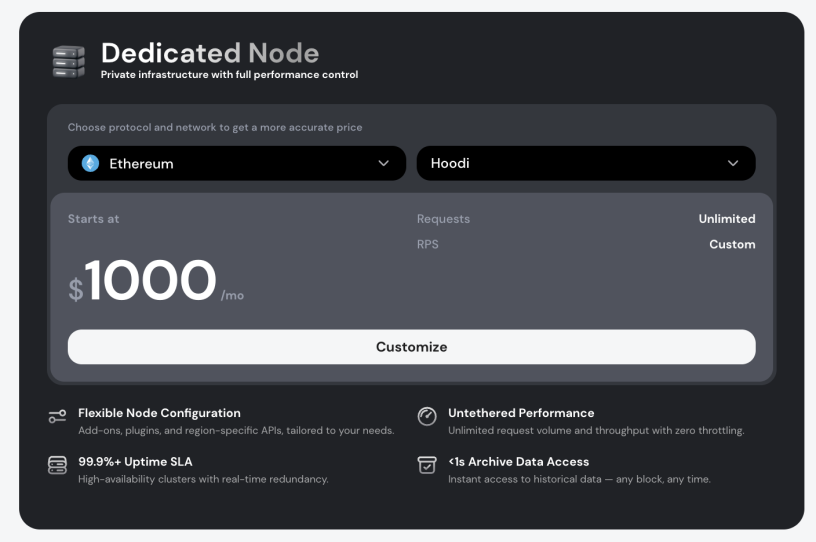
For customers that require precise control, dedicated resources, and tailored configurations, GetBlock offers Hoodi Dedicated Nodes:
Access the Dedicated Nodes tab from your account dashboard
Select Hoodi as your network and configure your node parameters
Submit your request and wait for the node provisioning
We know one size doesn’t fit all. So at GetBlock, we specialize in building custom node solutions that perfectly fit your project’s requirements, no matter how unique.
Talk to our team, and let’s build your ideal Ethereum infrastructure environment together.


Popular Posts

June 9, 2021
4 min read

November 9, 2021
5 min read

May 24, 2022
5 min read

March 18, 2021
4 min read


