
GetBlock February 2026 Dev Update: SOC 2 Type I, 2FA, CU Pricing Update, Add-ons Marketplace

GETBLOCK
March 4, 2026
8 min read
Hey folks, hope your February shipped a lot and only a little burned. We at GetBlock kept heads down on infrastructure, security, and did a pretty significant overhaul of Dedicated Nodes, including the launch of Add-ons Marketplace. Plus, Online Sessions kept going strong.
Here's what happened at GetBlock in February and what it means for our users.
TL;DR
GetBlock successfully completed a SOC 2 Type I audit
Dedicated Nodes got a full UX overhaul: new layout, updated configurator, and a more convenient add-ons management
CU pricing updated for certain chains
2FA is live inside your GetBlock accounts
Gradual rollout of our new API Gateway to production has started, providing better reliability and the foundation for new exciting products
Key node client updates bringing security fixes, performance improvements, and hardfork preps
4 Online Sessions held in February, plus a strong March lineup
The full breakdown below.
SOC 2 Type I: Passed
GetBlock has successfully completed its SOC 2 Type I audit with Atom Assurances.
SOC 2 Type I is an independent security audit that verifies a service organization's controls are properly designed to meet the Trust Service Criteria at a specific point in time. This covers areas like security, availability, and confidentiality of customer data.
We know that for teams evaluating infrastructure providers, compliance posture matters. This is part of us taking that seriously. SOC 2 Type II, which covers how controls perform over a sustained period, is currently in progress.
Dedicated Node updates: Add-ons, new UX
This was the biggest product push of the month. Dedicated Nodes got several updates that together make a pretty meaningful difference in how you manage things.
Reworked UI
The Dedicated Nodes area in your account has been rebuilt from the ground up.
Dedicated nodes now live on their own tab in the left-side menu. Each node gets its own page, giving quick access to:
Manage endpoints
View performance stats
(NEW) Enable or disable add-ons, and create endpoints to access the add-on’s services
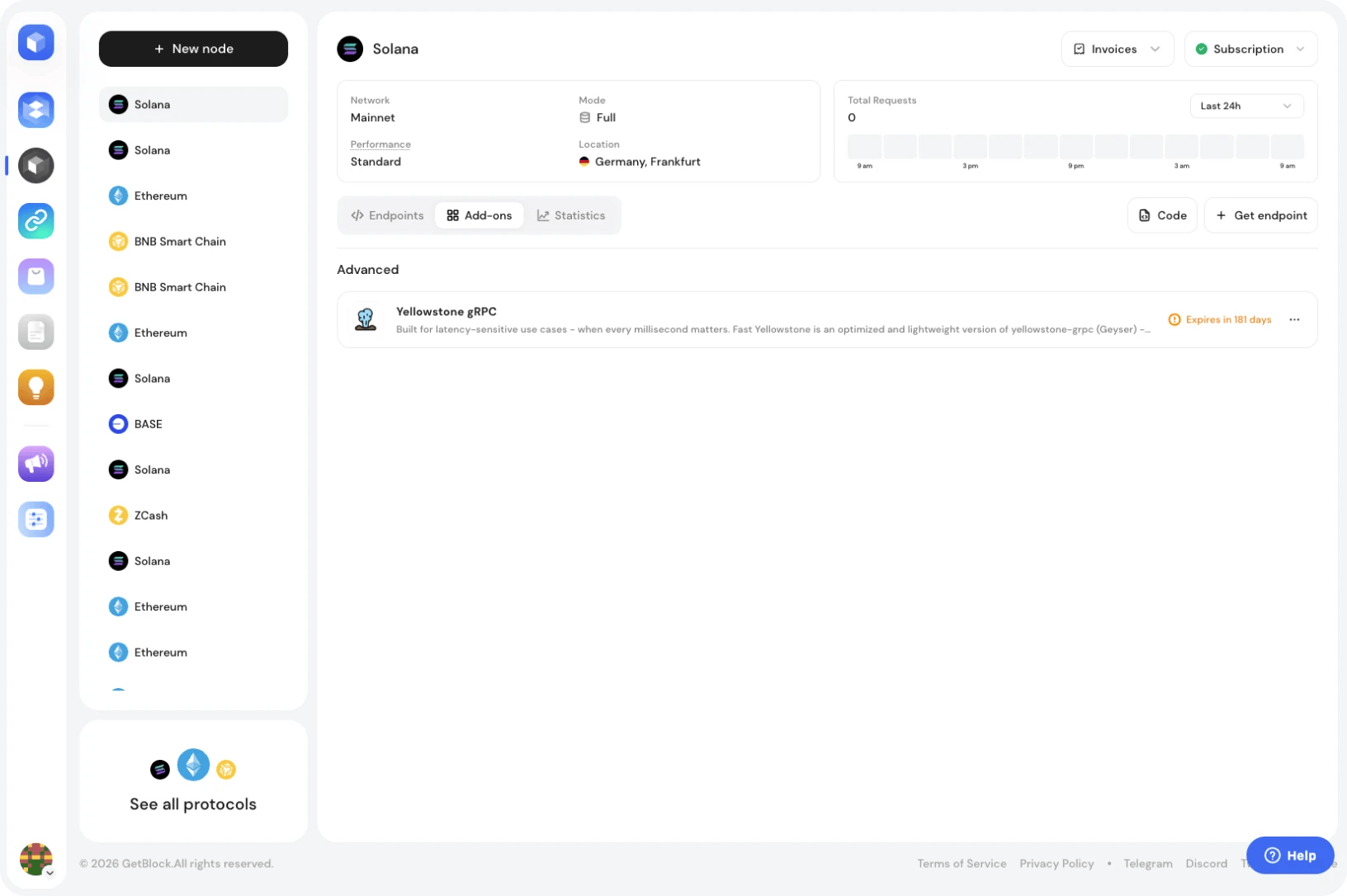
If you've got multiple nodes running, this alone makes life easier.
Updated node Configurator
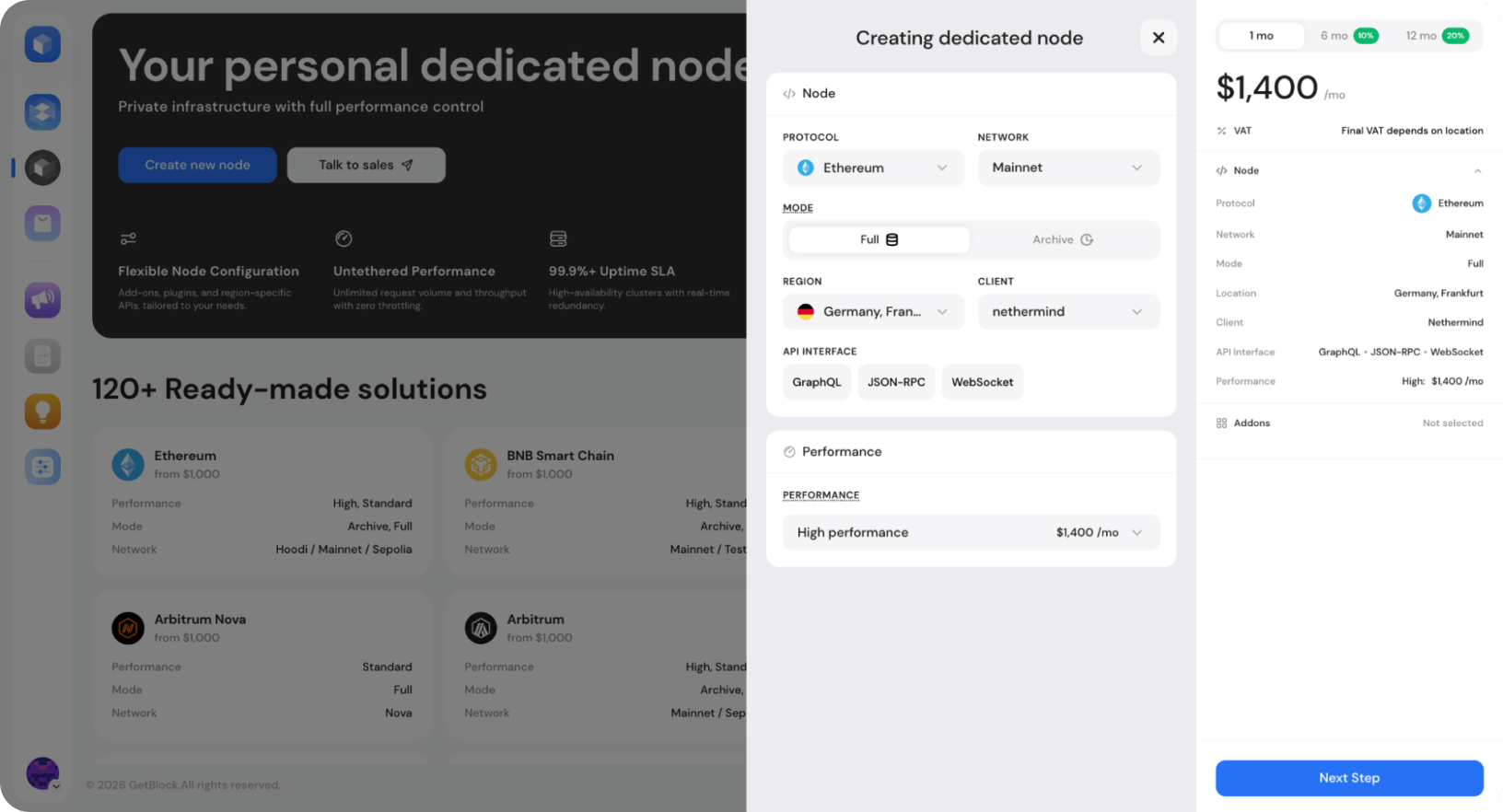
The new dedicated server deployment flow got a rework too:
We replaced the old multi-step node wizard with a single-screen configurator – every setting is visible at a glance.
The settings you know are the same – protocol, network, Full/Archive mode, deployment region, node client, API interfaces, and performance tier – we just put them on one panel so you can compare choices and finish setup faster.
The main upgrade: you can now select and buy add-ons directly from the configurator.
Addons Marketplace
This is the new one – we've launched an Add-ons Marketplace for dedicated nodes. Some add-ons that provide extra functionality on top of your node are available right now:
Bloxroute for BSC – for builders who need faster transaction propagation and block visibility on BNB Smart Chain
MEV Protection for ETH, BSC, and Base – shields your transactions from front-running and sandwich attacks
Yellowstone gRPC – low-latency gRPC streaming for Solana, built for apps that need real-time data at scale
Blockbook – address-level indexing for Bitcoin and similar chains, useful for wallets and explorers
You can either buy an add-on together with a new node or add it later to an existing subscription. Add-on charges are joined with the node subscription for one coherent bill.
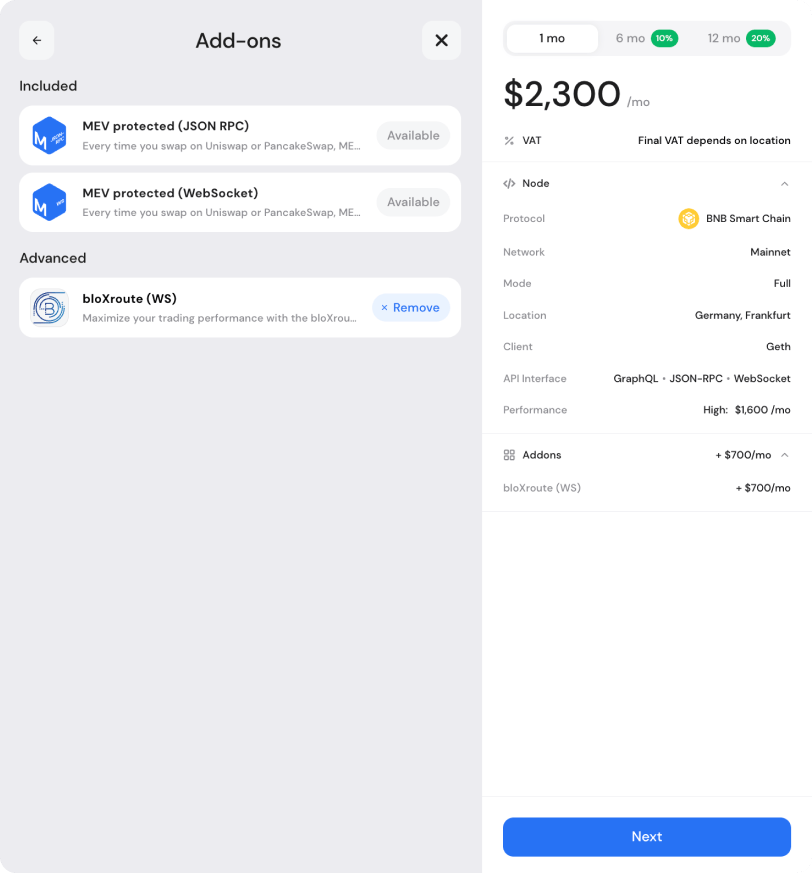
The marketplace is just getting started. We've got a solid pipeline of add-ons in development and plan to expand the catalog significantly over the coming months. So if there's something specific you'd want to see, let us know.
CU pricing update
Effective February 12, 2026, we recalibrated our Compute Unit (CU) costs for the Shared Node service.
The update applies only to select blockchain networks, including Arbitrum Nova, Immutable zkEVM, Zilliqa, Berachain, Monad, SEI, Ronin, Celo, Taiko, Flare, Stacks, Midnight, and IOTA, among others.
For those newer to GetBlock: Compute Units (CUs) are how we measure the actual resource consumption behind each RPC request. Different methods on different chains have different infrastructure costs. CUs let us price things based on real resource consumption rather than treating every request the same.
As chains evolve, the actual cost of serving them shifts. This update brings our CU pricing in line with where things stand today across the affected networks.
Take a minute to review the updated CU table for your chain to make sure your cost estimates are aligned. For a quick overview of CUs included in each Shared Node plan, see our pricing page.
Two-Factor Authentication (2FA) live
Pretty straightforward one – we added Two-Factor Authentication (2FA) to the dashboard to make account logins safer.
Haven't set it up yet? Go to Security Settings inside your dashboard, scan a QR code with your authenticator app (Google Authenticator, Authy, 1Password, whatever you use), save your recovery codes somewhere safe, and you're done.
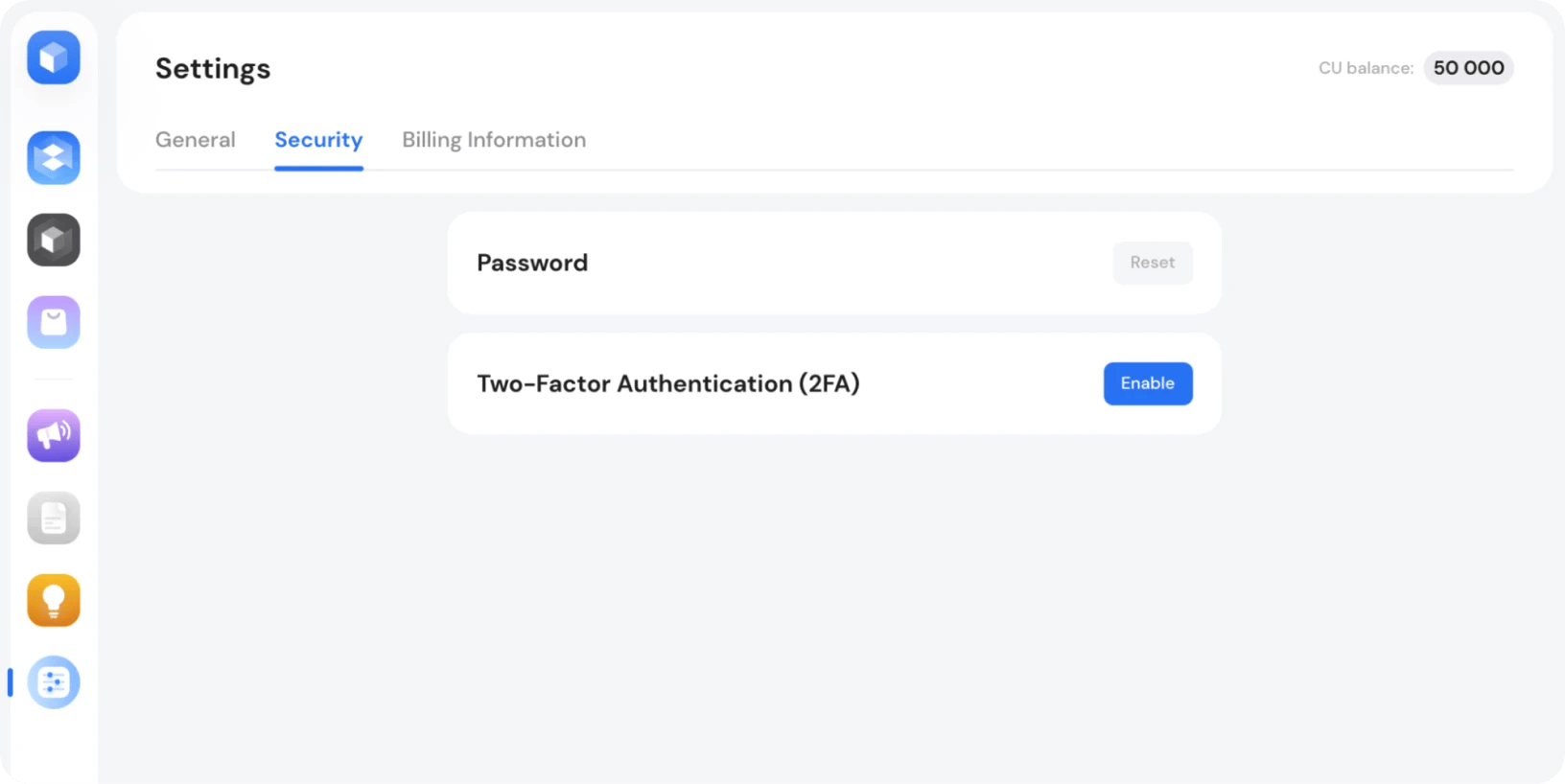
It's optional, but there's no good reason not to have it on.
API Gateway: Rolling out to production
This one is less flashy but probably worth understanding if you care about what's happening at the infrastructure level.
In February, we started a gradual rollout of a new API Gateway layer into our production environment. Think of it as the new traffic control center that sits between incoming RPC requests and our node infrastructure. It handles routing, rate limiting, billing logic, failover – all the plumbing that determines how a request gets from your app to the right node, reliably and efficiently.
Why does this matter? Because having that layer as a proper, flexible system opens up a lot of doors for what we can build on top of it. More intelligent failovers, better observability, and new product features. You won't notice much difference today, but this is the kind of foundational work that makes the next 6–12 months of product development possible.
Node updates
We keep a close eye on client releases across the networks we support. In the list below, we highlight some high-priority upgrades:
Polygon (Erigon v3.4.0 & Bor v2.6.0): Prepares for the Lisovo hardfork (block ~83756500, ~Mar 4, 2026); adds CLZ opcode, P256 gas updates, PIP-82 agentic gas program, dynamic EIP-1559 params
TRON (GreatVoyage-v4.8.1): Maintenance and efficiency improvements to Java-tron core, improved P2P rate limiting, new RPCs (e.g., eth_getBlockReceipts) and ARM/JDK17 support
Ethereum stack (geth v1.17.0 + reth v1.11.0): Security hotfixes in geth and major performance improvements in reth
Base (v0.14.7): Fix for an eth_subscribe regression (Flashblock transactions).
TON (core v2026.02‑1 + indexer v1.2.6 + http v2.0.64): Stability, performance, and indexing improvements; fixes memory leaks, speeds up candidate processing, and updates tooling for developers.
GetBlock Online Sessions: February recap
Earlier this year, we launched GetBlock Online Sessions – a recurring series of live events where we (and sometimes partners and guest speakers) cover topics relevant to Web3 developers, infrastructure teams, and anyone building in the space.
The format varies – technical deep-dives, panel discussions, recaps from industry events. The goal is pretty simple: make useful content accessible and give our team, partners, and builders a regular place to swap notes.
Throughout February, we ran and participated in four sessions:
How Stablecoins Made Crypto Functional – A look at why stablecoins aren't just a trading tool; they're infrastructure for businesses, DeFi protocols, and developers building payment or financial logic on-chain.
Thriving in Developer Relations: Lessons from a Woman in Tech – A candid session featuring our fabulous DevRel Ileolami on the challenges of working in Web3 and how to grow in the space.
Consensus Hong Kong: Virtual Recap & Team Insights – A virtual debrief from Consensus HK — what we saw, what stood out, and what it signals for crypto infrastructure in 2026 (Already available on GetBlock’s YouTube channel!)
Ethereum vs Solana Consensus: What's the Difference? – A proper technical breakdown of Ethereum's PoS versus Solana's hybrid PoH + PoS model; how they actually validate transactions, finalize blocks, and handle load.
Recaps, slides, and informal follow-ups happen in the GetBlock Telegram and X communities – worth joining if you're not in there already.
March 2026 lineup: How institutions integrate crypto & Hard lessons from production infra
Two sessions already on our Luma calendar. Both are worth your time.
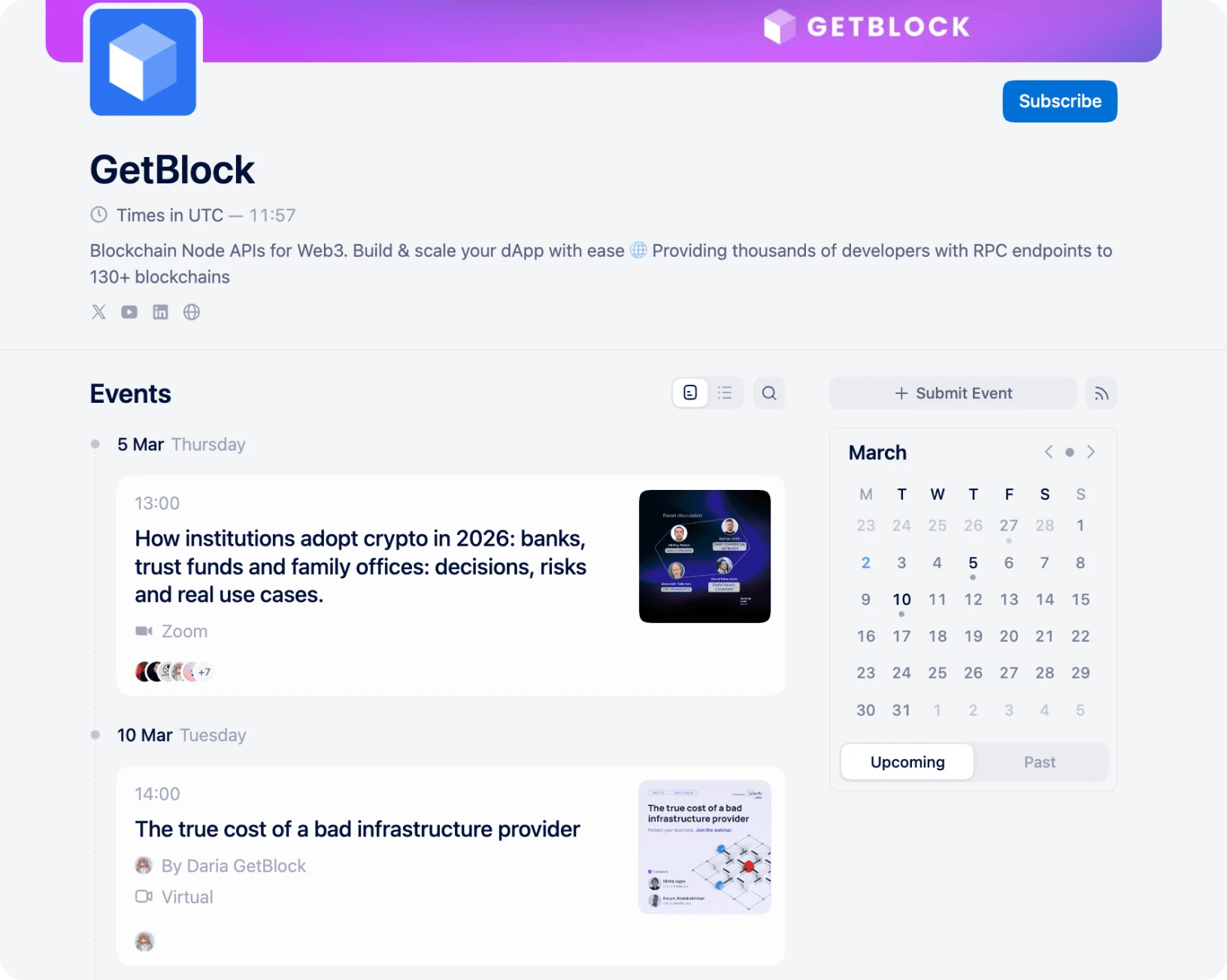
How Institutions Adopt Crypto in 2026
GetBlock CCO Roman Shtih joins a roundtable discussion with OQTACORE on how banks, investment funds, and family offices are actually integrating digital assets right now – what's working, what compliance hurdles look like in practice, and why some initiatives stall.
Date: Mar 5
Time: 1:00 pm (UTC)
Speakers: Dmitry Yelisov (CEO, OQTACORE), Alexander Seleznev (CEO, Pessimistic), David Kakauridze (Digital Asset Consultant), Roman Shtih (CCO, GetBlock)
Register: https://luma.com/qwiymse6
The True Cost of a Bad Infrastructure Provider
If you're running a crypto exchange, wallet, or DeFi app and you've ever dealt with latency spikes, unexpected downtime, or SLA disappointments. This session digs into what those actually cost, and what to look for when evaluating providers.
Date: Mar 10
Time: 2:00 pm (UTC)
Speakers: Karym Abdelrakhman (CEO, Simplify Labs) & Nikita Iugov (CTO, GetBlock)
Register at Simplify Labs event page
More sessions coming! Follow GetBlock on Luma, and you'll be the first to know.
Wrapping up
And that was February. We’ve got more infra work, product polish, and launches in the pipeline, so stay tuned. SOC 2 Type 1 audit completion is a particularly meaningful milestone for GetBlock and a baseline we plan to build on.
As always, questions, feedback, or feature requests – let us know via our Feedback portal or drop us a message through the contact form.
Ship safe,
– The GetBlock Team


Popular Posts

June 9, 2021
4 min read

November 9, 2021
5 min read

May 24, 2022
5 min read

March 18, 2021
4 min read


