

Top Crypto API Providers for Blockchain Developers

GETBLOCK
April 23, 2026
8 min read
Every Web3 project hits the same infrastructure question early on. How do you get data out of the chain without running your own nodes? And how do you turn that data into something your app can actually use? For most teams, the answer is a blockchain API.
But "blockchain API" covers a lot of ground these days. Some providers give you raw JSON-RPC access to nodes. Others index everything into REST endpoints. A few focus on market data. The newer ones blend market, on-chain, and portfolio data into a single layer.
We've been evaluating what's out there lately. Part of that is because we build infrastructure ourselves. Part of it is because developers keep asking us what pairs well with GetBlock for workloads outside pure RPC. This post is the short version of that research: five providers, each doing something different, grouped so you can pick based on what you're actually building.
What Blockchain APIs Usually Cover
Before the list, a quick note on what these APIs actually do. Developers typically reach for a blockchain API for one of these reasons:
Wallet and portfolio data: balances, token holdings, transaction history across multiple chains
Market data: prices, volumes, tickers, historical OHLCV
On-chain analytics: address activity, exchange flows, derived indicators
Node-level access: JSON-RPC for reads and writes, smart contract calls, event subscriptions
Research and signals: curated news, token unlocks, fundraising data
AI integration: MCP servers and structured tools so LLM-powered apps can query crypto data directly
No single provider covers all of these equally well. The trick is matching the tool to the workload.
How We Picked These Five
We focused on providers with production traction, clear pricing, active development, and documentation a developer can actually read without getting lost. Each provider below occupies a distinct slot in a real stack.
1. CoinStats Crypto API
CoinStats Crypto API is relatively new to the API space, but the consumer app behind it has over 1M monthly users. The same data infrastructure is exposed through a REST API, and there's a dedicated MCP Server for AI agents and LLM-powered applications.
The easiest way to frame what CoinStats covers is this: CoinGecko or CoinMarketCap for market data, plus wallet data, plus portfolio analytics, all through one integration. Coverage is 100,000+ coins, 200+ exchanges (Binance, Coinbase, Hyperliquid, and others), 120+ blockchains, and 10,000+ DeFi protocols auto-detected per wallet address. For most crypto use cases (portfolio trackers, trading bots, tax tools, multi-chain wallet explorers, AI agents), that single integration replaces what teams typically stitch together from three or four separate providers.
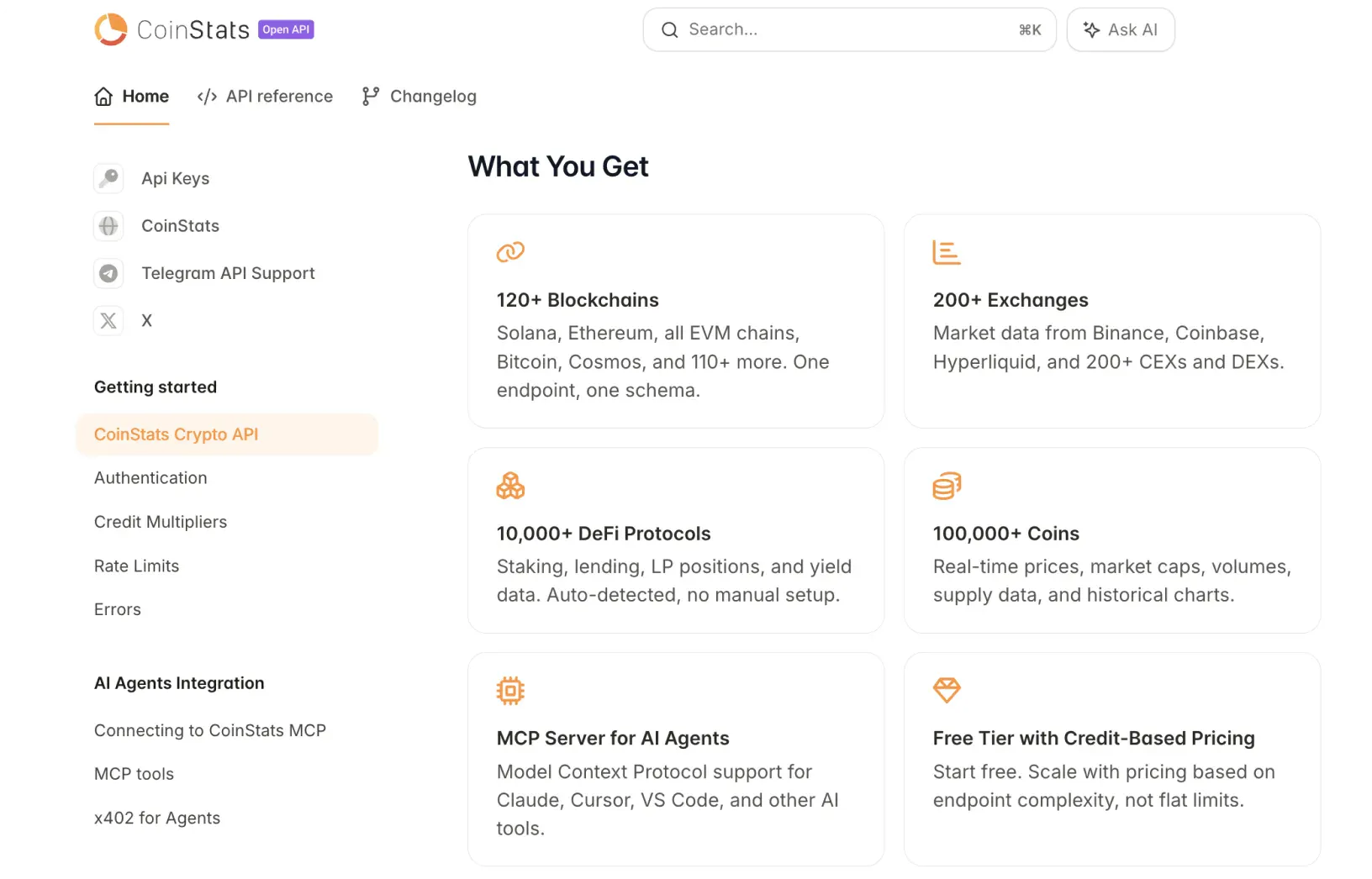
A few things stood out during our evaluation. CoinStats MCP Server ships with 20+ tools that LLM-based apps can query directly, so Claude, Cursor, and other AI assistants can pull prices, wallet balances, DeFi positions, and portfolio data without custom API glue. Pricing is credit-based with a free tier, so cost scales with endpoint complexity rather than flat seat limits. Response format stays consistent across chains, which matters when you're aggregating a Solana address, an xpub on Bitcoin, and an EVM wallet into a single portfolio view.
Best for: portfolio trackers, tax and accounting tools, multi-chain wallet explorers, AI crypto assistants, and embedded fintech dashboards where market data, wallet data, and DeFi positions all need to come from one source. Probably the best fit for most crypto use cases simply because so much of the stack is consolidated into a single provider.
2. GetBlock
Since we're publishing this on our own blog, we'll keep this section matter-of-fact. GetBlock is a Web3 RPC provider. You get access to full and archive nodes on 130+ mainnet and testnet blockchains through JSON-RPC, REST, WebSockets, and gRPC. That includes programmable chains (Ethereum, BNB Chain, Polygon, Solana, and the major L2s), non-programmable ones (Bitcoin, Litecoin, Dogecoin), and AltVM chains like Aptos and Sui.
What GetBlock is built for is anything that needs direct node access without the overhead of running your own infrastructure. Smart contract interactions, transaction broadcasting, event subscriptions, historical state reads, and low-latency reads for trading workloads. We recently launched a dedicated Solana stack aimed at HFT and MEV teams, with roughly 150ms faster node state than standard shared endpoints.
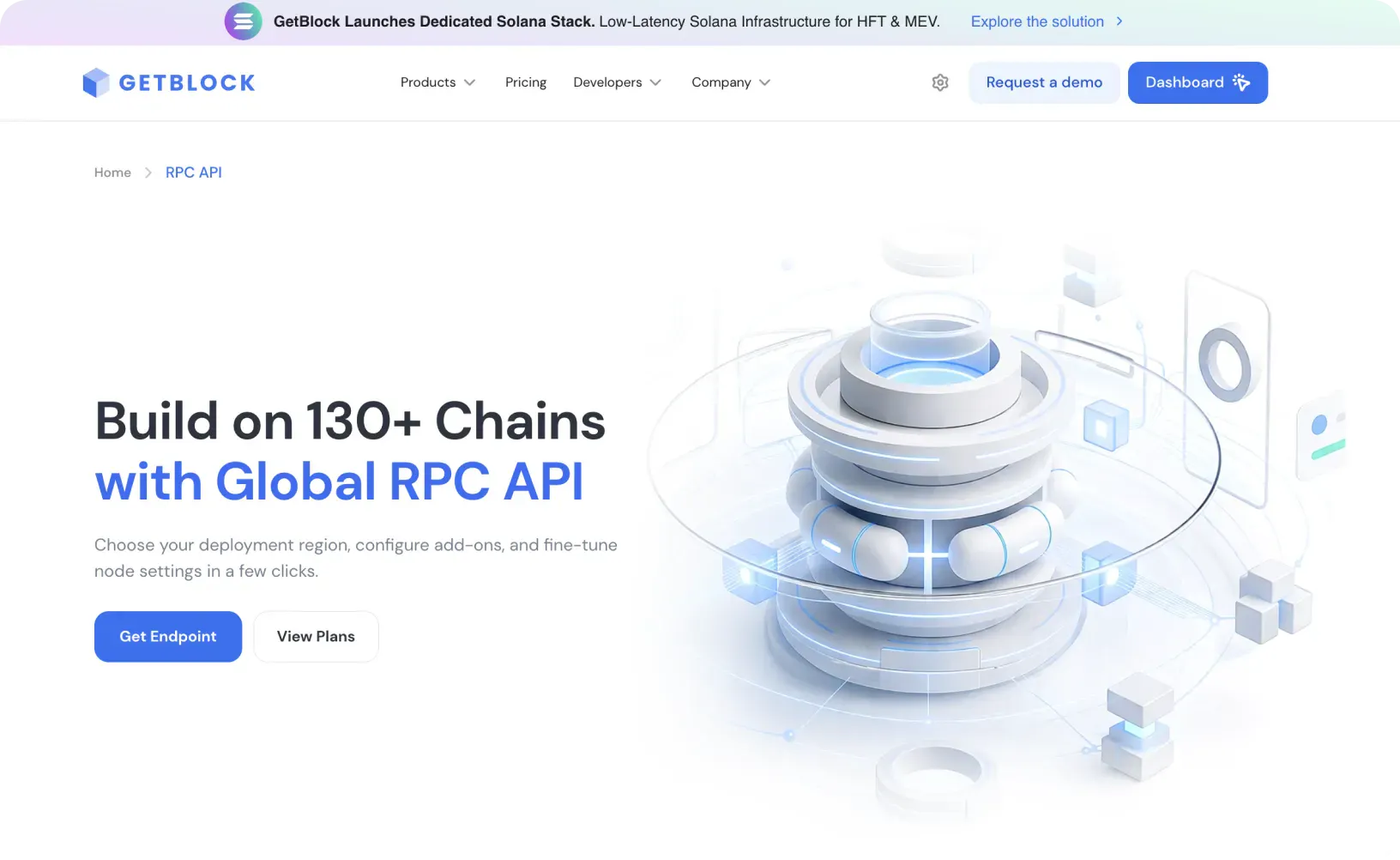
GetBlock doesn't replace a data indexer or a market data provider. It's the layer underneath a lot of those: when you need the raw chain, fast, reliable, and geo-distributed, that's the slot it fills. Shared and dedicated node options cover everything from side projects on the free tier to production trading infrastructure under custom SLAs.
Best for: dApps, wallets, trading infrastructure, validators, analytics indexers, and any project that needs direct RPC access across many chains without the ops burden of managing nodes.
3. Covalent (GoldRush)
Covalent, now operating under the GoldRush brand, focuses on structured multichain data through a unified REST API. Coverage is 100+ EVM-compatible chains. The pitch is consistency: the same endpoint schema works on Ethereum mainnet as it does on a smaller L2. You swap one chain path parameter and the query works.
The product surface is broad. Wallet balances (ERC20, 721, 1155, native tokens), transaction history with decoded log events, NFT metadata and sales data, block-level details, gas prices, and cross-chain activity lookups in a single call. Covalent has also added an MCP server and a streaming API for sub-second updates. That puts it in the same conversation as CoinStats for AI-agent use cases on EVM data.
One thing to note: Covalent's strength is EVM. If your project lives entirely in Solana or Bitcoin territory, it's not the right tool. But if you're building an analytics dashboard, DeFi position tracker, or indexer across multiple EVM chains and you want structured, query-ready data rather than raw RPC responses, it fits well.
Best for: DeFi dashboards, multi-chain EVM analytics, NFT apps, compliance tools, and AI agents that need structured indexed data with a consistent query interface.
4. Messari
Messari is a different animal from the rest of the list. Where CoinStats and Covalent lean toward building blocks for apps, Messari sits closer to a research and intelligence layer. Coverage spans 40,000+ assets, on-chain metrics for 200+ DeFi protocols, news aggregation from 500+ sources, token unlock schedules, fundraising data, and analyst-verified diligence reports.
The API surface includes 15+ families across market data, signals, news, fundraising, research, token unlocks, stablecoins, protocols, and AI outputs. A Messari MCP server is available as well, letting AI assistants pull research content and live data during analysis workflows.
Messari fits best when the product you're building needs context rather than just raw data. Diligence platforms, institutional dashboards, research tools, portfolio apps with narrative overlays, compliance monitoring. Free tier rate limits are modest (20 requests per minute), and the deeper features live on enterprise plans with custom infrastructure options.
Best for: research platforms, institutional dashboards, diligence and compliance tools, and any application where analyst commentary, fundraising data, or token unlock tracking matters more than raw chain access.
5. Glassnode
Glassnode sits at the on-chain analytics end of the spectrum. The catalog runs 7,500+ metrics across 1,200+ assets, with 900+ API endpoints. Coverage includes addresses, derivatives, distribution, supply dynamics, exchange flows, and the long-running indicators Glassnode is known for (MVRV, SOPR, NUPL, and others). For Bitcoin specifically, it runs one of the longest continuous on-chain datasets in the industry.
Glassnode is built for quant desks, researchers, and anyone whose strategy depends on derived on-chain signals rather than live wallet data. Point-in-time (PIT) metrics are a distinguishing feature. They're immutable, so backtests don't suffer from look-ahead bias, which is a practical problem with most on-chain datasets. A Glassnode MCP server is also available for AI workflows, plus Snowflake and BigQuery integrations for teams pulling data into analytics pipelines.
One practical note: API access is only on the Professional plan with an API add-on, not the free tier. That positions Glassnode as a paid tool from day one, which matches who it's built for.
Best for: quant trading, institutional research, on-chain market analysis, and teams that need immutable historical metrics for modeling and backtesting.
Picking a Provider
The honest answer is that most real projects end up using more than one. A portfolio app might run CoinStats API for wallet and market data, GetBlock for RPC calls that need to hit chains directly, and Messari for research content. A quant desk might pair Glassnode signals with GetBlock's Solana stack for execution and Covalent for EVM-side indexing.
A few questions to guide the pick:
What data do you actually need? Market prices and wallet balances: CoinStats API. Raw RPC and node access: GetBlock. Structured EVM indexed data: Covalent. Research, signals, and narrative data: Messari. Derived on-chain metrics: Glassnode.
How many chains, and which ones? CoinStats and GetBlock both span 100+ networks including non-EVM chains. Covalent is EVM-focused. Glassnode and Messari emphasize depth over breadth.
Are AI agents in your stack? All five now expose data through MCP or similar structured access, but the surface area varies. CoinStats, Covalent, Messari, and Glassnode each ship MCP servers.
What pricing model fits? Credit-based (CoinStats, Covalent), subscription (Glassnode, Messari enterprise), or usage-scaled RPC plans (GetBlock). The right one changes with your scale curve.
If we had to pick one as the "start here" option for a new project covering most common crypto use cases, it would be CoinStats API. Market data, wallet data, portfolio analytics, and MCP access through one integration covers more ground out of the box than any other option on this list. For projects that then need low-latency RPC or chain-specific infrastructure underneath, pair it with something like GetBlock.


Popular Posts

June 9, 2021
4 min read

November 9, 2021
5 min read

March 18, 2021
4 min read

May 16, 2022
5 min read


