
Monad Mainnet Live – GetBlock Launches Monad RPC Nodes for Builders

GETBLOCK
December 3, 2025
5 min read
Monad’s long-anticipated public mainnet went live on November 24, 2025, bringing unprecedented scalability and user experience to EVM-compatible apps. GetBlock, a multi-chain Web3 RPC infrastructure provider, steps in to deliver seamless Monad API access.
Low-latency Monad endpoints and private enterprise-grade node deployment are now available across our global RPC network. Developers can start building on Monad today with plug-and-play access, no node operations required.
TL;DR:
GetBlock expands its competitive multi-chain RPC portfolio with Monad, a new leading-edge blockchain.
GetBlock adds Monad Mainnet and Testnet support via JSON-RPC and WebSocket APIs served from Frankfurt, New York, and Singapore.
Reliable access to the Monad blockchain is available through both Shared Nodes and Dedicated Nodes services.
Monad API live: Start free with ready-to-use endpoints, deploy a private dedicated Monad node, or contact our sales team for white-glove onboarding and hands-on engineering support.
GetBlock delivers Monad RPC access – Fast, scalable infrastructure for builders
GetBlock starts providing access to a low-latency, globally distributed Monad RPC node infrastructure, bringing developers easy access to one of the most scalable EVM-compatible chains.
Two types of RPC services are available to match Monad’s breakthrough scalability with consistent performance and minimal latency:
Monad RPC endpoints (Shared Nodes): Access to Monad’s blockchain via production-grade JSON-RPC and WebSocket APIs, generated instantly on GetBlock’s dashboard; available from the free tier.
Dedicated Monad nodes: Isolated full node instances with custom service level agreements and highest throughput capabilities (1000+ RPS) – enterprise-grade infrastructure tailored for large-scale DeFi protocols, NFT and gaming platforms.
Here’s a closer look at the specific features and configurations:
Supported networks: Monad Mainnet & Testnet
Node mode: Full Monad nodes for reliable RPC queries and transaction broadcasting
Supported APIs: JSON-RPC and WebSocket interfaces
Global infrastructure: Nodes are deployed in Frankfurt, New York, and Singapore for low-latency access in key regions
Quick onboarding: Plug & play Shared Node endpoints and dedicated Monad nodes tuned and provisioned directly from the dashboard
GetBlock’s Monad integration removes typical infrastructure hurdles, allowing developers to focus on building without the extra step of running and maintaining their own nodes.
Get connected to a Monad RPC node in 4 simple steps
If you’re new to GetBlock, just sign up on our website and get immediate access to Monad API via our Shared Node service. Quick setup steps:
Navigate to the dashboard → Get endpoint
Select Monad (Mainnet or Testnet)
Choose the server location (Frankfurt, New York, or Singapore)
Generate your Monad node endpoint – JSON-RPC or WebSocket URLs
The endpoint is active and ready to connect to Monad's blockchain.
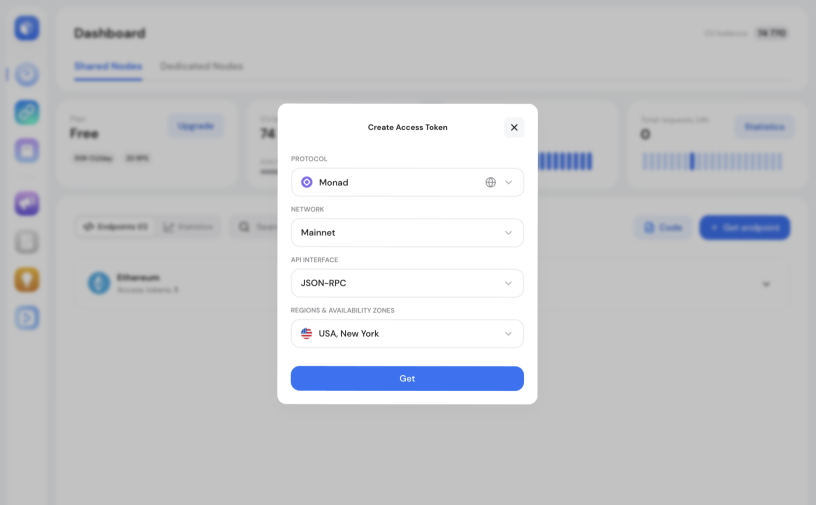
GetBlock’s Shared Nodes offer flexible plans to fit every development stage – from Free, Starter, Advanced, Pro to Enterprise tiers, providing increasingly higher throughput. This allows easy scaling as your app grows.
Take advantage of our Black Friday sale while it lasts – save up to 60% on GetBlock’s Shared Node plans through December 7.
Scale with Dedicated: Deploy a private Monad node
For projects requiring access to the best-performing Monad RPC infrastructure, GetBlock offers Dedicated Nodes. Request and tune a dedicated Monad node from the same dashboard:
Switch to the Dedicated Node tab and select the Monad blockchain
Specify the network, a preferred deployment region, and throughput needs
GetBlock provisions a separate full node instance for you
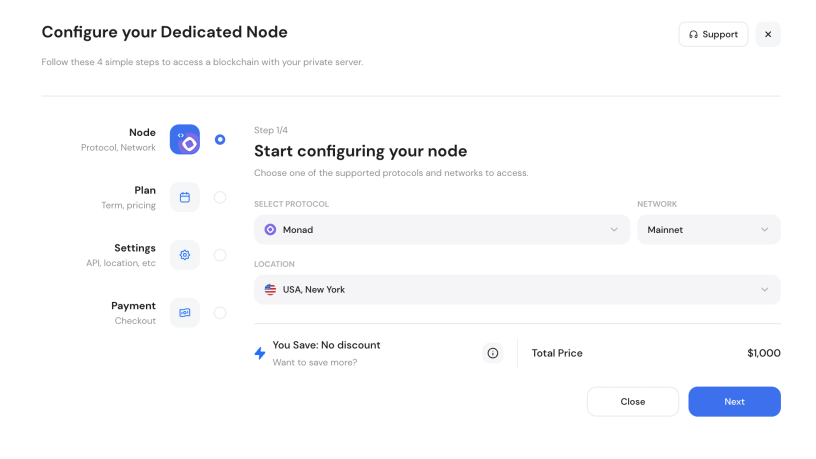
For custom configs, SLA details, or volume pricing, send your request directly via the contact form. We’ll work with you on configuring your instance to exact requirements
What is Monad blockchain? L1 EVM chain for extreme scale
Monad is a next-generation, Ethereum-compatible Layer-1 (L1) blockchain designed to achieve breakthrough scalability without compromising on decentralization or security.
The newly launched blockchain is receiving attention for its performance without trade-offs, powered by innovations like:
MonadBFT consensus – an optimized Byzantine Fault Tolerant protocol that ensures fast, secure finality;
RaptorCast, a novel block propagation protocol that speeds up synchronization between validators;
MonadDB, its custom-built storage engine – another pillar of performance, enabling fast access to blockchain state.
This architecture, along with optimistic parallel execution, enables high throughput with a target 10,000 TPS at sub-second finality, making it one of the most performant EVM chains available today.
Officially launched with its public mainnet on November 24, 2025, the ecosystem is already buzzing with a vibrant community and projects leveraging Monad’s unique capabilities. Most notable use cases include high-frequency and onchain trading platforms featuring real-time order books and apps demanding speed and responsiveness.
Commenting on Monad's debut at GetBlock, CEO Vasily Rudomanov indicates the key unique specifications of the new chain:
Surrounded by strong hype, Monad also excels in tech architecture ambitions. While being 100% EVM compatible, it targets 10,000 TPS and 0.4s block time with parallel execution and custom MonadDB. From the very beginning, Monad is available to Shared and Dedicated Node users at GetBlock, while region-specific endpoints route requests to Singapore, Frankfurt, and New York. All Monad RPC users are welcome at GetBlock.
Vasily Rudomanov — CEO, GetBlock
Monad is still in an early-stage blockchain, but with an ambitious vision to become the foundation for the next wave of groundbreaking decentralized applications.
Joining Monad now means participating in the forefront of blockchain innovation – start with GetBlock’s RPC service backing you every step of the way.


Popular Posts

June 9, 2021
4 min read

November 9, 2021
5 min read

May 24, 2022
5 min read

March 18, 2021
4 min read


