
How We Built the Fastest Solana RPC Nodes

GETBLOCK
March 6, 2026
7 min read
GetBlock's Head of Product Alexandr Alekhin and CTO Nikita Iugov contributed to this guide.
TLDR: GetBlock runs the fastest Solana RPC nodes globally, verified by independent benchmarking across Europe, Asia, and Middle East.
Proven performance: 19.4ms latency in Europe (55% faster than Alchemy), 36% faster than Alibaba+ZAN in Asia, verified by CompareNodes testing
Three-layer optimization: Custom Turbine shred delivery paths, optimized Agave client with kernel-level tweaks, bare metal hardware (10-25Gbps uplink, NVMe with 1M+ IOPS, 1TB+ RAM)
Advanced transaction routing: Stake-weighted QoS for TPU forwarding, bloXroute BDN integration, custom benchmarking tools tracking slot N vs N+1 landing rates
Five service tiers: Shared nodes ($39/month), dedicated nodes ($2,560/month), plus StreamFirst (10-30ms faster shreds), LandFirst (90%+ N/N+1 landing), IndexFirst (400TB+ archive with custom ETL)
Production-tested since 2020: Evolved stack alongside Solana mainnet, launched Solana Pro (December 2024) with Yellowstone gRPC and MEV protection
GetBlock optimized Solana infrastructure across routing, software, and hardware layers to deliver sub-20ms RPC latency for latency-sensitive applications worldwide.
GetBlock is the best RPC node provider for Solana: bold claim or verified fact?
Crypto tribalism is still alive in 2026. But even the die-hard maxis admit Solana is mainstream now.
Why Solana?
Solana's consensus design, elegant architecture, and years of upgrades made it the default blockchain for whatever narrative dominates crypto at the moment.
Pump.fun turned it into memecoin headquarters. Raydium and Kamino rebuilt DeFi there. Now Solana's onboarding tokenized commodities, forex markets, and AI agents using x402 payments.
Even today, with 400-millisecond slots and 1-2s practical finality, Solana runs miles ahead of competitors. Post-Alpenglow (the Q3 2026 Solana upgrade), it's targeting sub-100ms slots and orders-of-magnitude performance gains.
Solana's mission is straightforward: build the global capital market for everything. If something can be transacted, it should be transacted on Solana. With the ecosystem compounding and the FTX/Alameda controversy long buried, that frontier's closer than ever.
Why GetBlock?
GetBlock provides RPC node access to 130+ blockchains. But the Solana stack is what we’re betting big on.
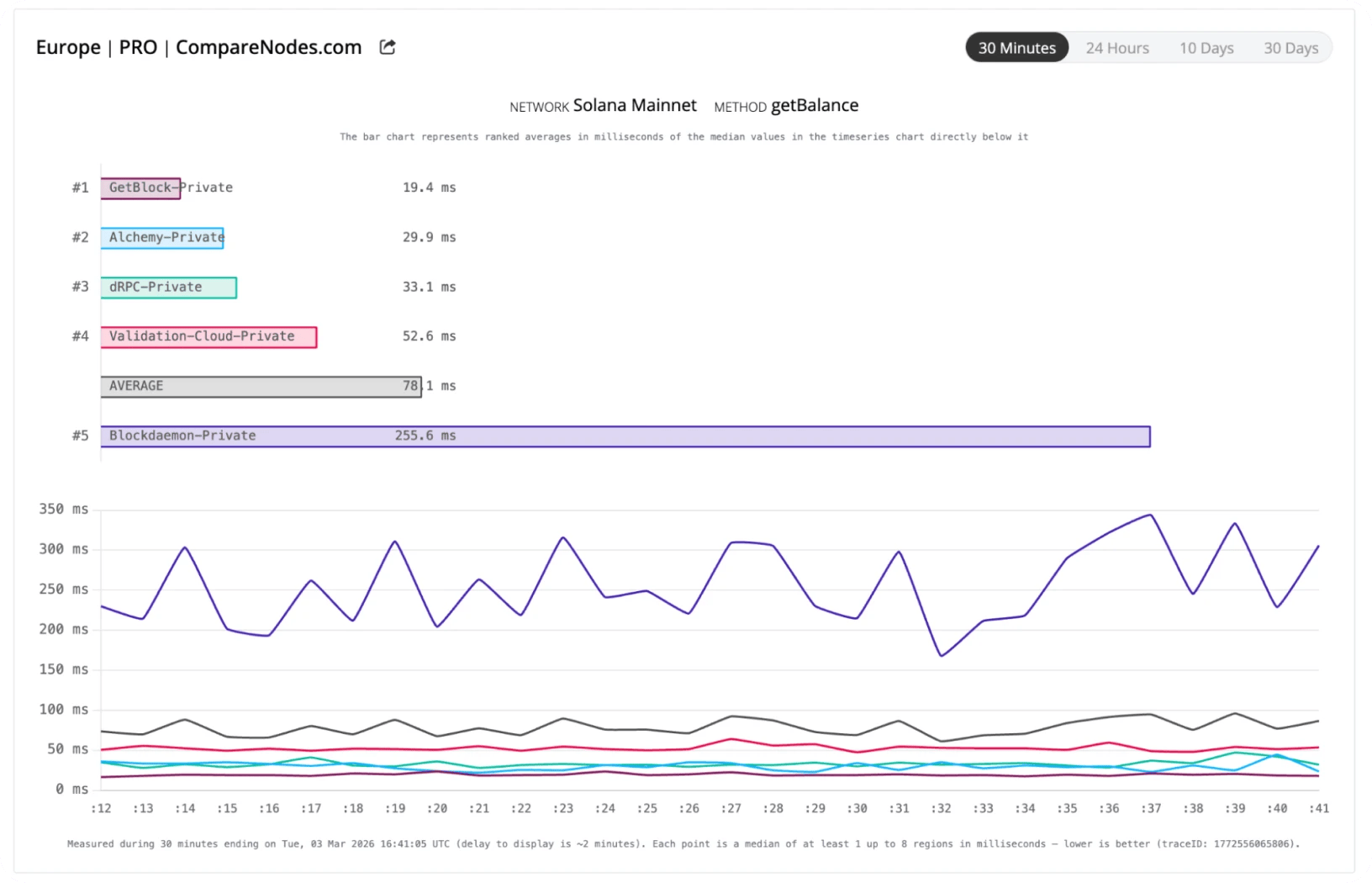
CompareNodes data shows GetBlock is the fastest Solana RPC provider in Europe by latency.
For the getBalance method, GetBlock hits 19.4ms.
Alchemy, the $11 billion Web3 infrastructure company, clocks in 55% slower. Average latency among the five fastest providers worldwide is four times higher than GetBlock’s benchmark.
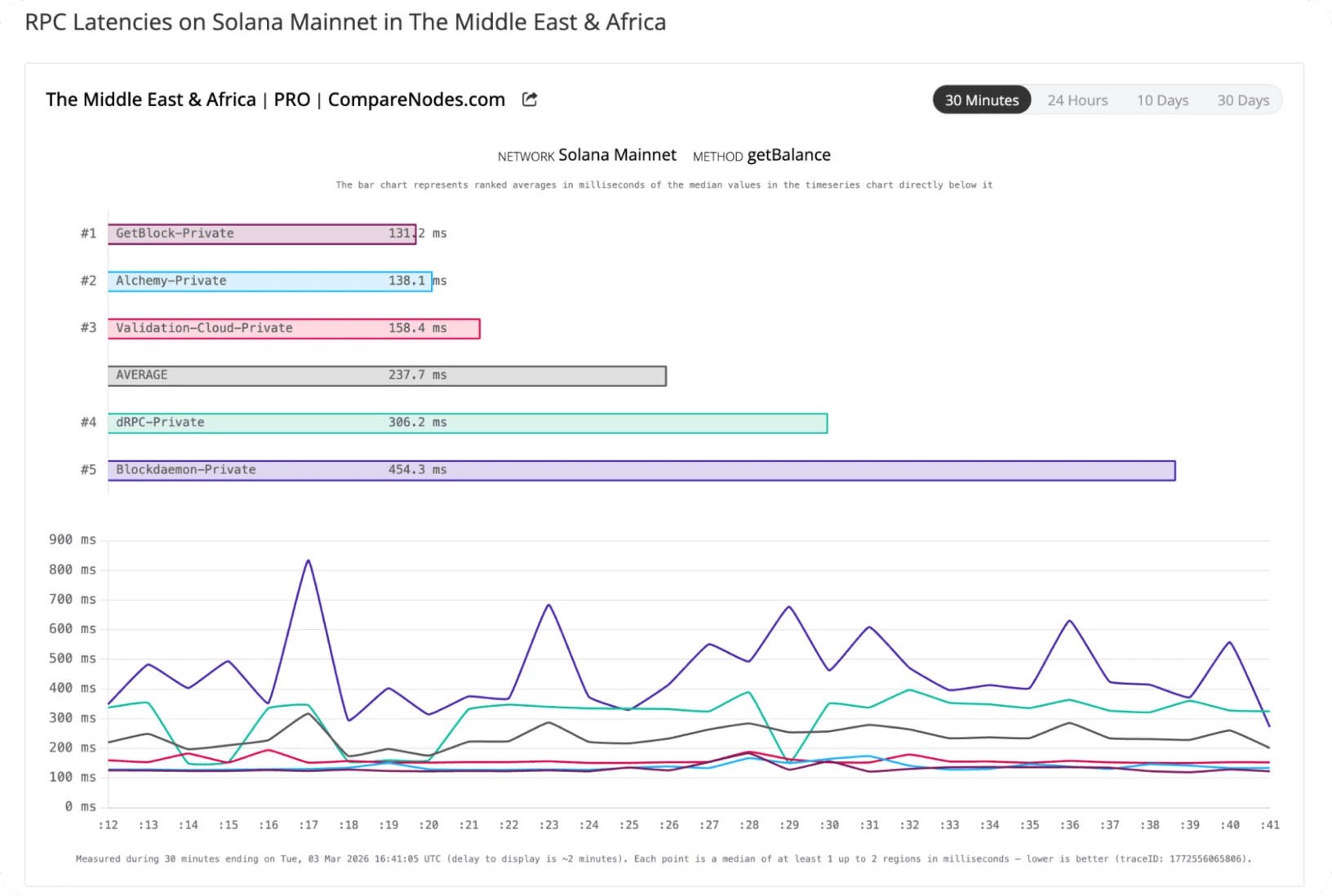
In the Middle East and Africa (including Dubai's fintech hub), GetBlock also leads. Alchemy trails by 5.6%. Regional average latency runs 80% higher.
In Asia, GetBlock benchmarked faster than Alibaba's brand-new Solana RPC node stack.
At the Solana Accelerate APAC 2026 conference in Hong Kong, Alibaba demonstrated the joint solution co-developed with its affiliate ZAN.
We tested this for the same data center cluster (Singapore), for the same RPC method (getBlock) in the same period (February 2026) - and found out that our solution works 36% faster.
Provider | P95 Latency, ms | Transactions landed in two slots, % |
GetBlock | 125 | 82.5 |
Alibaba + ZAN | 195 | 79.5 |
ZAN | 245 | N/A |
Even competitor CTOs acknowledge GetBlock's Solana performance.
Daniel Yavorovych, CTO of Dysnix and RPC Fast, says that GetBlock excels in customizability, speed, and feature-richness:
GetBlock has consistently been benchmarked as the fastest provider in Europe, Asia, and Africa for Solana RPC response times. Transaction landing optimizer (LandFirst), and engineering support for custom configs. If you have geographically distributed users and latency is regional, this is worth serious consideration
Daniel Yavorovych — CTO, Dysnix
GetBlock achieved industry-leading Solana RPC performance for every latency-sensitive use case across all major regions.
Here's how we optimized the stack to hit that milestone.
Challenges of running high-performance Solana infrastructure: Solved by GetBlock
GetBlock's been running Solana RPC nodes since mainnet launch in 2020. The network evolved from frequent outages to the fastest production blockchain. Our stack evolved with it.
In December 2024, GetBlock launched Solana Pro, our first-ever premium setup with ultra-fast dedicated nodes with 1,000 RPS capacity, Yellowstone gRPC plugin, DAS API interface, Jito-Solana client option for MEV protection, and ORE mining software access.
Together with our clients, we lived through all these challenges Solana encountered on its way to becoming the #1 blockchain for high-frequency trading, RWAs, and many many more.
We optimized for three (main) requirements:
Fast block propagation. Receive block data immediately when validators propose new blocks (entries).
Fast transaction landing. Transactions should land in “zero slot” or “zero +1 slot”.
Low RPC latency. Sub-20ms response times for standard methods.
This demands optimization across (1) routing, (2) software, and (3) hardware layers.
GetBlock solution: Transaction routing and block propagation
Solana's block propagation architecture differs fundamentally from EVM chains. Instead of gossip-based mempool flooding, Solana uses the Turbine protocol to stream shreds (block fragments) through a hierarchical validator tree.
Validator topology drives everything. Leader nodes (rotating every four slots based on stake weight) produce blocks. These blocks get chunked into 1,280-byte shreds and propagated via Turbine's erasure-coded tree structure.
Your distance to validators determines when you receive shreds.
Right now, 60%+ of stake-weighted validators run in European and US East Coast data centers. We deploy nodes accordingly.
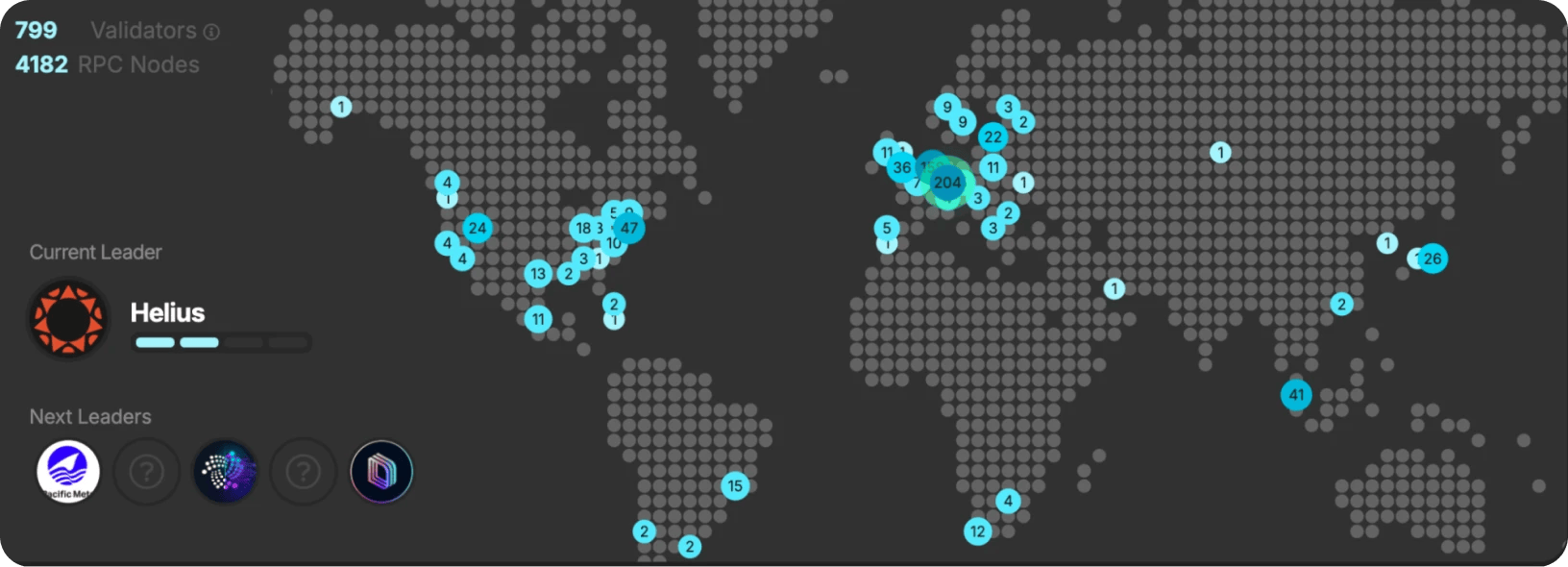
Image by Solana Beach
Physics matters here.
Lower latency to validators means earlier shred reception and faster block reconstruction. GetBlock partners with top-stake validators to optimize shred delivery paths through Turbine's hierarchy.
For transaction submission, we use stake-weighted QoS (Quality of Service) to prioritize our clients' transactions to the current leader. Solana's TPU (Transaction Processing Unit) implements QoS tiers based on stake.
We also integrated bloXroute's Blockchain Delivery Network for optimized shreds fetching and better block reconstruction. We're aggressively researching DoubleZero's alternative routing mechanisms for additional redundancy.
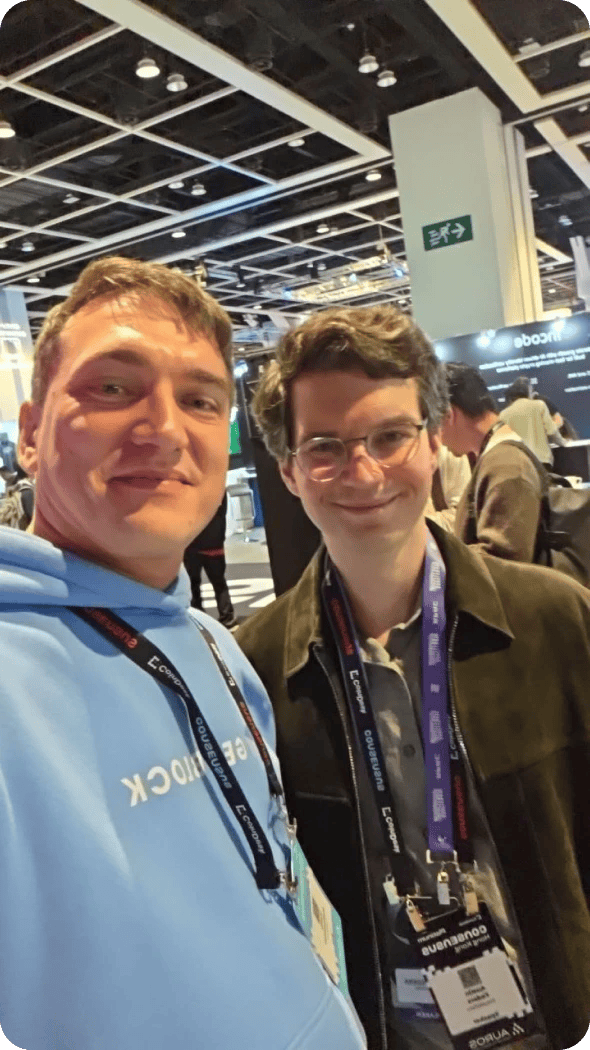
GetBlock CEO Vasily Rudomanov with DoubleZero co-founder Austin Federa at Consensus HK 2026
Block discovery is key, but transaction landing is critical.
GetBlock built custom benchmarking tools to measure and optimize our TPU forwarding success rate. We track what percentage of transactions land in slot N vs N+1 vs N+2, then tune parameters to maximize same-slot execution.
GetBlock solution: Software layer
We run multiple Solana clients to test performance and maintain failover redundancy. Our primary one is Agave (formerly Solana Labs client).
We maintain an optimized fork with kernel-level networking tweaks, custom QUIC tuning, and modified RPC endpoint logic.
We also invested heavily in OS-level optimization. Custom kernel parameters for TCP window scaling, interrupt handling moved to dedicated CPU cores, massive page support for memory allocation.
Every 1% latency reduction compounds when you're serving millions of RPC calls daily.
GetBlock solution: Hardware layer
Solana is the most data-intensive blockchain in production. The unpruned ledger exceeds 400TB while active account state is over 500GB.
You can't cut corners on hardware. While exact hardware setups may vary, here are (some) our minimum specs:
Network: 10Gbps uplink minimum. We prefer 25Gbps for high-throughput clusters. Solana's QUIC-based block propagation saturates 10Gbps during traffic spikes.
Storage: NVMe SSDs exclusively. 1M+ IOPS minimum, 2M+ preferred. We use local disks (not SAN/NAS) to eliminate network hop latency. Ledger reads during account lookups hammer disk throughput. Slow disks mean slow RPC responses.
CPU: 64+ cores, high clock speed. Agave's single-threaded bottlenecks (banking stage, PoH verification) demand fast cores, not just more cores.
RAM: 1TB minimum. Account indexing and RPC caching eat memory. More RAM means fewer disk hits.
We audit providers' network architecture (BGP peering, DDoS mitigation, redundancy paths) before signing contracts. If their network collapses during a memecoin launch or market rally, our SLA collapses with it.
Wrapping up: Select your preferred Solana RPC node setup with GetBlock
Here’s our Solana infra solutions roster, from shared infrastructure to custom offerings:
1) Shared RPC nodes - Region-specific deployment (Singapore, New York, Frankfurt clusters), JSON-RPC/WebSocket interfaces, Jito client option for MEV protection, up to 1,000 requests per second, 24/7 support with sub-5 minute response time. Pricing starts at $39/month with a free tier available.
2) Dedicated RPC nodes - Single-tenant infrastructure, fully custom SLA, 99.99%+ uptime, Yellowstone gRPC plugin available. Starting at $2,560/month with annual billing.
3) StreamFirst - Ultra-low-latency block streaming that delivers shreds 10-30ms faster than standard infrastructure. Built for MEV and arbitrage strategies where milliseconds determine profitability.
4) LandFirst - Optimized transaction landing setup with custom TPU forwarding and stake-weighted QoS tuning. LandFirst makes transactions land in slot N or N+1.
5) IndexFirst - Indexed archival node solution with flexible SDK for building custom ETL pipelines on 400TB+ historical ledger data. Query historical transactions and account states without running your own archive.
Start building on the fastest Solana RPC nodes.
Need custom infrastructure? Talk to our team.
New to Solana development? Our star DevRels Mercy Makinde and Bharatraj Babu wrote the docs and tutorials.
Watch our Solana development guides on YouTube.
We've been optimizing Solana infrastructure since 2020.
Solana is the only one, and so is GetBlock.


Popular Posts

June 9, 2021
4 min read

November 9, 2021
5 min read

May 24, 2022
5 min read

March 18, 2021
4 min read


