

How To Build a Base Flashblocks Listener

GETBLOCK
February 9, 2026
8 min read
Two seconds doesn't sound like a long time. Until you're waiting for a swap to confirm while the price moves against you. Or watching a trading bot miss an arbitrage opportunity because it couldn't confirm fast enough. Or building a game where every action feels sluggish.
In this guide, GetBlock demonstrates how Base Flashblocks cut confirmation times to 200 milliseconds and how you can build trading applications around this ultra-fast data stream.
TL;DR
Usually, layer 2 block times create friction for time-sensitive applications. Waiting 2 seconds for confirmation is too slow for trading bots, real-time games, and DeFi protocols where milliseconds determine profit or loss.
Here's what you need to know:
Base Flashblocks are sub-blocks streamed every 200 milliseconds, providing 10x faster confirmations than standard 2-second blocks.
Developed with Flashbots and launched on Base Mainnet in July 2025, Flashblocks deliver preconfirmations: ultra-fast signals that arrive before the full block is sealed.
Once a Flashblock is broadcast, its transaction ordering is locked. No more front-running from later transactions with higher fees.
In 2026, developers can stream real-time blockchain data with sub-second latency, enabling trading bots, monitoring tools, and applications that simply weren't practical before.
Let's explore how this works and why it matters for your next project.
The Speed Problem: Why 2 Seconds Is Too Slow
On Ethereum Layer 2 networks like Base, blocks are produced every 2 seconds. That's already faster than Ethereum's 12-second blocks. But for certain applications, it's still not fast enough.
These are reasons it’s still not fast for some applications:
Trading bots miss opportunities. An arbitrage window opens and closes in milliseconds. By the time your transaction confirms, the opportunity is gone. Or worse, someone else took it.
User experience suffers. Click a button, wait two seconds, and hope it worked. That's not the instant feedback users expect in 2026.
Front-running remains possible. In those 2 seconds before a block is sealed, transactions with higher priority fees can jump ahead of yours. Your swap gets sandwiched. Your trade executes at a worse price.
Real-time applications feel broken. Games, live auctions, and interactive DeFi protocols need instant feedback. A 2-second delay makes everything feel unresponsive.
The result? Developers either accept these limitations or build increasingly complex workarounds. Neither option is great.
Ready to access blockchain data with flexible pricing? Sign up for GetBlock and start building with our RPC endpoints today.
Flashblocks: Sub-Second Confirmations for Base
Do you remember when Base announced they were making the chain 10x faster? This is how they did it.
Flashblocks are sub-blocks streamed every 200 milliseconds. Instead of waiting for a full 2-second block, you get 10 smaller updates within that window. Each Flashblock contains roughly 10% of the transactions (by gas) that will eventually make up the full block.
You can liken this to the difference between batch processing and streaming. Traditional blocks batch everything together and confirm at once. Flashblocks stream updates as they happen.
How Flashblocks work
The flow is straightforward:
Transaction submitted: Your transaction enters the mempool.
Flashblock created: Every 200ms, the block builder creates a Flashblock containing pending transactions.
Preconfirmation delivered: The Flashblock is streamed to nodes. You get confirmation that your transaction is included.
Full-block sealed: After 10 Flashblocks (2 seconds), the entire block is finalized and submitted to the Ethereum L1.
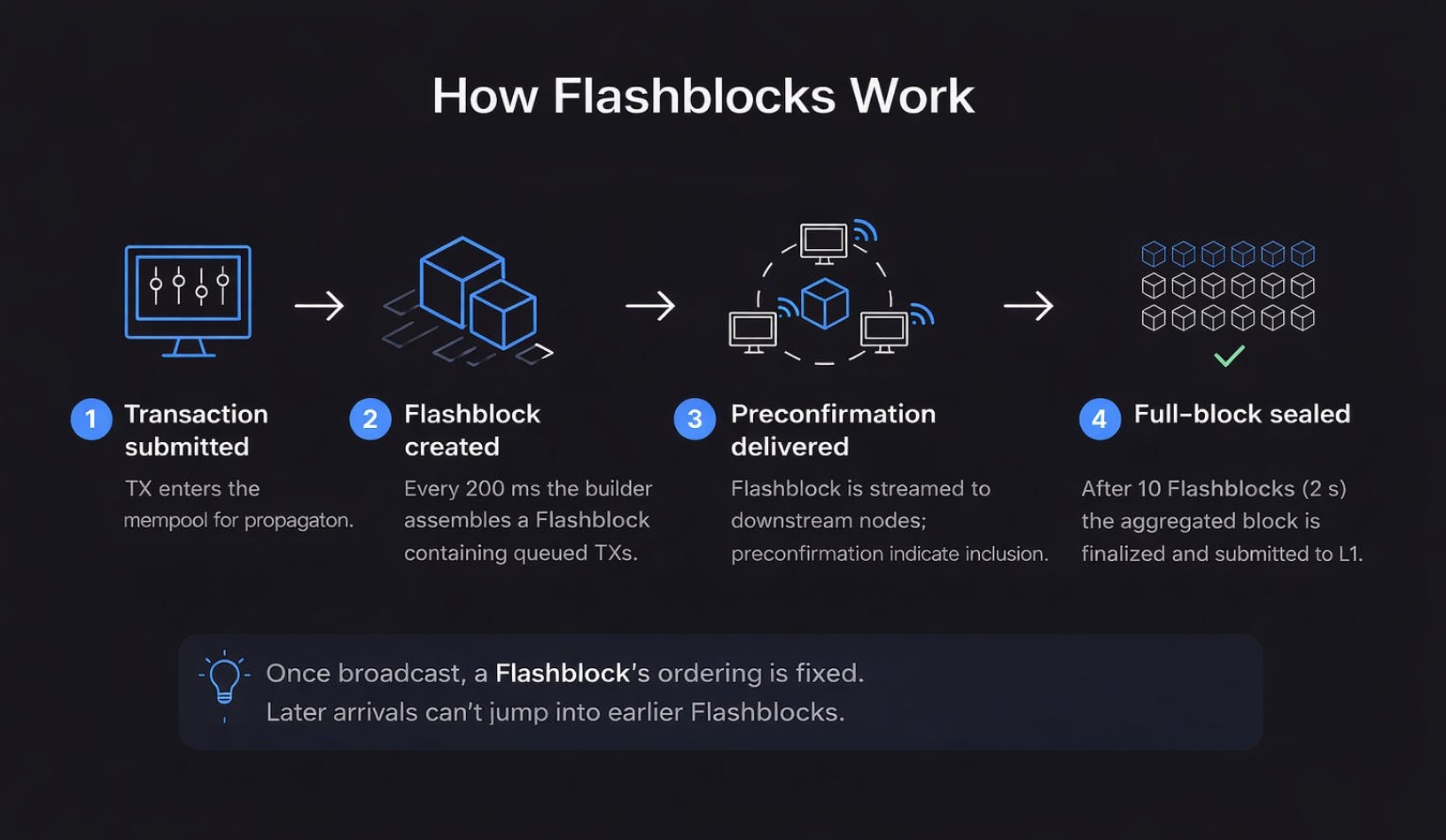
The key insight: once a Flashblock is built and broadcast, its transaction ordering is locked. A transaction arriving 50ms later with a higher fee can't jump into an earlier Flashblock. This is a fundamental shift in how transaction ordering works.
Why is it important for Developers?
Flashblocks aren't just faster blocks. They change our user experience in several ways:
Preconfirmations, not final confirmations. Flashblocks give you high-confidence signals that your transaction will be included. For 99%+ of use cases, this is as good as final. But for critical transactions involving large amounts, you might still want to wait for full block confirmation.
Locked ordering prevents MEV attacks. Once your transaction is in a Flashblock, its position is fixed. No more watching your swap get sandwiched by bots that saw your pending transaction.
Real-time state updates. Balance changes, liquidity shifts, and price movements are visible within 200ms. Your trading bot can react to market conditions almost instantly.
CEX-like experience on DEXs. Trading on decentralized exchanges finally feels as responsive as centralized ones. Click, confirm, done.
What Can You Build with Flashblocks: Use Cases
Flashblocks unlock application categories that weren't practical with 2-second confirmation times. Here's where the technology shines:
Trading Bots and Arbitrage
Speed is everything in trading. A 200ms confirmation means your bot can execute strategies that require rapid iteration. Spot an arbitrage opportunity, execute the trade, confirm it worked, move on to the next one. All in less time than it used to take to get a single confirmation.
Real-Time Monitoring and Alerts
Track wallet activity, whale movements, and liquidity changes as they happen. When a large swap hits a pool, you know within 200ms. Build alerting systems that notify you of market events before most participants even see them.
DeFi Protocol Frontends
Every DeFi application benefits from faster feedback. Swap confirmations, liquidity provision, lending and borrowing operations. Users see results almost instantly instead of watching a spinner for 2 seconds.
On-Chain Games
Games need instant feedback. When a player makes a move, they expect to see the result immediately. Flashblocks make on-chain gaming feel responsive. Actions update in real-time, not in 2-second intervals.
MEV-Resistant Applications
The locked ordering in Flashblocks creates opportunities for applications that need protection against front-running. Build trading interfaces where users can be confident their transactions won't be sandwiched.
Automated Market Makers
AMMs can update prices and rebalance more frequently with reliable sub-second data. Liquidity providers get better protection against stale prices.
Getting Started: Building a Flashblocks Listener
Ready to build with Flashblocks? Here's the high-level approach:
Step 1: Connect to the WebSocket Stream
Base provides public WebSocket endpoints for streaming Flashblocks:
1
2
wss://mainnet.flashblocks.base.org/ws  # Mainnet
wss://sepolia.flashblocks.base.org/ws  # Testnet
Connect using any WebSocket library. Messages arrive as Brotli-compressed JSON, so you'll need to decompress them before parsing.
Step 2: Parse the Flashblock Data
Each Flashblock message contains three components:
Diff: Block changes including transactions, state root, and gas used
Index: Which of the 10 Flashblocks this is (0-9)
Metadata: Block number, updated account balances, and transaction receipts
The receipts are particularly valuable. They include event logs, execution status, and gas consumption for each transaction.
Step 3: Build Your Application Logic
With parsed Flashblock data, you can:
Filter transactions by address to monitor specific wallets or contracts
Detect swap events by checking event signatures in transaction logs
Track balance changes for addresses you care about
Trigger alerts or automated actions based on on-chain events
Want to Learn How to Build It?
We've published a comprehensive guide in our documentation titled "How To Build a Base Flashblocks Listener".
In this guide, you'll learn:
Complete Go implementation with full source code
Data structure definitions for parsing Flashblock messages
Brotli decompression and JSON parsing
Error handling
Extensions for trading applications, including swap detection and balance tracking
And if you learn better by exploring code, check out the project repo on GitHub and don't forget to give us a star!
Want reliable blockchain infrastructure to power your Flashblocks implementation? Create your free GetBlock account and get instant access to 100+ blockchain networks.
Important Considerations
Before you ship to production, keep these points in mind:
Preconfirmation vs. finality. Flashblocks provide preconfirmations with extremely high reliability. But in rare cases involving chain reorgs, a Flashblock's data might differ from the final block. For most applications, this doesn't matter. For high-value transactions, consider waiting for full confirmation.
Rate limits on public endpoints. The public WebSocket endpoints are rate-limited and may not be suitable for production workloads. For serious applications, use a node provider like GetBlock that runs Flashblocks-integrated infrastructure.
Handle disconnections gracefully. WebSocket connections can drop. Build reconnection logic with exponential backoff so your application recovers automatically.
In Conclusion
Flashblocks represent a significant shift in how we think about transaction confirmations on Layer 2. For the first time, Ethereum-secured transactions can be confirmed in 200 milliseconds. That's not a marginal improvement. It's a 10x speedup that enables entirely new categories of applications.
For developers, this means you can build trading bots that actually compete, monitoring tools that catch events in real-time, and user experiences that feel instant.
For users, it means DeFi finally feels as responsive as centralized alternatives. No more waiting and hoping your transaction went through.
For the ecosystem, it means Base becomes a more attractive platform for applications where speed matters. And in blockchain, speed almost always matters.
In 2025, the infrastructure was built. In 2026, the applications will be deployed. The future of fast, responsive blockchain applications isn't theoretical anymore. It's streaming at 200ms intervals, right now.
Ready to start building? Check out our documentation and GitHub repo to implement Flashblocks in your next project.


Popular Posts

June 9, 2021
4 min read

November 9, 2021
5 min read

May 24, 2022
5 min read

March 18, 2021
4 min read


