
GetBlock January 2026 Dev Update: BSC Infra Boost, New Chains, Live Web3 Sessions

GETBLOCK
February 11, 2026
7 min read
Welcome to the first GetBlock Dev Update of 2026!
A solid start to the year: we expanded our network coverage, tested performance enhancements for BSC nodes, and launched an entirely new format to connect with the Web3 community – GetBlock Online Sessions.
TL;DR:
Our Dedicated BSC nodes moved from “just RPC” to execution-optimized and low-latency streaming infra with bloXroute BDN integration
Free tiers became more production-ready with MEV protection
21 new networks integrated to meet teams where they’re building
OKTChain endpoints deprecated; support ended Jan 1, 2026
GetBlock Online Sessions launched on Luma – a new format for Web3 talks
Core client updates for nodes
Let’s dive into what January looked like for us.
BSC nodes on steroids
In January, GetBlock customers using Dedicated BNB Smart Chain nodes had free access to our bloXroute BDN add-on.
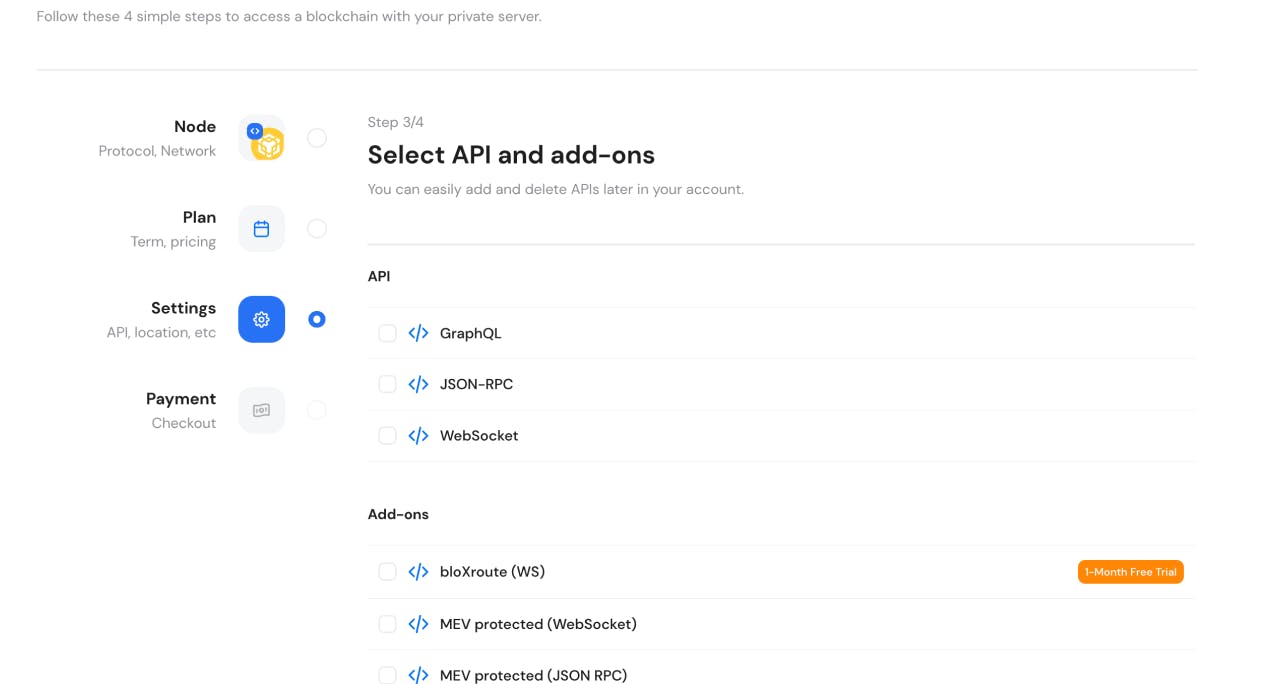
The bloXroute’s BDN add-on provides an optimized relay topology for our BSC nodes. Instead of relying only on the standard P2P gossip graph, a node exchanges information with the BDN relays through a locally deployed bloXroute Gateway.
The result is faster network discovery and better transaction delivery. Free trials offered to BSC Dedicated node users confirmed: typical propagation drops from ~200-250 ms to ~80-100 ms, giving you a ~100-170 ms head start – critical for bots, arbitrage, or time-sensitive DeFi flows.
Key benefits for BSC developers and traders:
Blocks and mempool updates arrive earlier because relays push them over shorter, optimized paths
Transactions arrive earlier in validator queues, increasing the chance of next-block inclusion
Fresher state for RPC calls and subscriptions so UIs, bots, and backends read a more up-to-date chain
Flexible transaction routing – ability to deliver transactions via private mempool paths to reduce MEV exposure, with optional priority tips for even faster propagation and inclusion
Activate a BDN add-on when setting up a Dedicated BNB chain node through your dashboard.
Trial access may still be available – reach out to the GetBlock team via our contact form to request while availability lasts.
MEV protection – now on Free plan
MEV-protected RPC endpoints are no longer restricted to paid tiers and are now accessible on the Free plan. These endpoints route transactions in a way that reduces exposure to common MEV strategies such as front-running and sandwich attacks.
How to use: When creating a new endpoint in the GetBlock dashboard, select an MEV-protected endpoint type. Check the API Interface dropdown – the feature is available for endpoints labeled “MEV protected”.
It’s a small but meaningful upgrade allowing all users, regardless of plan, to test this powerful feature early and even build with production-grade assumptions from day one.
21 new networks to build on
GetBlock continues expanding access to the most in-demand Web3 ecosystems. We kicked off the year with a major expansion – 21 new networks supported.
Here’s a full list of integrations that went live in late December and January.
Mainnets:
Incentiv – Layer-1 blockchain focused on a contribution-based economy and simplified developer and user experience
Lens – composable SocialFi protocol / social graph primitives designed for on-chain social apps
Botanix –EVM-compatible Bitcoin-anchored L2 that brings smart-contract capabilities and Bitcoin security together
Goat – Bitcoin Layer-2 rollup built for BTC-native DeFi and yield, designed to scale Bitcoin use cases
Tenet – EVM-compatible chain focused on LSDfi and liquidity-oriented staking with a Diversified PoS model
Swellchain – restaking-focused rollup that leverages restaked assets to extend Ethereum security
Matchain – AI-centric blockchain focused on decentralized identity, data sovereignty and on-chain AI tooling
Chiliz – sports-focused blockchain powering fan tokens and fan-engagement products.
IOTA – feeless, DAG-based distributed ledger aimed at IoT and high-throughput data and value transfer
IOTA EVM – EVM-compatible smart-contract layer on IOTA that enables Solidity dApps while settling to IOTA L1
Movement – modular Move-based rollup network for application-specific chains and composable MoveVM execution
Xphere – dual-chain architecture designed for high throughput and low latency
Atleta – Layer-1 geared toward sports and real-world use cases, offering modular infrastructure and EVM compatibility
Nervos – open-source, modular Layer-1 focused on security and interoperability with separate layers for scalability
Somnia – high-performance EVM-compatible Layer-1 built for real-time, large-scale consumer apps
XDC Network – enterprise-oriented hybrid EVM chain targeting trade finance, payments, and tokenized real-world assets
Electroneum – mobile-first blockchain focusing on low-cost transactions and financial inclusion use cases
Bahamut – EVM-compatible Layer-1 that targets high throughput and enterprise and GameFi use cases
Avail – modular data-availability layer and infrastructure project that many chains use for scalable, verifiable DA
Testnets:
Midnight testnet – privacy-focused chain prototype using ZK tech for “rational privacy” and developer-friendly privacy primitives
Allora testnet – decentralized, self-improving AI network testnet for community-built ML models and on-chain model coordination
Find the new chains in the dashboard and generate endpoints. If you need archive queries, double-check the “archive mode” option inside the endpoint setup menu. Dedicated Node deployments are also available.
End of OKTChain support
GetBlock has deprecated support for OKTChain, following the network’s end-of-life timeline.
In mid-2025, OKX announced that its Cosmos-SDK-based OKTChain would be phased out in favor of the X Layer network, with a planned end-of-life date of January 1, 2026. Based on that announcement, support and maintenance for OKTChain RPC nodes at GetBlock were discontinued ahead of the scheduled EOL.
GetBlock Online Sessions are live – Join our Web3 talks for builders
Online Sessions is new, free virtual meetup series hosted on Luma we launched in 2026.
We wanted to create a space where engineers, devs, and builders could talk shop without the distractions of marketing hype and flashy announcements – just real knowledge sharing, from people who ship things.
Season 1 kicked off in January with:
BUIDL Europe recap – ecosystem insights, trends, and developer signals from the event
The evolution of BNB Chain – technical and ecosystem-level changes relevant to infra and application teams
Here are a few upcoming ones you might want to drop into:
Feb 13: Thriving in Developer Relations: Lessons from a Woman in Tech – Partner-hosted AMA (NexaScale) with our very own DevRel Ileolami. A candid look at DevRel work, challenges, and growth in Web3.
Feb 16: Consensus Hong Kong: Virtual Recap & GetBlock Team Insights (Vasily Rudomanov, CEO; Yogesh Talurmath, BD) – What Consensus HK revealed about the direction of crypto infrastructure, markets, and capital.
Feb 27: Ethereum vs Solana Consensus: What’s the Difference? (Alexandr Alekhin, Head of Product) – A technical comparison of Ethereum’s PoS and Solana’s PoH + PoS models and their impact on performance and decentralization.
Full schedule and registration links are available on GetBlock’ Luma.

Topic suggestions are more than welcome!
Got insights or lessons that other builders would actually use? We’re looking for sharp minds with clear ideas to share. Apply to speak and take the stage.
Node client updates
A quick heads-up on some of the high-impact node client updates of January:
opBNB (v0.5.5): Mandatory release before the Fourier hardfork (2026-01-07), slashing the block time to 250 ms
BSC (v1.6.6): Ports critical go-ethereum security fixes
Base (v0.14.4): Update for Base Reth nodes with Flashblocks; adds base_transactionStatus RPC, new Flashblocks subscription streams, and performance fixes
Bitcoin Core (v30.2): Stability and minor performance enhancements
Solana (Agave v3.0.14): Fixes critical issues in core consensus-related component
TRON (GreatVoyage-v4.8.0.1): Maintenance and efficiency improvements to the Java-tron core and TRC10 logic
Polygon (bor v2.5.8 + heimdall v0.6.0): Execution and consensus fixes improving transaction handling and validator reliability
XRPL (rippled v3.1.0 + clio v2.7.0): Protocol and bug-fix updates for the XRP Ledger core server with improved Batch transaction validation, plus enhanced Clio API methods
Sui (v1.64.2): Improve node stability and RPC behavior
Ethereum stack (Erigon v3.3.4, Reth v1.10.2, Prysm v7.1.2): Routine execution and consensus client releases for the Ethereum stack
Other supported node clients also received routine maintenance, bug fixes, and performance improvements.
Setting the pace for 2026
That’s January. As always, we’ll be sharing our progress every month on what’s shipped and what’s improved.
Next up: We're actively building more node performance boosters, developer tooling, and ecosystem-specific optimizations. Can’t wait to share – but no spoilers yet.
Thanks for reading! Here’s to another month of shipping, building, and learning together.
– The GetBlock Team


Popular Posts

June 9, 2021
4 min read

November 9, 2021
5 min read

May 24, 2022
5 min read

March 18, 2021
4 min read


