

Sub-7ms Latency, Custom Node Software, Industry’s Tightest SLAs: What GetBlock Built for Blockaid

GETBLOCK
March 19, 2026
8 min read
GetBlock, a premium RPC node service and infrastructure platform for Web3 and AI, is running an exclusive solution for one of its Tier 1 customers: Blockaid.
Backed by Ribbit, Variant, Cyberstarts, Sequoia, Greylock, and Google Ventures, Blockaid is an on-chain security powerhouse with $312 billion in assets secured. Since its launch in 2022, Blockaid has prevented more than 527+ million malicious transactions, shielding an elite roster of crypto platforms including Coinbase, MetaMask, and Uniswap.
Blockaid joined GetBlock's customer family roughly a year ago. The ask was ambitious from day one: a super-fast, highly capable multi-blockchain setup with rich customization options, 99.99% uptime, the tightest SLAs in the industry, a dedicated DevOps team, and much more.
Here is what GetBlock brought to the table — and why this story might matter for your business.
Blockaid's Request: Ecosystem of Ultra-High-Performance Node Clusters with 7ms Latency, Four-Nines Uptime, Custom Software
The Blockaid team first reached us in February 2025. Without going too deep into their business logic, GetBlock's RPC nodes sit at the core of Blockaid's transaction-scoring mechanism.
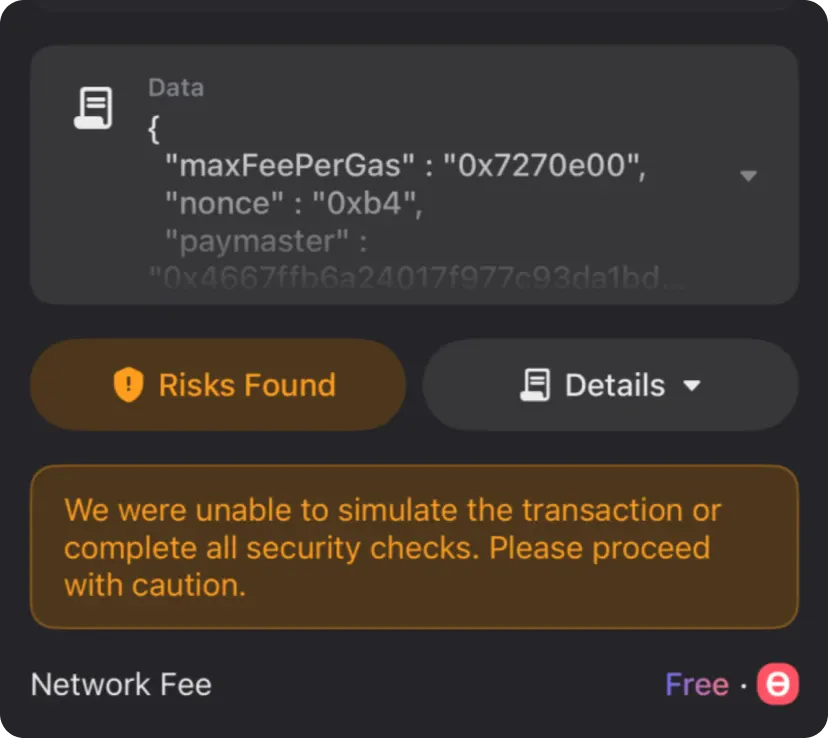
That mechanism is what allows users to check whether a pending transaction or approval will result in lost funds before it is too late.
It is no secret, then, that the infrastructure underneath needs to be fast, reliable, flexible and powerful.
Here is exactly how Blockaid defined (some of) those requirements from day one:
Low latency. A target of 7ms was set while 30ms was agreed on as regular, operational level.
Solid uptime. 99.99% - yes, these “four nines” we all love, meaning fewer than 53 minutes of downtime per calendar year.
Multi-chain coverage. And genuinely multi-chain: EVM networks (Arbitrum, Ethereum), non-EVM chains (Bitcoin, Sui), mainstream L2s (Base, Optimism) and niche networks (Abstract, Zero Network).
Operational flexibility. Each blockchain deployment carries its own contract period of one, two, three, nine or 12 months. But the node roster is never final, so GetBlock must be able to spin up new nodes rapidly, on request.
Detailed RCA framework. For every incident, a root cause analysis should be delivered within three hours.
Dedicated Grafana dashboard. Full visibility into every element of the infrastructure GetBlock operates on Blockaid's behalf.
Highest accessibility. Direct Slack access to GetBlock's CTO, a dedicated DevOps team, and a guaranteed response time of under five minutes.
And here is the requirement nobody would expect: once each node is deployed and fully synchronized, Blockaid's team installs a unique, custom binary built in-house.
From GetBlock's side, it operates as a black box since the exact customization Blockaid applies is a classified commercial secret.
All of this is codified in an SLA document that is among the most demanding GetBlock has ever signed.
If you need a dedicated node with a custom binary but lack the in-house engineering capacity to build it yourself, GetBlock can handle that too.
In Q4 2025, we created a fully custom fork of OP Stack built on the Erigon execution client to help Revert Finance develop proprietary analytics infrastructure on Base. Read the full GetBlock × Revert Finance case study.
GetBlock's Response: Infrastructure
Blockaid and GetBlock signed all agreements by March 2025 and deployed the first full nodes across three geographic clusters: New York, Frankfurt and Singapore.
Multi-blockchain powerhouse built for sub-7ms latency and four-nines reliability
Targeting approximately 7ms latency across the majority of RPC methods is a genuine engineering challenge.
To put it in context: according to CompareNodes' continuous benchmarking, GetBlock is one of the very few RPC node providers globally capable of demonstrating sub-10ms aggregate latency across multiple blockchains including BNB Smart Chain (BSC) and Solana.
GetBlock's BSC infrastructure is the fastest across North America, South America, Europe and the Middle East; its Solana node is the fastest in Asia.
To pair that latency with 99.99% uptime, GetBlock provisions Blockaid with load-balanced clusters of two to three full nodes per blockchain so no single point of failure can take down the service.
The blockchain lineup itself presented its own challenges. GetBlock was the first major commercial RPC provider to launch an Abstract RPC node — Abstract being a ZK rollup secured by Ethereum.
Other networks, including World Chain and Zerion’s Zero, were researched and deployed specifically for this engagement. That research was led by Dmitrii Petrov, one of GetBlock's longest-serving engineers.
As Blockaid hit new business milestones through Q1 2025 - being happy with our first joint endeavours, the infrastructure scaled with it. By late summer 2025, dozens of dedicated full nodes were live across isolated, load-balanced clusters. The node deployment cycle, once measured in weeks, had been cut to days.
The custom binary installation process required its own engineering solution. GetBlock established a three-stage procedure:
first, the server is provisioned and optimized;
second, standard node software is installed and the node synchronizes to the chain tip;
third, once the node is live and capable of reading and writing blockchain data, Blockaid shares its custom image, and GetBlock deploys it on the same server.
For Blockaid as an end user, all of this complexity is invisible. What they see is a set of RPC API endpoints available in GetBlock's dashboard - exactly the same experience any developer gets when spinning up a production node in a few clicks.
Ready to build your own custom infrastructure? Explore GetBlock's plans and pricing or reach out directly to design an exclusive setup tailored to your stack.
Monitoring and reporting
After solving for customization, latency and reliability, GetBlock built a dedicated monitoring and reporting layer. Engineers composed bespoke Grafana dashboards tracking resource utilization at granular depth with every cluster, every host, real-time CPU usage percentage.
This gives Blockaid precious live operational intelligence they can act on to optimize costs and capacity planning.
GetBlock and Blockaid co-developed a root cause analysis (RCA) framework covering every infrastructure incident. Within a maximum of three hours post-incident, a full RCA report is delivered to ensure the same failure mode never recurs.
As an additional alerting layer, GetBlock maintains a dedicated Slack channel for node status notifications. Because Blockaid's workload includes periodic traffic spikes — an inherent feature of real-time transaction screening at scale — the automated alerting system ensures the on-call team is always prepared and that no actionable alert is missed.
As a result, Blockaid has full, real-time visibility into every layer of the infrastructure GetBlock manages on their behalf.
GetBlock's Response: Service
Operating infrastructure for a customer of this criticality demands more than uptime guarantees. It demands a service model built around that customer's operational rhythm.
Dedicated support and technical expertise
As stipulated in the SLA, Blockaid has a direct line to Nikita Iugov, GetBlock's CTO, reachable via Slack or Telegram at any time.
While dozens of GetBlock engineers contribute to the Blockaid setup, this account has a single dedicated technical lead: Dan, a certified Kubernetes engineer and skilled SRE with a master's degree in a related discipline. Dan serves as the single point of technical accountability bridging the engineering team and Blockaid's leadership for both incident response and long-term roadmap decisions.
On the customer success side, Blockaid is managed by Elena Airapetian, Senior Account Manager and a GetBlock veteran.
Together with Elena's team, a specific communication framework was designed: during any planned maintenance or network upgrade, GetBlock pushes a status update every 30 minutes, so Blockaid tracks the process in real time rather than waiting for a post-maintenance summary.
Set it and forget it: GetBlock saved Blockaid an estimated 1,500 hours of infrastructure heavy lifting
What is this all about?
Here is what this partnership actually means in practice.
Blockaid did not simply gain an RPC node provider. They gained a fully managed DevOps-as-a-Service layer that preserves in-house levels of flexibility and customization while dramatically reducing the burden on their own engineering team.
The approximate weekly resource allocation GetBlock dedicates to this account:
CTO: 2–3 hours per week
DevOps team: 18–20 hours per week
Business development and account management: 5–6 hours per week
Over a full year of partnership, that compounds to an estimated 1,300–1,508 hours that Blockaid's team did not have to spend on infrastructure. This time was redirected toward building the next generation of Web3 security tools, protecting user assets and mitigating attacks.
Wrapping Up: What GetBlock Can Offer Your Web3 Enterprise
GetBlock is proud to support Blockaid's infrastructure layer.
And the same capabilities are available to any Web3 organization operating at scale:
Ultra-low latency
Industry-leading stability and uptime
Unparalleled customization from dedicated monitoring systems to custom software images
130+ supported blockchain networks, with any new network deployable within three business days
Dedicated technical support with direct access to C-level leadership
The choice is yours. Let's build your Web3 infrastructure together.
Always here for you,
GetBlock Team


Popular Posts

June 9, 2021
4 min read

November 9, 2021
5 min read

May 24, 2022
5 min read

March 18, 2021
4 min read


