

Adoption, Acceleration, AI: CEO Vasily Rudomanov’s Op-Ed from Consensus Hong Kong

GETBLOCK
March 11, 2026
7 min read
As the dust (really) settles following Consensus Hong Kong and Accelerate APAC, I wanted to take a moment to reflect on what was said, showcased, and accomplished at two of Q1 2026's leading blockchain conferences.
Hong Kong: The Island, The Gateway, The Fusion
In recent years, major crypto conferences have gravitated toward locations best characterized as "East meets West." Cynics might dismiss this as a pragmatic response to visa complications, but the pattern represents something more profound.
Events from ETH Belgrade—hosted at what was once the frontier between the Austrian and Ottoman empires—to UAE gatherings like Blockchain Life and Solana Breakpoint show that the synergy between these two worlds transcends boundaries and accelerates innovation.
Yet no venue exemplifies this convergence better than Hong Kong.
A British Crown colony until 1997, Hong Kong is now a Special Administrative Region of China, maintaining its own governing and economic systems under the "one country, two systems" principle, distinct from socialist Mainland China. With 7.5 million residents occupying just 1,114 square kilometers, Hong Kong ranks as the fourth-most densely populated region in the world—and serves as its premier economic hub.

This makes Hong Kong an island of the West within the East, or perhaps the reverse—a gateway both worlds use to explore and engage with each other.
The opportunities this creates are extraordinary.
Businesses See, Businesses Act
What distinguishes Consensus Hong Kong is its business-first orientation. This conference attracts people who view blockchains not as ideological pursuits but as viable commercial opportunities.
This pragmatic focus sets it apart from developer-centric gatherings like Devcon and Devconnect. Consensus Hong Kong prioritizes projects with proven product-market fit addressing real market needs. While technical conferences may showcase more ambitious technological architectures, at Consensus, commercial viability takes center stage.
This orientation shapes how the conference advances crypto adoption. In 2026 it emphasizes institutional adoption over mass consumer onboarding.
Most telling was the prominent presence of S&P Global, the financial analytics and intelligence powerhouse. As one of the most trusted data providers for corporations worldwide, S&P Global's exploration of Web3 infrastructure signals a potential shift in how major institutions perceive the space.
This represents a milestone in the industry's maturation—another step toward recognition as a legitimate asset class and transformative technology. The more prominently blockchain developments feature in S&P Global's market intelligence, the more rapidly they'll enter the strategic considerations of corporate leadership worldwide.
Web3 and AI: In Search of Real Convergence
Predictably, the intersection of AI and Web3 dominated conversations at Consensus. What proved most compelling, however, was the diversity of approaches companies are taking to bridge these technologies.
Consider Action Model, a protocol built on the emerging concept of Large Action Models (LAMs). While traditional AI chatbots generate responses, LAMs execute tasks—booking travel, scheduling appointments, deploying software. This capability unlocks machine-to-machine commerce: autonomous agents transacting with one another through APIs, settling payments - starting from x402 transactions - programmatically. Building on this foundation, Action Model has developed dynamic agent swarms—LAM-powered systems that collaborate across workflows to address complex B2B and B2C operational challenges.
The Vana Foundation represents another notable approach. The project has built an EVM-compatible Layer 1 blockchain designed to accelerate the use of blockchain data as training context for AI systems. This framework positions data itself as an asset class, creating new pathways between on-chain and off-chain information.
Users deposit personal data—social media histories, health records, browsing patterns—into encrypted Data Liquidity Pools. These pools enable a two-sided marketplace: AI developers gain access to diverse training datasets, while data contributors maintain ownership and capture value from their information. The model represents an early attempt to reconcile data privacy, ownership rights, and the computational demands of modern AI development.
Government Adoption: Hong Kong's Stablecoin Framework Takes Shape
Hong Kong has long been a financial innovator, which made remarks from senior government officials particularly noteworthy. The Honourable John KC Lee, Chief Executive of the Hong Kong Special Administrative Region, outlined the territory's ambitions for Hong Kong dollar-pegged stablecoins.
Beginning in 2025, Hong Kong implemented one of the world's most comprehensive regulatory frameworks for stablecoins, requiring issuers to obtain licenses from the Hong Kong Monetary Authority. The first license could be granted as early as this March, with 36 issuers reportedly awaiting approval. The list includes major technology conglomerates like Alibaba's Ant Group and JD.com.
We may be within days of witnessing the launch of the first regulated HKD-pegged stablecoins—a development that could establish a new standard for government-sanctioned digital currency frameworks globally.
Headlines, Expected: Robinhood, WLFI, and Tom Lee
Major conferences naturally draw attention to marquee names and announcements. Among the most significant presentations was Robinhood's pitch on tokenized securities. The U.S. fintech giant emphasized the strategic importance of offering tokenized stocks and commodities alongside crypto and forex within unified trading platforms.
However, listing tokenized real-world assets—particularly within self-custody systems—introduces complex privacy and security considerations that remain unresolved.
Pyth Network, a decentralized oracle platform and Chainlink rival, made a compelling case for democratized market data access. By leveraging blockchain infrastructure—beginning with Solana—the platform aims to deliver institutional-grade financial data comparable to Bloomberg Terminal at a fraction of the cost, potentially leveling the playing field for retail traders.
Representatives from World Liberty Financial (WLFI), the Trump family-backed blockchain venture, discussed the GENIUS Act, proposed U.S. stablecoin legislation. Regardless of one's views on the political dimensions, institutional involvement at this level accelerates mainstream adoption, albeit through unconventional channels.
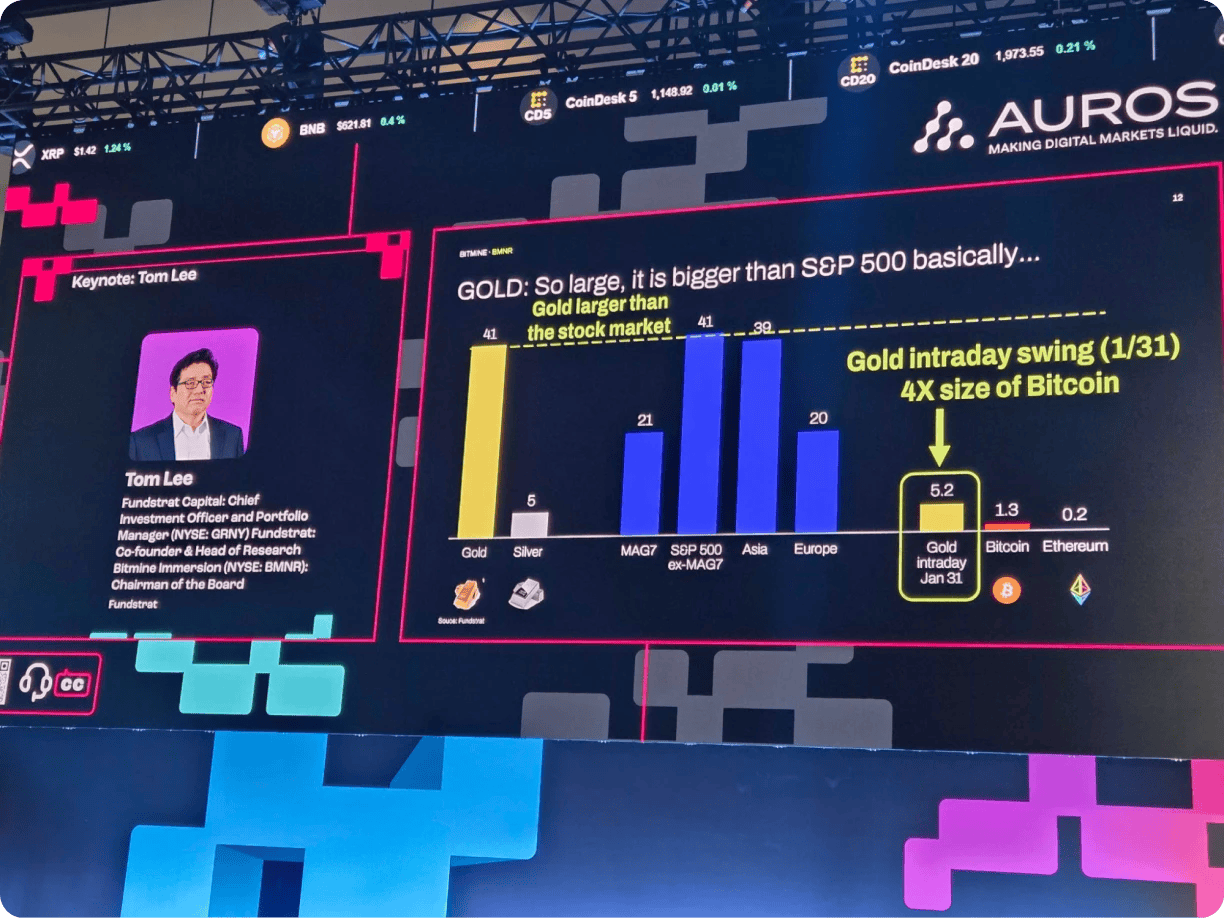
Tom Lee of Fundstrat and Bitmine delivered perhaps the conference's most optimistic outlook. The Wall Street veteran, addressing a market where Bitcoin trades 50% below its all-time high, presented data suggesting gold has been an irrational purchase 44% of the time throughout its observable history, compared to just 3% for Bitcoin.
While the comparison spans vastly different timeframes, the analysis offers a provocative framework for evaluating Bitcoin's role as a macro store of value.
Headlines, Unexpected: Polkadot's Technical Renaissance
While the mentioned presentations were largely anticipated, one development caught many observers off guard: Polkadot's ambitious technical overhaul.
The project has faced persistent criticism for underdelivering on its initial promises. Yet beneath the noise, Polkadot is executing its most significant architectural transformation in years. The JAM (Join-Accumulate Machine) upgrade represents a fundamental reconceptualization of the protocol, replacing traditional smart contracts with a service-oriented architecture that positions blockchain as a general-purpose compute layer.
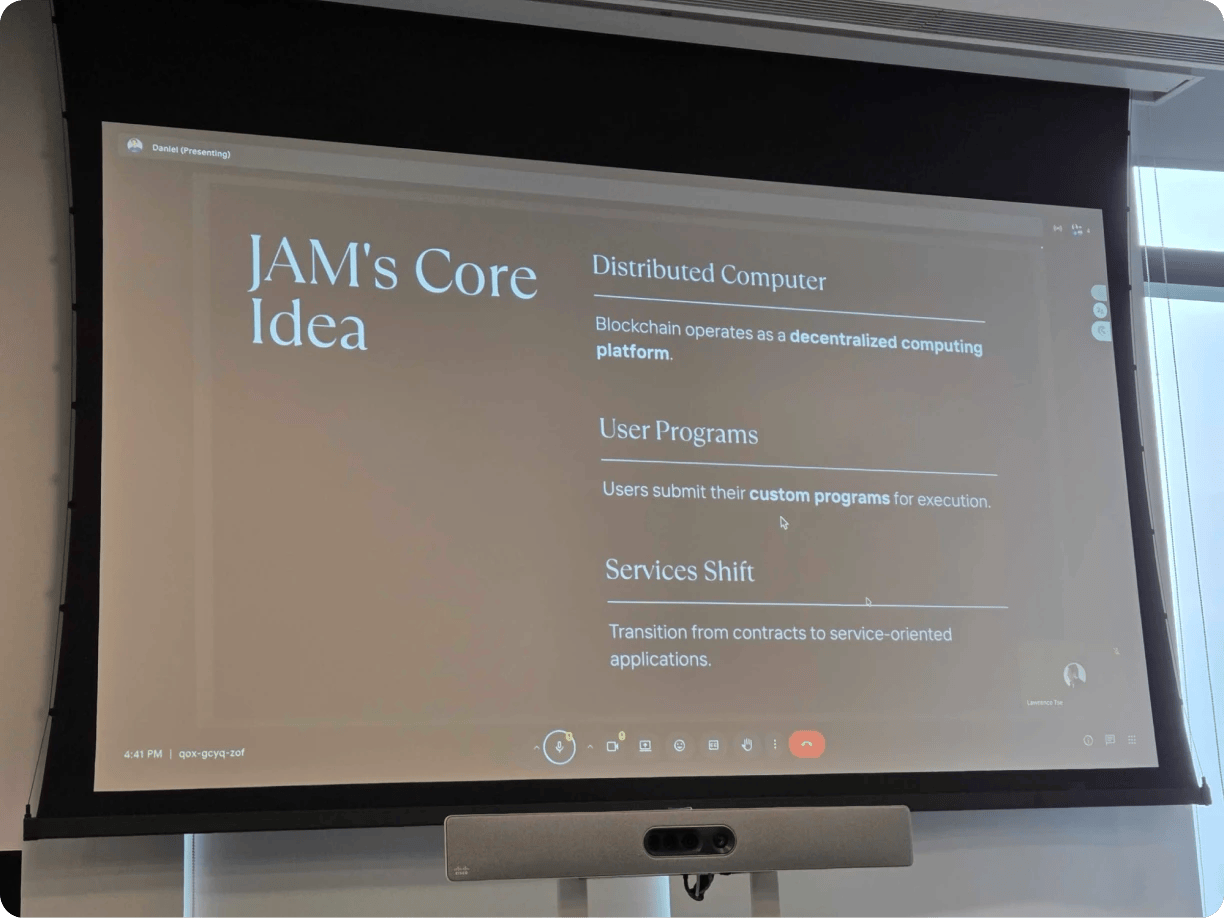
This redesign eliminates conventional nodes and parachains in favor of JAM chains—autonomous decentralized networks that promise greater flexibility and production readiness. Fluence Network, a decentralized serverless computing platform, is among the first to implement this architecture in practical applications.
The broader crypto community may have written off Polkadot prematurely. The technical substance of this transformation warrants closer attention from those tracking infrastructure innovation.
Epilogue: The End of Tribalism?
To put it simply—forgive the cliché—this conference signaled a new phase in global blockchain adoption.
In a recent LinkedIn post, I called it the "First Real Synergy," and that description still feels right.
But there's one other observation worth sharing as I close.
During a panel discussion on Layer 1 competition, the speakers were predominantly from Solana's ecosystem: Austin Federa from DoubleZero, teams from Jupiter DEX and Backpack, among other ecosystem veterans. Yet the consensus among them was striking—the era of zero-sum competition may be ending.
Solana shouldn't try to out-Ethereum Ethereum with its Alpenglow upgrade, just as Ethereum shouldn't chase Solana's developer culture with its ambitious 2030 roadmap.
Both networks—along with the rest of L1s, L2s, and L3s—are constructing a shared foundation for Web3 as a global technological and sociocultural phenomenon, not merely a financial one.
At GetBlock, we've long believed that crypto tribalism had an expiration date.
Consensus Hong Kong 2026 reinforced that conviction. We're not here to compete for bragging rights or tear each other down.
We have too much to build.


Popular Posts

June 9, 2021
4 min read

November 9, 2021
5 min read

May 24, 2022
5 min read

March 18, 2021
4 min read


